Rethinking the Western History of Political Power
There is something about the way we teach the history of political thought that has always bothered me. We often present the rise of modern political institutions as though humanity moved through a fairly straightforward sequence: first there were kings, then came absolute kings, then people challenged them, revolutions took place, constitutions emerged, and finally we arrived at democracy.
The problem is not that this story is entirely wrong. The problem is that it is presented too comfortably.
When I look more closely at European history, I find a much more complicated story. I find kings claiming authority from God, churches claiming authority over kings, rulers suppressing dissent in the name of religion, political power becoming concentrated around courts, and entire populations paying the price for wars and ambitions that they had little role in deciding. I also find something else: people repeatedly resisting this concentration of power.
The European political tradition therefore contains a contradiction that deserves much greater attention. The West did not simply discover modern freedom. It first spent centuries constructing powerful forms of political and religious authority and then spent centuries fighting against them. That history matters when we teach political science in India.
When the King Became More Than a King
The idea that kings ruled by divine sanction was not a marginal belief in European political history. It became an important element of monarchical political thought, particularly in early modern Europe. James VI and I of England defended the divine right of kings. In his The Trew Law of Free Monarchies (1598), he argued for the divinely ordained character of monarchy and famously compared the king to a father within the political community.
In France, Jacques-Bénigne Bossuet provided perhaps the most systematic theological defence of absolute monarchy in his Politics Drawn from the Very Words of Holy Scripture. For Bossuet, royal authority was sacred and the king’s power was connected directly to God.
I find the underlying political question more interesting than the theology itself. If the king receives his authority from God, who on earth can legitimately question him? If a ruler is God’s appointed representative, what happens when he becomes unjust? And if resistance to the king can be interpreted as resistance to divine order, how does an ordinary subject distinguish political obedience from political submission? These questions were not theoretical curiosities. European history repeatedly confronted them.
Louis XIV and the Concentration of Power
The reign of Louis XIV provides an extraordinary example of the political culture of absolutism.
Louis XIV ruled France from 1643 to 1715 and gradually strengthened the authority of the monarchy. Versailles became the great theatre of royal power. Nobles were drawn into the orbit of the court, administration became increasingly centralised, and the monarchy projected itself as the centre of French political life. The famous phrase L’État, c’est moi – “I am the State”—is almost certainly apocryphal. I would therefore hesitate to use it as historical evidence. But the fact that generations have associated the phrase with Louis XIV is itself revealing. It captures the image of sovereignty becoming identified with the person of the ruler.
Then came 1685.
Louis XIV revoked the Edict of Nantes, which had provided significant protections to French Protestants. Protestant worship was suppressed, churches were destroyed, clergy were expelled and many Huguenots fled France. Here political centralization and religious uniformity came together. The problem was no longer simply that the king could tax his subjects. The political authority of the monarchy was now implicated in determining the religious conformity of the population.
This is where concentrated power becomes dangerous. Once the political authority of the ruler is reinforced by religious authority, disagreement can cease to be treated as disagreement. It can become disobedience, heresy or even treason.
When Church and Political Authority Became Entangled
The European story becomes even more complicated when we bring the Church into the discussion.
Medieval Europe did not have one simple hierarchy of power. Kings, emperors, nobles, cities and the Church all possessed different forms of authority. They sometimes competed with one another and sometimes reinforced one another. The Investiture Controversy between Pope Gregory VII and Emperor Henry IV is a good example. The immediate dispute concerned the appointment of bishops, but the underlying question was much larger: who possessed legitimate authority over the political and religious order?
Henry IV’s journey to Canossa in 1077, where he sought reconciliation with the pope, has become one of the great symbols of the medieval struggle between imperial and papal authority. But this episode also makes me question a common simplification.
It is tempting to say that the Church was merely an opponent of royal power. That is not the whole story. At different times, religious authority legitimised rulers, rulers protected religious institutions, and both could participate in structures that disciplined society. The problem, then, was not simply “Church versus State.” It was the much more complicated relationship between sacred legitimacy and political power.
When War Became ‘Sacred’
The Crusades reveal another dimension of this problem.
In 1095, Pope Urban II called for the First Crusade. Military mobilisation was presented not simply as an ordinary political conflict but as a religious undertaking. I do not think it is historically responsible to explain the Crusades only through religious fanaticism. They involved pilgrimage, political ambitions, territorial interests, aristocratic competition, economic considerations and genuine religious conviction.
But something politically important happened when warfare received sacred legitimacy. A political decision can be questioned. A sacred mission is much harder to question. Once violence is placed under the protection of sacred purpose, those who oppose it can themselves be portrayed as opposing the sacred order. That is one of the recurring dangers of political theology: when a political objective becomes sacred, political disagreement can become moral deviation.
Who Decides Who Is a Heretic?
The same question appears in the history of European religious persecution.
The medieval persecution of the Cathars and the Albigensian Crusade beginning in 1209 is an obvious example. The conflict was presented in religious terms, but it also involved territorial and political interests in southern France. The later history of the European witch trials raises an even more disturbing question. Between the fifteenth and seventeenth centuries, thousands of people were prosecuted and executed for alleged witchcraft across different parts of Europe. The causes differed from place to place. Secular courts, ecclesiastical authorities, local communities, social tensions and legal procedures all played roles.
I do not want to reduce this complex history to one institution. But there is a larger issue that cannot be ignored. Who gets to define the enemy? Who decides what constitutes acceptable belief? Who determines when an unusual belief becomes heresy, when a neighbour becomes a witch, or when disagreement becomes evidence of moral corruption?
Once the same authorities possess the power to define deviation and punish it, the possibility of abuse becomes enormous.
Charles I and the Question of Accountability
The English Civil War brings the problem of royal authority into particularly sharp focus.
Charles I believed strongly in the divine right of kings. In 1629 he dissolved Parliament and subsequently governed for eleven years without calling it, a period often described as his “Personal Rule.” His attempts to raise revenue without parliamentary consent, along with religious and political conflicts, contributed to the crisis that eventually produced civil war.
And then something extraordinary happened. The king lost. Charles I was captured, tried and executed in 1649. Think about what that meant in political terms. The person who claimed to possess divinely sanctioned authority was subjected to judgment by a political institution. The issue had moved beyond whether Charles was personally a good or bad ruler. The question had become whether a ruler could place himself beyond political accountability simply because he was a king.
The execution did not solve England’s political problems. It did, however, mark a profound challenge to the older conception of unquestionable royal authority.
The so-called ‘Glorious Revolution of 1688-89’
The conflict did not end there.
The so-called ‘Glorious Revolution of 1688–89′ again raised questions about the limits of royal power. James II’s policies and his conflict with Parliament generated growing opposition, particularly amid fears surrounding religious policy and succession. The settlement that followed strengthened Parliament and placed important limits on the Crown. The English Bill of Rights of 1689 became an important milestone in the constitutional development of England.
Again, I find the intellectual shift more important than the event itself. The monarch was increasingly becoming an office within a political order, rather than the complete embodiment of that order. That is a fundamental transformation.
The French Revolution and the Collapse of the Old Order
The French Revolution took the problem much further.
By 1789, France faced enormous fiscal difficulties alongside deep social inequalities and entrenched privileges. The monarchy, aristocracy and established institutions of the ancien régime were increasingly difficult to defend in the face of growing political and economic pressures. The Bastille fell. Feudal privileges were abolished.
The Declaration of the Rights of Man and of the Citizen proclaimed principles of liberty and political equality. Louis XVI was eventually executed. The old assumption that political authority flowed naturally from hereditary monarchy was being replaced by claims of popular sovereignty. Yet the French Revolution also gives us another warning that I think is often forgotten when revolutions are presented too romantically. The destruction of monarchy did not automatically produce liberty.
The Reign of Terror followed. The guillotine became an instrument of revolutionary justice. Political suspicion expanded. Revolutionary authorities began identifying enemies of the people, and thousands were executed. This is perhaps one of the most important lessons in the entire history. Concentrated power does not become safe merely because the person holding it has changed. A king can become authoritarian. So can a revolutionary committee. A church can become intolerant. So can a political ideology. A monarchy can claim divine legitimacy. A revolutionary government can claim historical necessity.
The vocabulary changes. The danger can remain.
The West’s Great Achievement—and Its Great Problem
I do not think the answer is to dismiss Western political thought. That would be intellectually lazy. let’s try to understand what is wrong with that when we bring it into our domain and our way of thinking and understanding of Political History. Modern Westerners and their political thought has made ‘enormous contributions’ to our understanding of liberty, constitutional government, representation, separation of powers, individual rights and limitations upon authority. These achievements become much more meaningful when we understand the historical problems from which they emerged.
- Hobbes was writing in the aftermath of civil war.
- Locke was writing amid conflicts concerning government, property, consent and political authority.
- Montesquieu was deeply concerned with the concentration of power.
- Rousseau questioned inherited political authority and asked where legitimate sovereignty ultimately resides.
- The American and French Revolutions challenged established forms of political authority.
- The nineteenth century witnessed continuing struggles over political representation, class privilege, labour rights and economic inequality.
Modern Western political thought was therefore not simply a detached philosophical discovery. It was also a response to the political problems generated by European history itself. That distinction is important. And we also fail to understand that this is not Indian or Indic history, but all the ideas, that we are taught and have been made to learn – what is the purpose of that?
Why I Think This Matters for Indian Political Science
This is where my concern becomes more immediate. When I teach or read political science in the Indian context, I often find that students encounter European political development as though it were the universal history of political development. They learn about divine monarchy, absolutism, sovereignty, revolution, constitutionalism and democracy.
All of these are showed to be ‘important’. But the problem arises when a historically specific European trajectory becomes the implicit standard against which every other civilisation is judged. Then the question quietly becomes: “Where was India’s absolutist king?” “Where was India’s social contract?” “Where was India’s revolution?” “Where was India’s version of the European state?”
I think we should stop beginning with those questions. Before asking whether another civilisation followed the European trajectory, we should understand why Europe followed its own trajectory in the first place. The European experience was shaped by its particular relationship between monarchy, aristocracy, Church, territory, war, taxation, feudal privilege and competing jurisdictions. Its modern political institutions developed partly through struggles against those historical conditions. That is a legitimate and fascinating history. But it is European history. It should not quietly become the universal template for understanding political society everywhere.
The Question I Would Put to My Students
When I discuss political authority, I would therefore begin with a much simpler question: What happens when those who possess power also acquire the authority to define what is right?
European history gives us many answers. The king can claim divine sanction. The Church can define heresy. The state can suppress dissent. An aristocracy can defend privilege. A revolutionary government can define enemies of the people. And each can provide an intellectual justification for its own authority.
That is why I am increasingly convinced that the central question of political theory should not be merely who rules.
It should be: Who can question the ruler?
And then another question follows: What prevents the authority that protects society from becoming the authority that controls society?
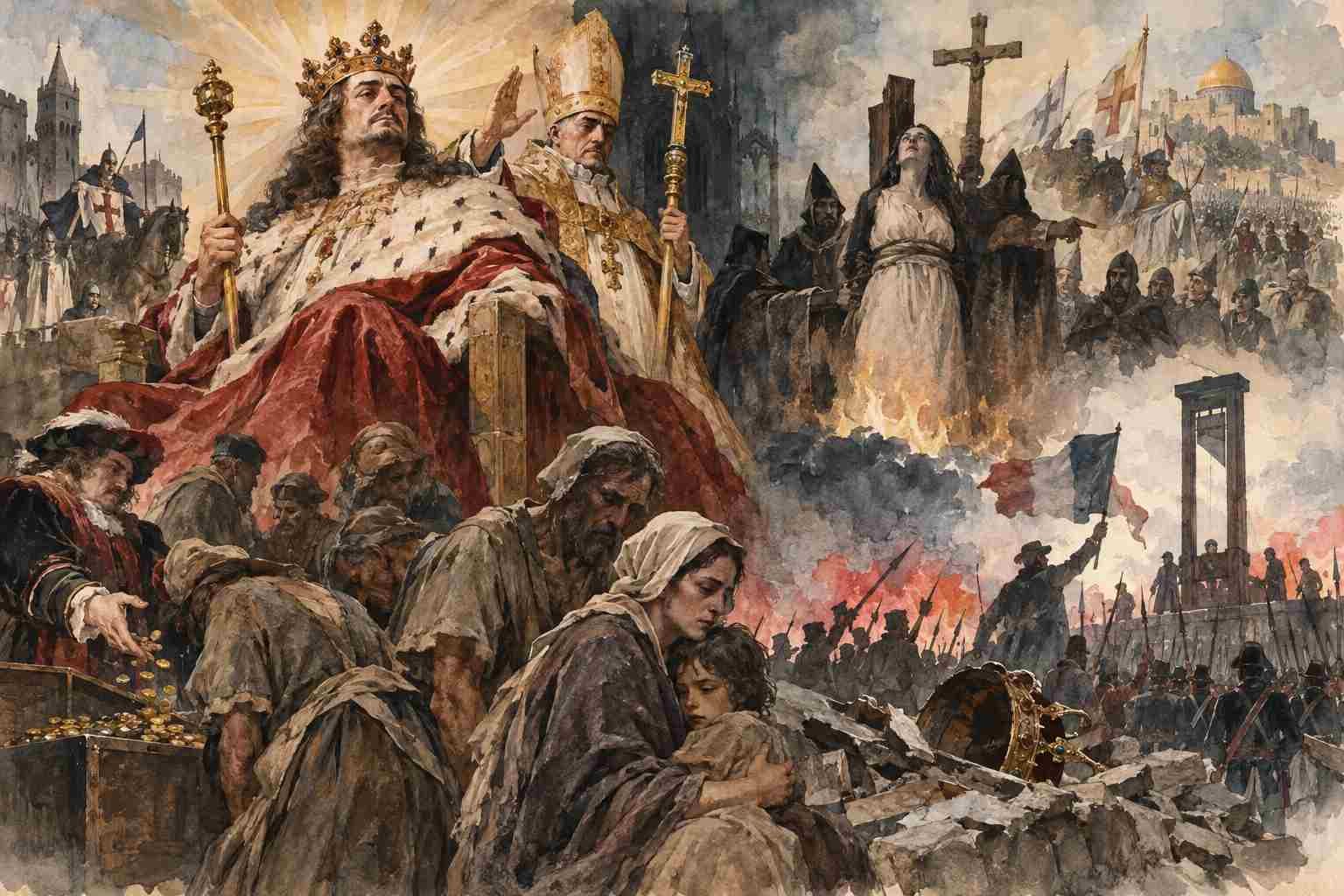
The history of Europe is extraordinarily valuable precisely because it shows us what happens when these questions are not adequately answered. The story is not simply one of kings giving way to democracy. It is a much more difficult story: power was sacralised, concentrated, challenged, revolutionary movements emerged, old authorities collapsed, and new forms of authority sometimes reproduced the same tendencies towards concentration.
Perhaps this is the point at which political science becomes genuinely comparative. We should study what Europe became without assuming that Europe represents what humanity necessarily was—or what every civilisation must become. The West’s political experience is immensely important. But it is an experience before it is a universal law. And for me, that distinction is the beginning of a more honest political science.