Culture as a Way of Life
What does Saṃskṛti mean beyond the translation “culture”?
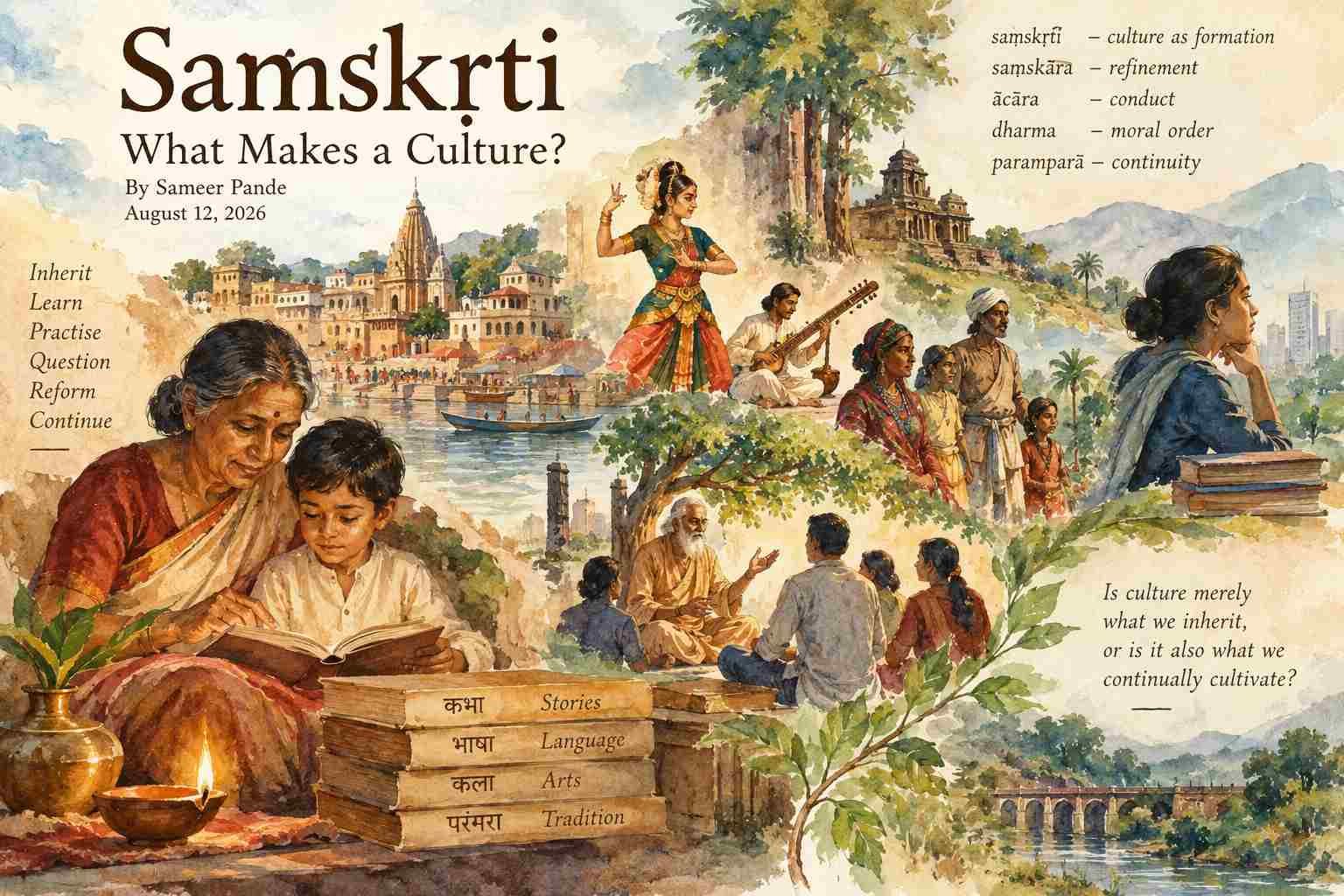
If you would have asked me few years ago, what culture is, I would have directly translated it into culture. We casually translate it into that. but the question is more difficult than it first appears. In contemporary usage, culture is often reduced to visible forms: festivals, food, clothing, music, language, monuments and rituals. These are certainly expressions of culture, but they are not culture in its entirety. A society’s culture also lies in what it considers worthy, how it raises its children, how it distinguishes appropriate from inappropriate conduct, how it remembers its past, how it relates the individual to the family and community, and what kinds of persons it seeks to form.
The Sanskrit term saṃskṛti is related to the semantic field of making, preparing, forming and refining. Classical lexicographical evidence associates it with preparation, formation and perfection, among other meanings. Saṃskāra, from the same broader verbal formation, similarly carries meanings including forming well, refining, preparing, educating and, in particular contexts, ritual consecration. We should not, however, turn etymology into a claim that ancient India possessed a fully developed modern theory called “culture.” The historical use of saṃskṛti has its own semantic history. What the terminology does provide is a productive conceptual opening: culture can be understood not merely as something possessed, but as something formed.
From Inheritance to Formation
Every human being enters a world already organised by meanings. Before a child can consciously choose a language, a family structure, a ritual, a story or a conception of right and wrong, these have already begun to shape the child’s world. Culture therefore precedes individual choice.
Yet culture is not simply imposed upon individuals. People interpret what they inherit. They reproduce some practices, abandon others and create new ones. A mother teaching a child a language, a grandparent narrating a family story, a teacher transmitting a discipline, an artisan teaching a craft, or a community celebrating a festival are all participating in cultural transmission. The individual is therefore both formed by culture and a potential agent of its transformation.
This is where saṃskāra becomes particularly useful as a conceptual term. Its semantic range includes not only ritual purification but also preparation, refinement, education and the formation of the mind. Culture, in this sense, concerns the making of dispositions. What kind of person does a society encourage one to become? What habits does it cultivate? What forms of conduct does it reward or discourage?
These questions take us beyond the catalogue of cultural objects and toward culture as a process of human formation.
Family, Language and Everyday Practice
The first institution of culture is usually not the state, the school or the religious organisation. It is the family. A child learns how to greet another person, how to speak to elders, how to eat, how to share, how to celebrate, how to mourn and how to understand relationships long before these practices are encountered as abstract principles. Much of culture is therefore transmitted without being formally taught.
Language is particularly important because it does more than communicate information. It carries memories, categories, metaphors and inherited distinctions. Stories provide models of conduct; rituals give repeated form to collective memory; music and art preserve sensibilities that cannot always be reduced to propositions. Everyday practices can therefore carry cultural knowledge even when the people performing them do not articulate that knowledge theoretically.
This is why a society cannot be understood only through its formal institutions or written doctrines. Lived culture also resides in ordinary behaviour.
Ācāra: When Values Become Conduct
The movement from values to conduct brings us to ācāra. The term can refer to conduct, custom and recognised forms of normative practice. In the Dharmaśāstra tradition, ācāra is important precisely because social order is not conceived only through abstract rules; customary and normative conduct also matters.
But an important methodological distinction is necessary. A prescribed ācāra is not automatically evidence of what everyone actually practised. Normative literature tells us what particular authors or traditions regarded as proper conduct; historical practice must be reconstructed through additional evidence.
This distinction is essential to the study of any culture. What people say they value, what institutions prescribe, and what people actually do are related but not identical.
Culture therefore exists partly in the space between norm and practice.
Dharma and the Moral Ordering of Life
The same caution applies to dharma. Translating dharma simply as “religion” obscures much of its semantic range. In the intellectual traditions of India, dharma can concern duty, right conduct, obligation, moral order and normative social life, although its meaning varies considerably across texts and contexts. Even the modern Government of India’s Sanskrit Institute describes Dharmaśāstra as encompassing conduct, ritual, duties and judicial matters rather than religion in the narrow modern sense.
This gives us another dimension of culture. A culture does not merely tell people what exists; it develops ideas about how one ought to live.
Yet these ideas are never perfectly uniform. Indian intellectual history contains competing interpretations of duty, liberation, social obligation, ritual authority and the good life. To speak of an Indian cultural tradition, therefore, should not mean imagining a single voice speaking across millennia.
Paramparā: Transmission Without Mechanical Repetition
Culture survives through transmission, but transmission is not the same as mechanical repetition.
Paramparā is commonly translated as tradition, but the concept is particularly useful when we think about succession and transmission. The Indira Gandhi National Centre for the Arts has itself noted that Sanskrit terminology can illuminate dimensions of “tradition” that are not always captured by English terminology, while also emphasising the plurality of levels through which paramparā operates.
A living tradition therefore changes precisely because it is transmitted. Each generation receives an inheritance under different circumstances. It may reinterpret an old practice, apply an old principle to a new situation, reject an established custom or create a new synthesis.
Continuity does not require sameness.
Diversity Within Culture
This becomes especially important when we speak of Indian culture.
There has never been a single social experience called “Indian culture.” The subcontinent contains immense linguistic, regional, occupational, caste, tribal and religious diversity. Sanskritic traditions interacted with vernacular traditions; textual cultures interacted with oral cultures; elite institutions interacted with popular practices.
A serious account of saṃskṛti must therefore include those differences rather than treating them as deviations from a single cultural norm. Dalit, Adivasi, women’s, regional and popular experiences are not supplementary material to be added after the “main” history has been written. They are part of the history through which culture itself was produced and transmitted.
At the same time, acknowledging diversity does not require us to deny every possibility of cultural continuity. The interesting historical question is precisely how unity and diversity have interacted.
Culture, Power and Reform
Culture is not automatically benign. Customs can preserve memory and belonging, but they can also preserve hierarchy. Institutions can cultivate solidarity while simultaneously excluding particular groups. A tradition can provide moral resources for reform, but it can also be invoked to resist reform.
This is why neither romantic celebration nor wholesale rejection is an adequate method.
To criticise a cultural practice is not necessarily to reject the culture from which it emerged. Conversely, to defend cultural continuity should not require defending every historical practice. A living culture must possess the capacity for internal criticism.
The crucial question is therefore not whether tradition changes. It always does. The question is how change takes place, who initiates it, whose experience counts, and what is carried forward into the next generation.
Culture as Continuous Formation
I therefore find saṃskṛti more useful when understood not as a synonym that simply replaces the English word “culture,” but as a conceptual invitation to examine culture as formation.
We inherit a world before we can choose one. Yet we also participate in deciding what that inherited world will become. Through language, family, conduct, education, art, ritual, institutions and everyday choices, we reproduce culture. Through criticism, innovation and reform, we transform it.
That leaves us with the question from which we began: Is culture merely what we inherit, or is it also what we continually cultivate?
If it is only inheritance, individuals become prisoners of the past. If it is only individual choice, society loses memory and continuity. Culture lies between the two: it is the inherited field within which human beings are formed, and the living field that human beings themselves continually reform.
That, ultimately, is why saṃskṛti matters. It directs our attention away from culture as a collection of objects and toward culture as a process of becoming.