
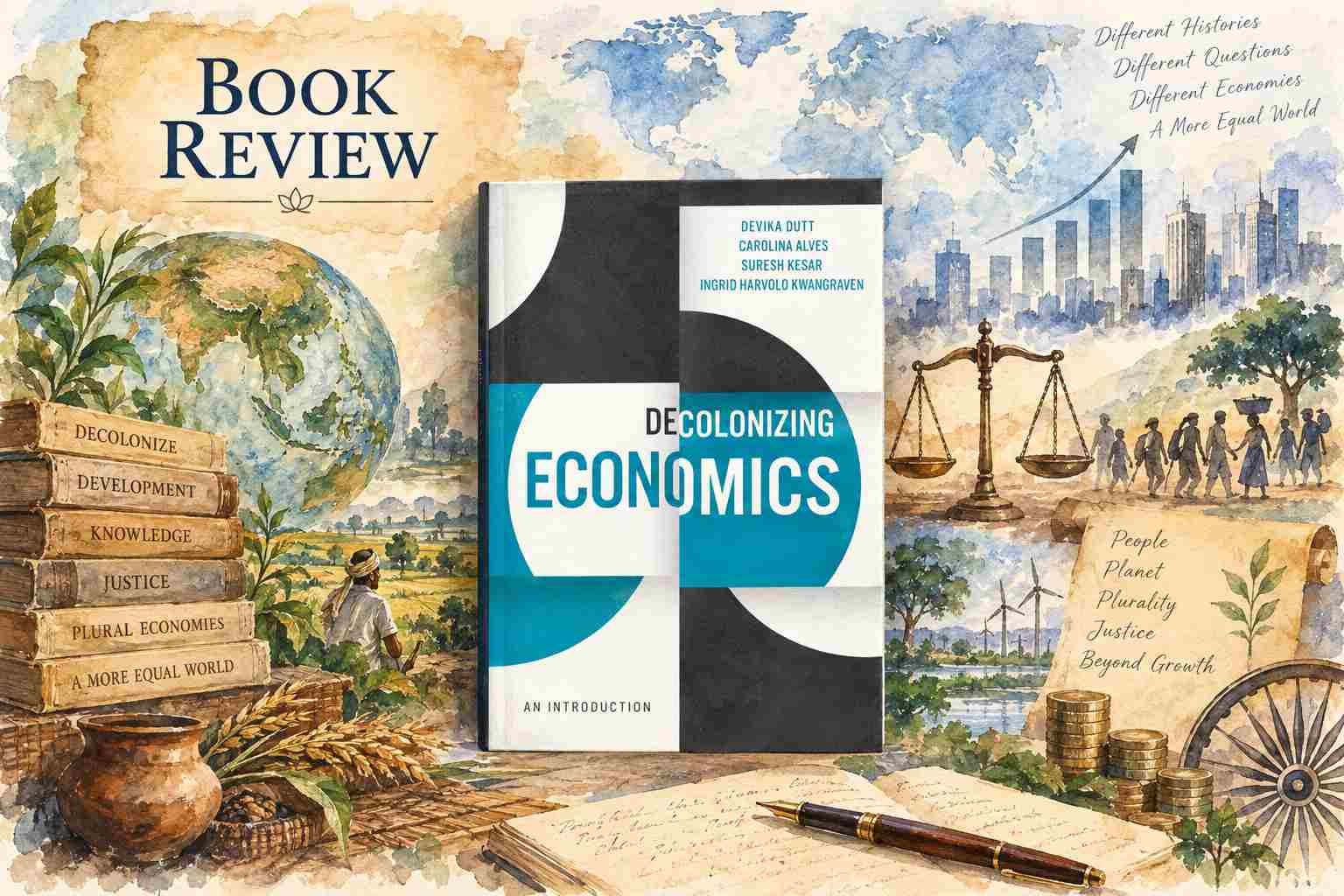
A book review of Decolonizing Economics
[Book is By Devika Dutt, Carolina Alves, Surbhi Kesar & Ingrid Harvold Kvangraven (Polity Press, 2025)]
The Book review is by Shailja Tewari
Introduction: What Is the Book Trying to Do?
Decolonizing Economics: An Introduction is not simply asking economics to include more scholars, cases or countries from the Global South. Its deeper concern is with the intellectual architecture of the discipline: how economics defines its questions, constructs its categories, selects its methods, and decides whose knowledge becomes authoritative. The authors argue that mainstream economics has elevated an idealized experience of capitalist development in the West into a supposedly universal model and has consequently treated other societies as deviations, deficits or problems to be corrected.
The book is deliberately positioned as an intervention rather than a final theory. In the Prologue, the authors call it “our account” and invite readers to interrogate, debate and extend their argument. Their project is therefore simultaneously historical, methodological and political: to recover neglected intellectual traditions, expose the structural power behind apparently neutral economic categories, and rethink how economics is taught and practiced. Part I traces the making of “Eurocentrism in Economics”; Part II asks what decolonization could look like in theory, research, curriculum, universities and policy.
The Power and Powerlessness of Economics
Chapter 1 establishes the central problem: economics is exceptionally powerful in shaping policy and conventional wisdom, yet remarkably narrow in who gets to produce authoritative economic knowledge. The authors begin with the institutional concentration of the discipline: nearly 90 per cent of authors in the top eight economics journals are based in the United States and Western Europe. Dani Rodrik’s discussion of the problem becomes an important entry point. Rodrik notes how research in Kenya helped Joseph Stiglitz develop ideas on asymmetric information and how Albert Hirschman’s experience in Nigeria influenced his work. Yet the authors draw attention to his description of such settings as “anomalous” and “unfamiliar.” The language reveals the deeper problem: the capitalist centre remains the implicit norm, while the rest of the world becomes the empirical exception.
The chapter then explains what the authors mean by mainstream economics. Its dominant formulation is organized around scarcity, allocation, optimization, incentives and efficiency. The authors argue that this framework has become so normalized that its assumptions appear natural rather than historically situated. Economics therefore does not merely describe the world; it helps shape institutions, policy priorities and public reasoning.
The Indian caste-based affirmative-action debate becomes the chapter’s most important illustration. When reservation is evaluated primarily through efficiency, merit or resource allocation, the historical structure of caste-based exclusion recedes from view. Studies may measure outcome gaps, opportunity gaps or caste networks, while the structural power relations producing those inequalities remain insufficiently theorized. The authors’ point is therefore sharper than “India is missing from economics”: India may be present as data while remaining absent as a source of theory.
Chapter takeaway: The problem is not only representation; it is epistemic authority, who defines the categories through which economic reality is understood.
The Foundations of a Eurocentric Discipline
Chapter 2 reconstructs the history that economics tells about capitalism and about itself. The authors challenge the “official story” in which capitalism emerges organically in Europe through markets, private property, technological progress and Enlightenment rationality. Adam Smith occupies a central place in this narrative, particularly through the “invisible hand,” specialization and the idea that self-interested exchange can generate prosperity. The authors argue that this account depoliticizes and de-historicizes capitalism by treating its development as a natural progression.
Against this, they present an alternative history centered on transforming social relations. Enclosure and dispossession in England helped create a population dependent on wage labour; colonialism and the Transatlantic Slave Trade were intertwined with capitalist expansion; and racialization and patriarchy shaped the organization of production and social reproduction. Colonial India becomes an important case: formal systems of property ownership altered existing relations to land and could strengthen dominant groups at the expense of marginalized communities.
The chapter also addresses what the authors call the “great gap” in the history of economic thought. Economic reasoning did not begin with European classical economists. Chinese ideas associated with wu-wei, Ibn Khaldun’s analysis of division of labour, and Dadabhai Naoroji’s “drain theory” demonstrate that economic thought existed outside the canonical European lineage. Naoroji is particularly significant because he interpreted colonial rule through systematic wealth extraction rather than through the language of modernization.
The chapter thus identifies two connected forms of Eurocentrism: a Eurocentric history of capitalism and a Eurocentric history of economic ideas. Both make Europe appear to be the origin, norm and trajectory of economic development.
Chapter takeaway: To decolonize economics, the discipline must rethink not only its theories of capitalism but also the history of who is remembered as an economic thinker.
Colonization of the Discipline: From Political Economy to Contemporary Economics
Chapter 3 explains how political economy narrowed into the contemporary discipline of economics. Earlier political economists such as Smith, Ricardo and Marx addressed class, history, social relations and political institutions. The marginalist revolution shifted attention towards utility, individual choice, rationality and equilibrium. Jevons, Walras and Menger helped establish marginal utility as a central analytical concept, while methodological individualism increasingly treated individuals and firms as the primary units of analysis.
The authors emphasize that this was not simply a story of technical refinement. The discipline increasingly sought the scientific authority of physics through mathematical formalization and econometric estimation. During the Cold War, economics became more uniform: equilibrium, rationality, scarcity and choice expanded beyond particular market situations and became general principles for understanding social life. Institutional forces, funding patterns and the marginalization of radical economists reinforced this narrowing.
The chapter identifies three mechanisms through which Eurocentrism persists: first, the establishment of economic laws by removing social, political and historical structures; second, the use of equilibrium to reconcile individual behaviour with a stable social order; and third, the empirical turn, which encourages the idea that economics can simply uncover neutral facts through data.
The authors also show how these assumptions enter the classroom. Even newer approaches may remain within a late-neoclassical framework if they retain the same theoretical starting point. Textbooks therefore have enormous power because they shape the first conceptual vocabulary through which students encounter economic life. The chapter’s key argument is that the discipline has not merely become more technical; it has become narrower in what it is prepared to see.
Chapter takeaway: The “colonization” of economics is a process of theoretical narrowing in which historical and structural questions are displaced by individual choice, equilibrium and technical empiricism.
Development Economics: A Failed Attempt to Break from Colonial Roots
Chapter 4 asks a crucial question: if development economics emerged to understand poverty and the economies of the former colonies, why did it not become the natural home of decolonized economics? The authors answer by reconstructing two competing origin stories. The conventional “Truman version” locates the development project in Harry Truman’s 1949 speech and the promise to bring scientific and industrial progress to “underdeveloped areas.” The alternative “Bandung version” places development thinking within the longer anti-colonial struggle of newly independent countries seeking sovereignty, redistribution and control over their economic futures.
The authors emphasize that this alternative project existed before Truman. At Bretton Woods, representatives from Latin America, India and China raised concerns about the interests of poorer countries. The Bandung Conference and later the New International Economic Order advanced claims concerning sovereignty, natural resources, redistribution and a more equitable international economic order. These projects challenged the existing global distribution of power and were consequently marginalized or defeated.
Development economics subsequently became increasingly institutionalized through Western-led organizations and policy frameworks. Structural Adjustment Programs promoted by the IMF and World Bank linked development to market reform, privatization, deregulation and institutional restructuring. When these approaches failed to produce the promised transformation, the field increasingly moved towards smaller, measurable interventions and randomized controlled trials.
The authors do not reject empirical work or growth, industrialization and modernity themselves. Their objection is to a development framework that treats capitalist transition as the assumed destination and then studies localized problems without adequately explaining the historical structures that created them. Development economics thus becomes a revealing case of the periphery being studied through the conceptual authority of the centre.
Chapter takeaway: Development economics addressed the problems of the Global South without fully escaping the developmental hierarchy in which the capitalist centre remained the implicit model of progress.
Heterodox Economics and the Decolonization Agenda
Chapter 5 turns from diagnosis to possible intellectual resources for decolonization. Heterodox economics is presented as a broad umbrella covering Marxist, post-Keynesian, feminist, dependency and other traditions that differ from mainstream economics in their treatment of social relations, history, institutions and power. Its particular usefulness lies in shifting attention from isolated individuals to the structures in which individuals are embedded.
The authors illustrate this through several substantive examples. In labour markets, heterodox analysis can focus on the relationship between capital and labour and on how employment conditions affect bargaining power. In monetary theory, the global monetary system is presented not as a field of equal currencies but as a hierarchy in which the US dollar occupies a dominant position. The CFA franc illustrates how monetary arrangements can persist through colonial and political power rather than simply through market efficiency. In the analysis of group inequality, heterodox traditions examine how racialization, patriarchy and caste become embedded in economic structures rather than reducing inequality to individual prejudice.
The chapter is especially important because the authors do not idealize heterodox economics. They explicitly examine “Eurocentrism in heterodox theory” and the marginalization of scholarship from the periphery even within heterodox communities. Some radical traditions remain heavily centred on European experiences of capitalism and may neglect colonialism, racialization, gender or post-colonial forms of development.
Consequently, heterodox economics is described as a “necessary but insufficient condition” for decolonization. It offers conceptual resources for analysing structural power, but it cannot simply become a replacement canon. The decolonization project must also transform heterodox economics itself.
Chapter takeaway: Heterodoxy opens the door to structural and historical analysis, but decolonization cannot mean replacing one established canon with another.
Toward a Decolonization Agenda
Chapter 6 provides the book’s conceptual framework for what decolonizing economics should involve. The authors begin by rejecting a superficial approach in which colonialism, race or gender are simply added to existing mainstream models. If the underlying framework remains Eurocentric, the addition changes the content without changing the epistemic structure.
A central distinction is between the universal and the particular. The authors do not reject universalism; instead, they propose “radical universalism”: a form of universalism capable of beginning from diverse historical experiences rather than treating one particular history as the universal norm. The Haitian Revolution is used to demonstrate that supposedly universal ideas such as freedom cannot be narrated only through European intellectual history.
The chapter then introduces the “vantage point of theorization.” Where one begins matters because some analytical starting points make structural relations visible that others conceal. This is connected to methodological reflexivity: researchers must examine their own location, assumptions and relationship to structures of power. Positionality is therefore important, but the authors explicitly reject the idea that identity alone guarantees better scholarship.
The authors finally call for the deconstruction and reconstruction of categories. Terms such as developed/underdeveloped, traditional/modern, rational/irrational and other colonial, patriarchal and racialized classifications are treated as historically produced categories rather than neutral descriptions. The goal is not merely to include previously excluded people but to question the conceptual machinery through which inclusion and exclusion are produced.
This chapter is therefore the bridge between critique and reconstruction: decolonization becomes a project of changing the vantage point, methods, categories and theoretical assumptions of economics.
Chapter takeaway: Decolonization requires epistemic reflexivity, questioning not only who produces knowledge, but the categories, vantage points and assumptions through which knowledge is produced.
Exploring the Decolonization Agenda
Chapter 7 demonstrates how the proposed agenda can alter substantive economic analysis. The authors examine growth and structural transformation, trade and uneven development, labour and informality, and institutions and rationality. Their aim is not to create a separate “peripheral economics,” but to show that theorizing from the experiences of peripheral economies can improve economics as a general discipline.
Dependency theory provides the major intellectual entry point. Raúl Prebisch’s centre–periphery framework and the Prebisch–Singer thesis challenge the assumption that international trade automatically produces convergence between countries. André Gunder Frank’s analysis similarly treats development and underdevelopment as interconnected outcomes of a common historical process. Ruy Mauro Marini’s concept of “super-exploitation” explains how labour in peripheral economies can be incorporated into global capitalism under structurally unequal conditions. Vânia Bambirra extends the analysis by bringing gender into the study of peripheral capitalist development.
The discussion of labour and informality challenges the expectation that capitalist development naturally absorbs workers into formal employment. Informality can instead be understood as structurally reproduced within particular forms of capitalist development. The discussion of institutions and rationality then questions the universal figure of homo economicus and considers alternative conceptions of human behaviour, including Ubuntu and systemic approaches to rationality.
The chapter’s larger methodological move is significant: instead of asking why peripheral societies have failed to become like the centre, it asks how centre–periphery relations themselves are produced. The periphery is consequently transformed from an object of explanation into a vantage point from which the general structure of capitalism can be theorized.
Chapter takeaway: The periphery should not merely supply cases for theories produced elsewhere; experiences of the periphery can themselves generate theories of global capitalism.
What Is to Be Done?
Chapter 8 translates the book’s theoretical argument into an agenda for education, universities and economic policy. The authors reject two simplistic approaches to curriculum reform: removing European thinkers altogether, or adding a few non-Western names to an otherwise unchanged syllabus. Instead, students should be taught to develop “criticality within theory” and “criticality between theories,” while also examining the institutional and political processes through which some theories become canonical.
The authors use comparative advantage as a pedagogical example. Ricardo’s theory can be taught, but students can also be asked to consider the historical and political context in which Ricardo wrote, including his position as a landowner and his opposition to the Corn Laws. The objective is not to invalidate the theory but to remove the assumption that it emerged outside history and political interest.
The chapter also calls for centering structural power, recognizing that economics is normative, challenging Eurocentric universalism, placing theories within theoretical, political and historical contexts, and encouraging political engagement. The authors extend decolonization beyond classroom content to university governance, research practices and policy institutions.
For India, one of the chapter’s most significant observations is the marginal presence of scholars such as B.R. Ambedkar, Kancha Ilaiah and Anand Teltumbde in economics curricula, even within progressive or heterodox departments. This raises a question larger than representation: can these thinkers be treated merely as supplementary material, or can their questions reshape economic theorization?
The chapter closes with the warning against “fake decolonization”, institutional language that adopts the vocabulary of decolonization without disturbing underlying structures of power.
Chapter takeaway: A decolonized curriculum must change how students think about theory, canon formation and knowledge production, not merely diversify the reading list.
Conclusion
The final chapter returns to the danger that decolonization itself can be absorbed by the institutions it seeks to challenge. The authors argue that decolonization has become fashionable and can easily be reduced to diversity initiatives, symbolic gestures or marketable institutional language. Their term “fake decolonization” captures this process of co-optation. Consequently, decolonizing economics requires a transformation of the way economic structures, historical processes and relations of power are theorized.
The chapter therefore closes the book without closing the debate. Its final contribution is methodological as much as substantive: it asks readers to connect economic knowledge to broader struggles over inequality, power, colonialism and social transformation. The book’s unfinished character is, in this sense, part of its argument. A decolonized economics cannot be created by a single canon, institution or group of scholars; it requires an ongoing process of intellectual contestation and reconstruction.
The book therefore presents an interesting paradox. It asks economics to move beyond a single intellectual centre, yet its own account can at times appear centred on the West even while critiquing Western dominance because the principal response is articulated through Western and transnational critical traditions. This does not invalidate the authors’ argument, but it does reveal a limitation in its scope.
At the same time, I do not think the perspective presented by the authors can be accepted as a complete account of decolonization. The book is written from a clearly situated intellectual position and draws substantially on heterodox traditions such as Marxist, post-Keynesian, post-colonial, feminist, dependency and Black Radical approaches. These traditions provide important analytical tools, and the authors themselves acknowledge that heterodox economics is not automatically free from Eurocentrism. Yet this creates an interesting tension within the book: while it questions the tendency of mainstream economics to universalize a particular Western historical experience, its own explanation of decolonization is largely constructed through an established critical vocabulary. The question therefore arises whether one framework is being displaced by another rather than whether the intellectual field is genuinely being pluralized.
