Beyond the Modern Nation-State
When we study political science, one assumption usually goes unquestioned: that the state is the natural unit through which political life should be understood. We speak of the state, sovereignty, territory, population and government almost as though these categories have existed in the same form everywhere.
But have they?
Was a rājya the same thing as the modern state? Was rāṣṭra simply an ancient Indian equivalent of the modern nation? Was political authority always concentrated in a central government? And if a village assembly, guild, jāti, temple, gaṇa, community or local institution exercised meaningful authority, should we regard these merely as subordinate to the state?
These questions matter because the modern state is not the universal beginning of political organisation. It is a particular historical formation.
The European State and the Idea of Sovereignty
The modern conception of the state developed gradually in Europe. Medieval Europe contained overlapping authorities—kings, nobles, cities, churches, feudal institutions and the Holy Roman Empire. Political authority was therefore dispersed rather than concentrated in a single sovereign centre.
The transformation accelerated between the sixteenth and seventeenth centuries. Jean Bodin systematically theorised sovereignty in the context of the French religious wars, while Thomas Hobbes, writing amid the English Civil War, imagined the sovereign as the authority capable of preventing society from collapsing into conflict.
The Peace of Westphalia of 1648 is often presented as the birth of the sovereign state. That description is too simple. State formation and territorial sovereignty had been developing for centuries before 1648; Westphalia was one important stage in a much longer European transformation.
The resulting political imagination nevertheless became enormously influential: a defined territory, a central authority, a population, a legal order and sovereignty exercised within territorial boundaries.
Eventually, through European imperialism and colonial expansion, this particular political form became a global standard.
And this is where the Indian question becomes interesting.
Was Rājya the Indian State?
The Sanskrit political vocabulary does not give us one word that neatly corresponds to the modern state.
We encounter rājya, rāṣṭra, janapada, deśa, viṣaya, grāma, gaṇa and saṅgha, among others. Their meanings overlap in some contexts but are not interchangeable. The rāṣṭra itself has an old political history. Vedic and early Buddhist sources use rāṣṭra in political contexts, while janapada developed as a significant territorial-political category. But perhaps the most important distinction is conceptual. Political society was not necessarily imagined as a single institution called “the State.”
Authority could be distributed across several levels—king, ministers, village, clan, guild, religious institutions, assemblies and communities.
This is particularly visible in Kautilya.
The State as Saptāṅga
The Arthaśāstra does not reduce the rājya to the king. Kautilya describes seven prakṛtis, or limbs:
Svāmī, Amātya, Janapada, Durga, Kośa, Daṇḍa and Mitra—the ruler, ministers, territory and people, fortified centre, treasury, coercive power and allies. This is a remarkable conceptual move. The king is only one limb of the political organism.
The janapada includes both territory and its people. The kośa provides economic capacity. Daṇḍa provides coercive power and protection. Amātyas provide administrative competence. Mitra reminds us that political existence is also relational and international. In other words, the political order is an ecology of institutions and capacities, not simply a sovereign sitting at the top.
This is very different from teaching students that the state is merely “government + territory + population + sovereignty.”
The King Was Not the State
There is another important distinction. In the modern imagination, the government can be separated conceptually from the state. In premodern political thought, however, kingship was central—but kingship itself was normatively constrained.
The Arthaśāstra famously states:
“Prajā-sukhe sukhaṃ rājñaḥ, prajānāṃ ca hite hitam.”
“In the happiness of the subjects lies the happiness of the king; in their welfare, his welfare.” (Arthaśāstra 1.19.34)
This is not merely a sentimental statement about a benevolent ruler. It establishes a political principle: the ruler’s interest is inseparable from the welfare of the governed. The Manusmṛti similarly makes protection central to kingship and even warns that royal officials themselves may become exploitative, requiring the king to protect subjects from those appointed to protect them. (Manusmṛti 7.123). Authority therefore carried dharma and responsibility with it.
Before the State: Assembly, Community and Local Authority
Indian political history also cannot be reduced to kings and empires.
The Vedic corpus contains references to institutions such as sabhā, samiti, vidatha and gaṇa. These were not modern parliaments, and we should resist the temptation to turn every ancient assembly into a modern democratic institution. Yet their existence reminds us that political participation and collective decision-making had institutional forms outside the king’s household.
Later, the Buddhist tradition preserves the memory of gaṇa-saṅghas, including the Vajji confederacy. The Mahāparinibbāna Sutta describes the Vajjis as maintaining their political strength through regular assemblies and collective deliberation.
Here again, political organisation existed in forms that do not fit neatly into the modern binary of “state versus individual.”
Rāṣṭra, Rājya and Nation Are Not the Same
This distinction becomes especially important today.
A nation is generally understood through ideas of common political identity, historical memory and collective belonging. A state is an institutional-political structure possessing authority over a territory. A rājya refers to a realm or domain of rule. A rāṣṭra has a much older and context-dependent semantic history and cannot simply be translated as “nation-state.”
The danger begins when we take a modern European category and search ancient India merely for its Sanskrit equivalent. That reverses the direction of inquiry. Instead of asking, “Where was the Indian state?”, we should ask:
How did Bharatiya society organise authority, obligation, protection, resources and collective life? That question opens a much richer field of study.
Beyond the State-Centric Imagination
The Indic political world was certainly capable of strong kingdoms and empires. The Mauryan state was not some loose federation of village communities. Kautilya describes taxation, bureaucracy, espionage, fortifications, armies, diplomacy and elaborate administrative mechanisms. But alongside the rājya existed other institutions and communities with their own forms of authority.
The village was not merely an administrative unit waiting for orders from the capital. Guilds regulated economic activity. Communities maintained customs. Religious institutions possessed resources and authority. Local bodies mediated social life. Kingship itself was embedded within dharma.
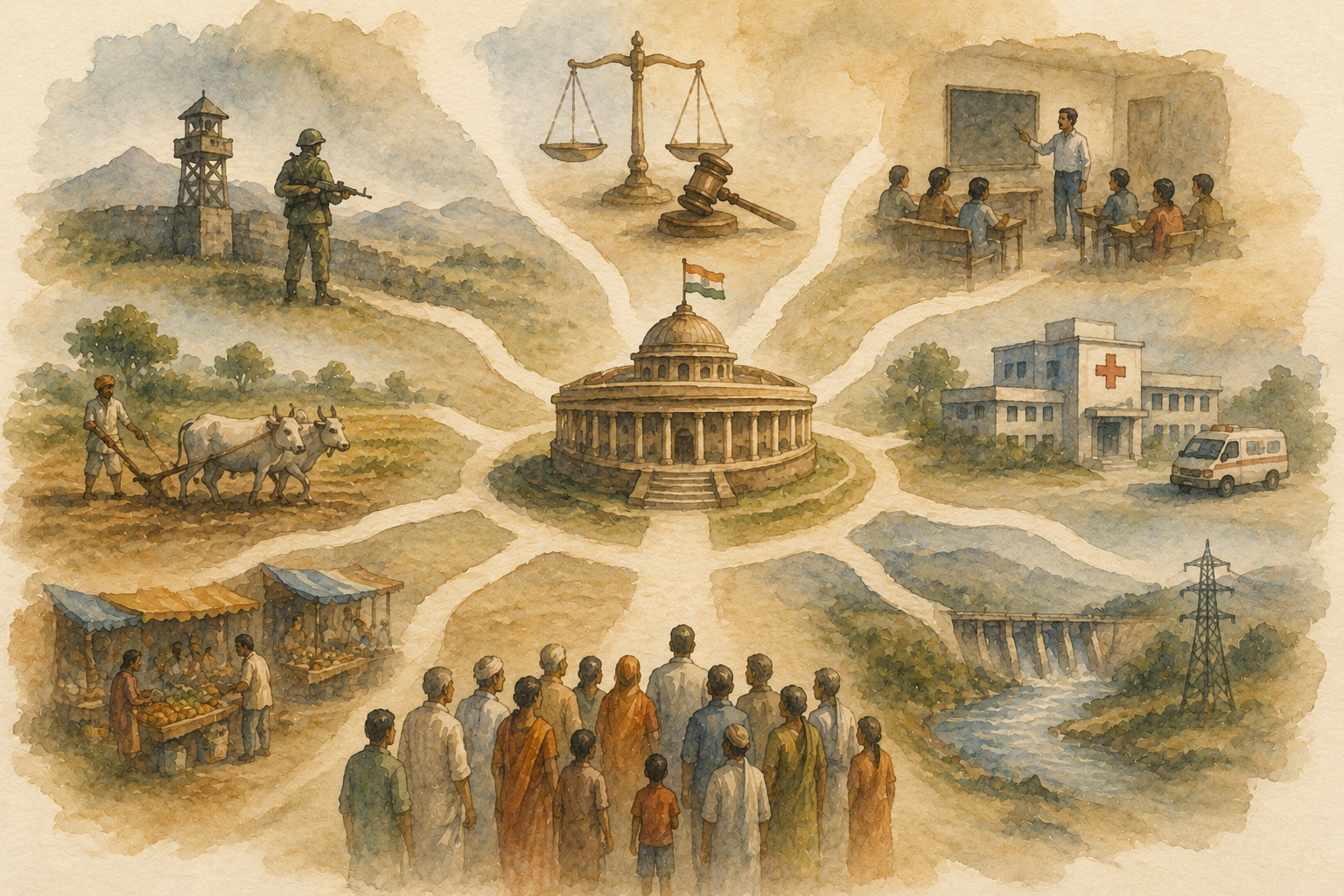
This suggests a different way of conceptualising political order: not a pyramid with the State at the top, but a layered and interdependent arrangement of institutions. Perhaps this is the larger lesson for contemporary political science. The question is not whether Bharat had a “state” before Europe invented the modern state. That question already assumes the conclusion.
The better question is: what forms of political organisation did different societies develop, what problems were those institutions designed to solve, and what conception of human life did they embody? The modern state is one answer to the problem of organising collective life.
It need not be the only answer. And once we recognise that, the study of rājya, rāṣṭra, janapada, gaṇa, saṅgha, grāma and dharma becomes not an exercise in finding ancient equivalents of Western concepts, but the beginning of a genuinely comparative political science.
References
- Kangle, R. P. The Kautiliya Arthasastra. University of Bombay, 1960–1965.
- Olivelle, Patrick. King, Governance, and Law in Ancient India: Kautilya’s Arthasastra. Oxford University Press, 2013.
- Kane, P. V. History of Dharmaśāstra. Bhandarkar Oriental Research Institute, 1930–1962.
- Manu. Manusmṛti, Chapter 7.
- Mahābhārata, Śānti Parva, sections on Rājadharma.
- Mahāparinibbāna Sutta, Dīgha Nikāya 16.
- Stanford Encyclopedia of Philosophy. “Sovereignty.”