An Introduction to “Foundations of Indian Culture” | Indic Social Studies Series
(Yet to be published)
Series: An Indic Social Studies Series
Published by: Centre for Indic Studies, Indus University
Author (Original Work): G. C. Pande (Govind Chandra Pande)
Original Work: Foundations of Indian Culture
Publisher: Motilal Banarsidass
Booklet: Selected excerpts, observations and introductory insights from Foundations of Indian Culture
Access: Open Educational Resource / Free Academic Publication (Non-Commercial)
About the Booklet
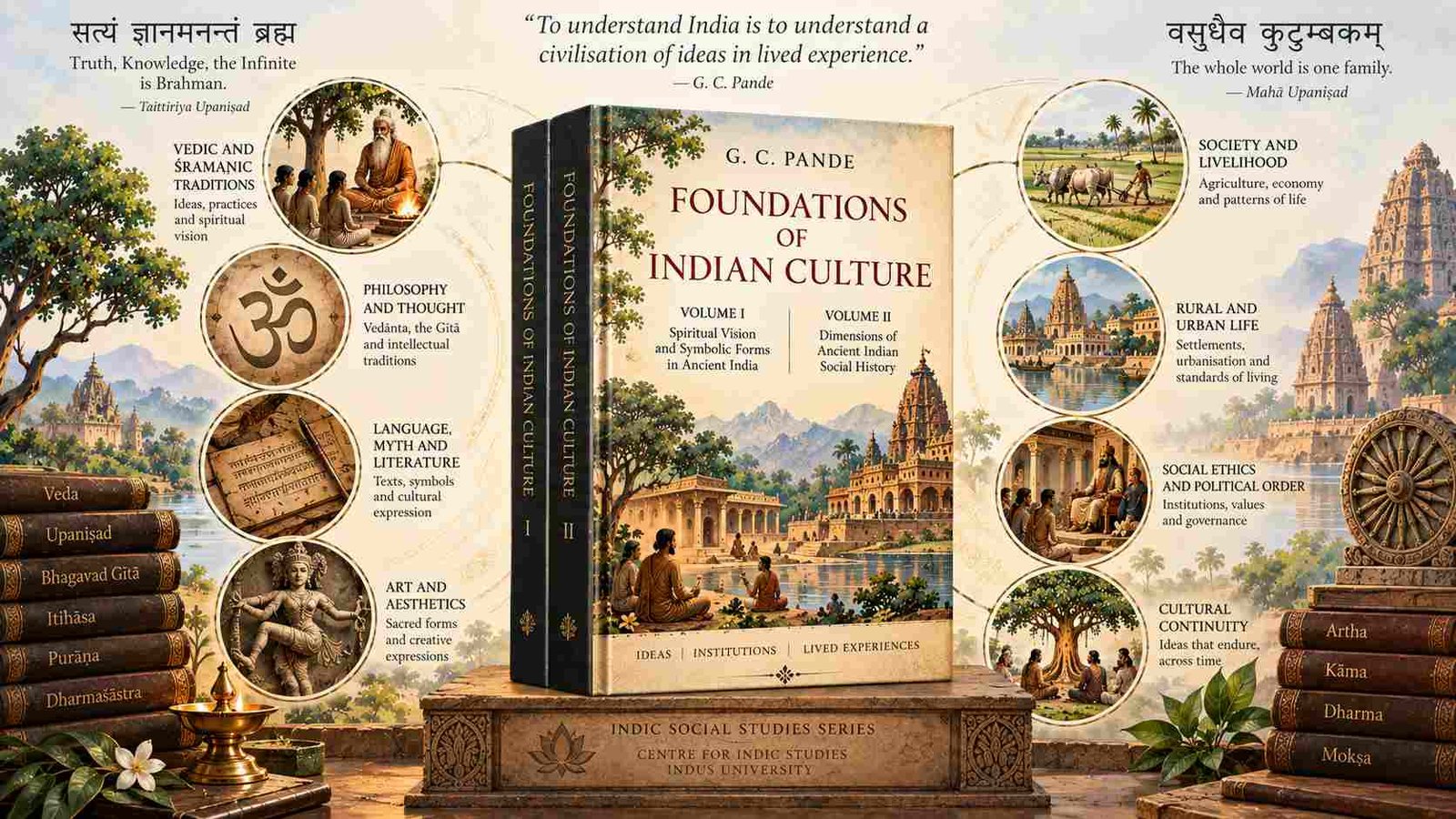
As part of the Indic Social Studies Series published by the Centre for Indic Studies, this educational booklet introduces the work of G. C. Pande, Foundations of Indian Culture.
Pande’s work is presented in two volumes. The first, Spiritual Vision and Symbolic Forms in Ancient India, examines the intellectual and spiritual foundations of Indian culture, while the second, Dimensions of Ancient Indian Social History, turns towards social, economic and political life.
Taken together, the two volumes attempt to ask a fundamental question: what are the underlying ideas through which Indian culture has developed, persisted and expressed itself across changing historical circumstances? Pande connects the study of Indian culture with both critical historical inquiry and the study of its deeper intellectual and spiritual traditions.
The first volume explores Vedic and Śramaṇic traditions, Vedānta, the Gītā, language, myth, rational knowledge, literature and art. The second examines geographical identity, population, economic life, patterns of livelihood, urban and rural society, standards of living, socio-ethical ideas and political order.
The importance of the work for Indic Social Studies lies in this attempt to bring together ideas, institutions and lived social experience rather than treating culture merely as a collection of customs, monuments or historical events.
What’s Inside This Booklet?
1. Understanding the Foundations of Indian Culture
An introduction to Pande’s approach to culture as something shaped by foundational ideas, intellectual traditions and historical experience.
2. Spiritual Vision and Cultural Expression
The booklet introduces Pande’s discussion of Vedic and Śramaṇic traditions and the ways in which philosophical and spiritual ideas found expression in Indian cultural life.
3. Language, Myth, Literature and Art
Pande examines major forms through which Indian ideas have been expressed, including language, mythology, literature, rational knowledge and art.
4. Society, Economy and Livelihood
The second volume moves from intellectual foundations towards social history, examining population, economic attitudes, agriculture, rural life, urban organisation and standards of living.
5. Social Ethics and Political Order
The work also examines the development of socio-ethical ideas and political order in Vedic and post-Vedic India, providing a broader framework for understanding the relationship between culture, society and political institutions.
Primary Goals
- Introduce students to G. C. Pande’s interpretation of Indian culture
- Examine the ideas underlying Indian cultural continuity
- Connect spiritual and philosophical traditions with social history
- Study Indian society through its economic, social and political institutions
- Encourage interdisciplinary approaches to the study of culture
- Bring together intellectual history and empirical historical inquiry
- Provide a foundation for further study in Indic Social Studies
Key Topics Covered
- Foundations of Indian Culture
- Vedic Vision
- Śramaṇic Traditions
- Vedānta and the Gītā
- Indian Philosophy
- Language and Myth
- Literature and Art
- Rational Knowledge and Science
- Geographical Identity
- Population and Society
- Economic Ideas and Attitudes
- Vedic Patterns of Livelihood
- Rural and Agrarian Society
- Urban Life
- Standards of Living
- Socio-Ethical Ideas
- Vedic and Post-Vedic Social Order
- Political Order and Ideas
A Question to Begin With
When we speak of Indian culture, what exactly are we talking about?
Is culture simply a collection of traditions, customs, texts, temples, languages and artistic forms? Or are these different expressions of deeper ideas about human life, society, knowledge, ethics and the relationship between the individual and the world?
G. C. Pande’s Foundations of Indian Culture approaches this question by moving between spiritual vision and historical experience, ideas and institutions, philosophy and everyday social life.
That makes the work particularly useful for asking a larger question:
Can a civilisation be understood only through the events of its history, or must we also examine the ideas that gave those events their meaning?