An Introduction to “The Oriental Renaissance” | Indic Social Studies Series
(Yet to be Published)
Series: An Indic Social Studies Series
Published by: Centre for Indic Studies, Indus University
Author (Original Work): Raymond Schwab
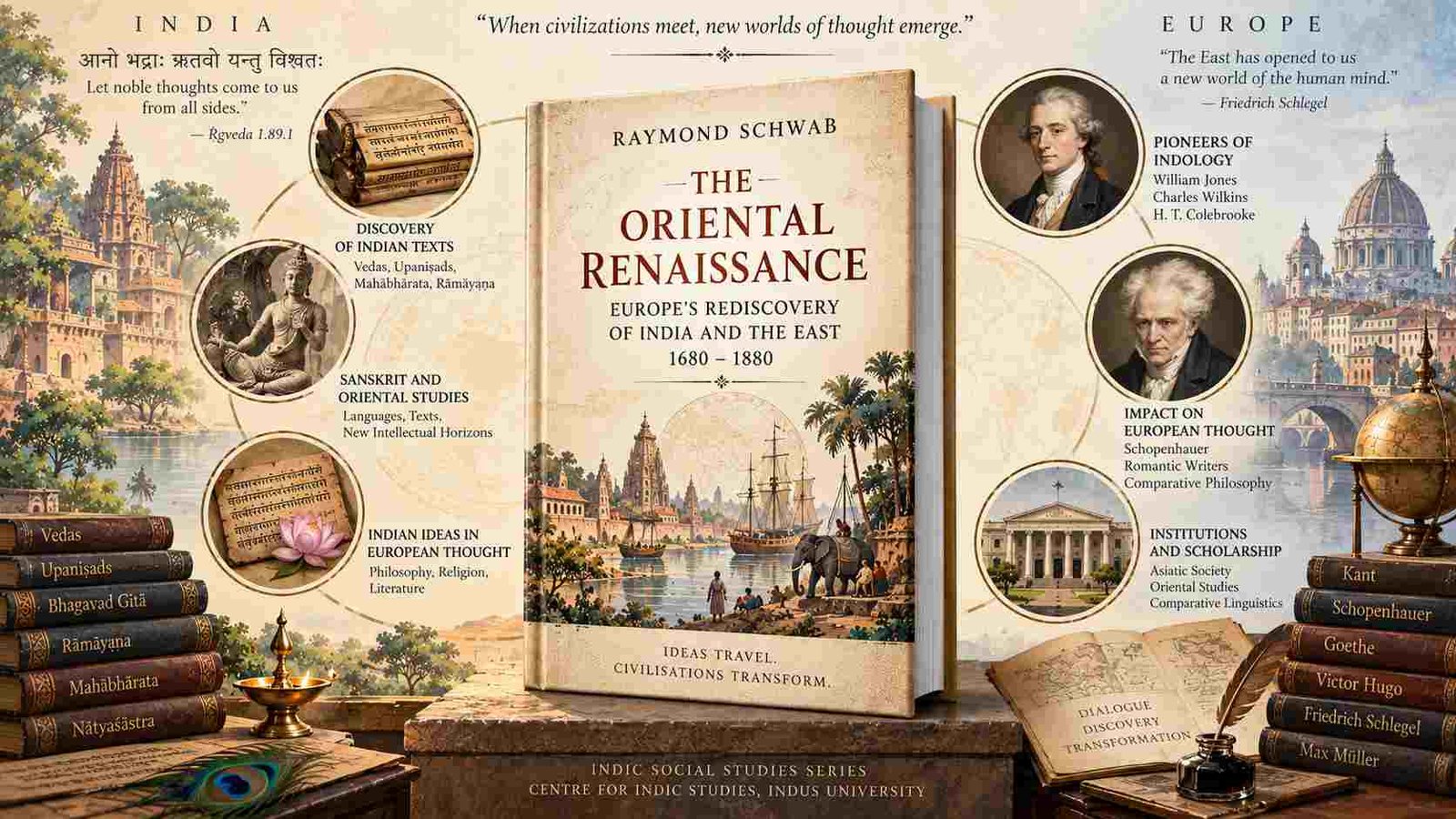
Original Book: La Renaissance orientale / The Oriental Renaissance: Europe’s Rediscovery of India and the East, 1680–1880
Original Publication: Payot, Paris, 1950
English Edition: Columbia University Press, 1984
Booklet: Selected excerpts, observations and introductory insights from The Oriental Renaissance
Access: Open Educational Resource / Free Academic Publication (Non-Commercial)
About the Booklet
As part of the Indic Social Studies Series published by the Centre for Indic Studies, this educational booklet introduces the important work of Raymond Schwab, The Oriental Renaissance. The original French work, La Renaissance orientale, was published by Payot in Paris in 1950; the English edition, The Oriental Renaissance: Europe’s Rediscovery of India and the East, 1680–1880, was published by Columbia University Press in 1984.
Schwab examines a major intellectual development in Europe between the late eighteenth and nineteenth centuries: the growing encounter with the languages, texts, philosophies and religious traditions of Asia, particularly India. The discovery, translation and study of Sanskrit texts became an important part of this intellectual movement, influencing European scholarship, literature, philosophy and ideas about human civilisation.
The book traces this development through the emergence of Oriental studies, the establishment of institutions such as the Asiatic Society, the European study of Sanskrit, the development of comparative linguistics and the influence of Indian ideas and texts on European writers and thinkers.
The significance of the work lies in the reversal of a familiar direction of intellectual influence. Instead of asking only how Europe interpreted or classified India, Schwab asks what happened inside European intellectual life when Europe encountered India and the wider East.
What’s Inside This Booklet?
1. What Was the “Oriental Renaissance”?
An introduction to Schwab’s central idea: that the encounter with Asian texts and intellectual traditions produced a significant intellectual movement in Europe, particularly during the eighteenth and nineteenth centuries.
2. Europe Encounters Sanskrit
The booklet explores the emergence of European engagement with Sanskrit texts, translations and Indian literature, including the growing importance of works such as the Vedas, Upaniṣads, Mahābhārata, Rāmāyaṇa and Śakuntalā in European intellectual circles.
3. The Rise of Oriental Studies
Schwab traces the development of Oriental studies through scholars, institutions, translations and new methods of linguistic and textual study. The establishment of the Asiatic Society and the work of figures such as William Jones, Charles Wilkins and H. T. Colebrooke form part of this history.
4. India and European Literature
The influence of Indian literature and ideas extended beyond academic Orientalism. Schwab examines their repercussions in European literature, particularly among Romantic writers and intellectuals. His chapters discuss figures including Lamartine, Victor Hugo, Vigny, Michelet and Schopenhauer.
5. From Indology to a Wider Intellectual Encounter
The work also considers how the study of India and Asia affected European thinking about language, religion, philosophy, history and humanity. The “Orient” became not merely an object of study but part of a wider European intellectual conversation.
Primary Goals
- Introduce students to Raymond Schwab’s concept of the Oriental Renaissance
- Understand the history of European engagement with Indian texts and ideas
- Examine the emergence of Indology and Oriental studies
- Explore the role of Sanskrit in European intellectual history
- Understand the influence of Indian literature and philosophy on European thinkers
- Encourage students to study intellectual exchange as a two-way historical process
- Examine how knowledge of India contributed to transformations within European thought
Key Topics Covered
- The Oriental Renaissance
- Europe and the Rediscovery of the East
- Sanskrit and European Scholarship
- Discovery and Translation of Indian Texts
- Asiatic Society of Bengal
- William Jones
- Charles Wilkins
- H. T. Colebrooke
- Friedrich Schlegel and German Indology
- Comparative Linguistics
- Indology and Oriental Studies
- Indian Literature and European Romanticism
- India and Schopenhauer
- Buddhism and European Thought
- India in European Intellectual History
- Orientalism and the Making of Modern Knowledge
A Question to Begin With
What happens when a civilisation encounters texts and ideas that do not fit easily into its existing intellectual categories?
The story of the encounter between Europe and India is often told as a story of European discovery of the East. Schwab’s work allows us to ask a different question:
What did Europe discover about itself when it began to seriously encounter India?
This makes The Oriental Renaissance particularly useful for the study of Indology, intellectual history, comparative philosophy and the history of knowledge. It allows us to examine not only how India was studied in Europe, but also how the encounter with India contributed to changes in European scholarship, literature and intellectual imagination.