An Introduction to “Hindu Polity” | Indic Social Studies Series
(Yet to be Published)
Series: An Indic Social Studies Series
Published by: Centre for Indic Studies, Indus University
Author (Original Work): K. P. Jayaswal
Original Book: Hindu Polity: A Constitutional History of India in Hindu Times
Booklet: Selected excerpts, observations and introductory insights from Hindu Polity
Access: Open Educational Resource / Free Academic Publication (Non-Commercial)
About the Booklet
As part of the Indic Social Studies Series published by the Centre for Indic Studies, this educational booklet introduces the important work of K. P. Jayaswal, Hindu Polity.
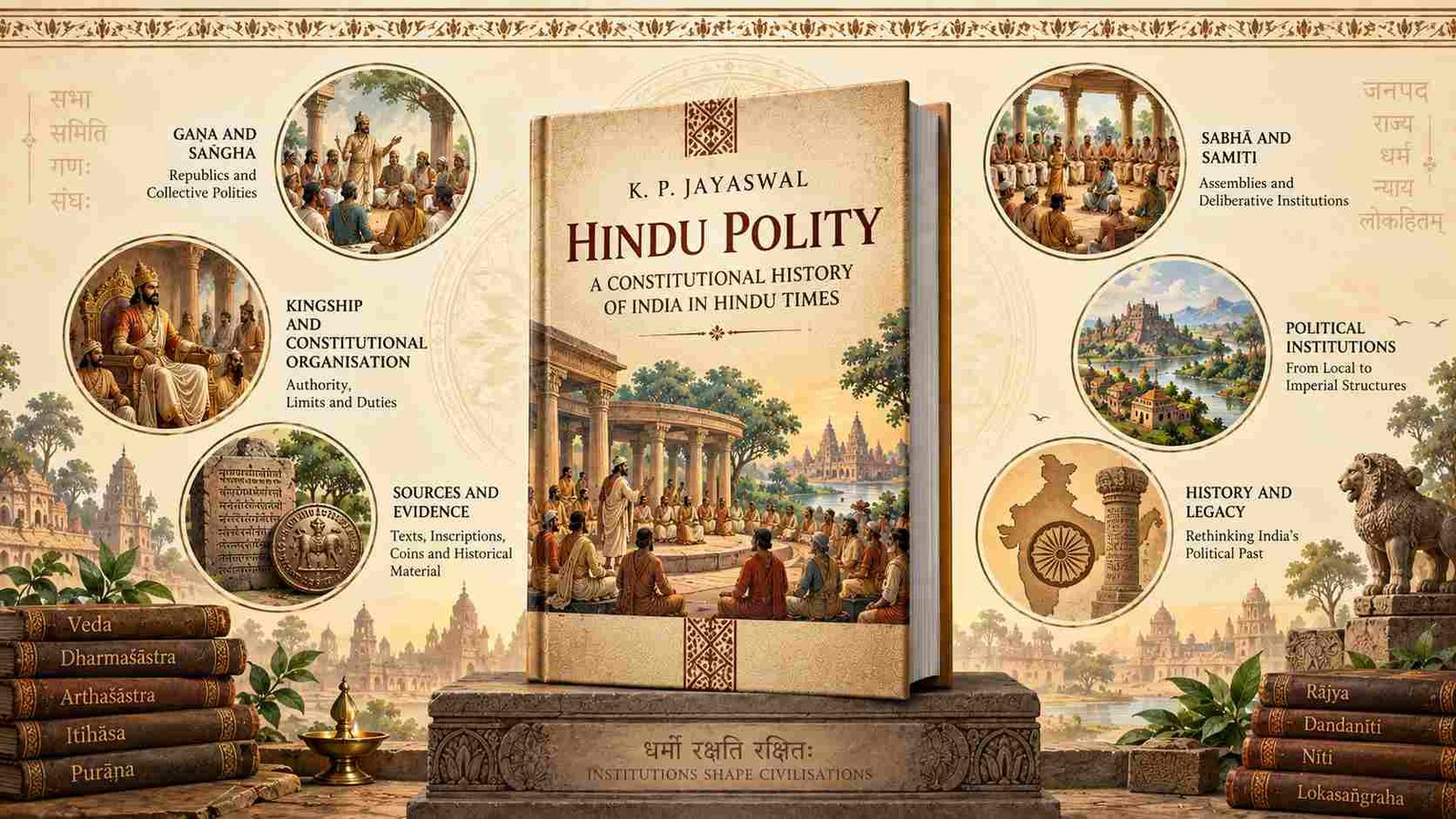
Originally published in the early twentieth century, Jayaswal’s work was an important attempt to reconstruct the political institutions of ancient India through literary, epigraphic and historical evidence. Rather than treating ancient Indian political life simply as a history of kings and dynasties, Jayaswal examined questions of constitutional organisation, popular institutions, republics, assemblies, kingship and political authority.
The work is particularly significant for its discussion of Gaṇa and Saṅgha traditions, republican institutions and the different forms through which political communities were organised in ancient India.
The booklet introduces these arguments while also encouraging readers to examine the sources and historical evidence through which such interpretations of Indian political history were developed.
What’s Inside This Booklet?
1. Understanding Hindu Polity
An introduction to Jayaswal’s attempt to reconstruct the political organisation of ancient India and to understand political institutions within their historical context.
2. Republics and the Gaṇa-Saṅgha Tradition
The booklet examines Jayaswal’s discussion of ancient republican communities and collective forms of political organisation, including the Gaṇa and Saṅgha traditions.
3. Assemblies and Popular Institutions
Attention is given to institutions such as Sabha, Samiti and other forms of deliberative and collective political activity, and to the question of how political participation was organised.
4. Kingship and Constitutional Organisation
Jayaswal’s analysis also raises questions about the position of the king, the limits and sources of political authority, succession and the relationship between the ruler and political institutions.
5. Political Institutions and Historical Sources
The work draws upon literary texts, inscriptions, coins and other historical material to reconstruct political institutions. The booklet introduces this source-based approach and its significance for studying ancient Indian polity.
Primary Goals
- Introduce students to K. P. Jayaswal’s study of ancient Indian political institutions
- Examine the Gaṇa-Saṅgha and republican traditions
- Explore the relationship between kingship, assemblies and political authority
- Encourage the study of Indian political history through indigenous historical sources
- Revisit the question of political participation in ancient India
- Provide a foundation for further research into the history of Indian political thought
Key Topics Covered
- Hindu Polity
- Ancient Indian Political Institutions
- Gaṇa and Saṅgha
- Ancient Republics
- Sabha and Samiti
- Assemblies and Political Participation
- Kingship
- Constitutional Organisation
- Political Authority
- Local and Collective Institutions
- Sources of Ancient Indian Political History
- Inscriptions and Coins
- Buddhist and Brahmanical Sources
- Evolution of Political Institutions
A Question to Begin With
When we study the history of political institutions in India, should the story begin with monarchy alone?
Or does the history become more complicated when we also examine assemblies, republics, councils, collective political bodies and different forms of shared authority?
Jayaswal’s Hindu Polity invites us to look at ancient India through precisely these questions. His work is therefore useful not simply as a historical account of political institutions, but as an entry point into the larger study of how political authority and collective life were organised in ancient India.