Rethinking What We Mean by Culture
What do we mean when we say “culture”? I have increasingly found this to be a more difficult question than it ought to be. Not because culture is inherently incomprehensible, but because the academic study of culture has accumulated so many theoretical layers that, at times, the object we originally set out to understand seems to disappear beneath the vocabulary we have constructed around it.
A contemporary student of Cultural Studies is likely to encounter culture through concepts such as discourse, representation, power, identity, hegemony, gender, race, class, othering, resistance and deconstruction. Thinkers such as Raymond Williams, Stuart Hall, Michel Foucault, Edward Said and Pierre Bourdieu have undoubtedly transformed the field. They taught us to look beyond the obvious, to ask how meanings are produced, who controls representation, whose voices become authoritative, how institutions shape consciousness, and how apparently ordinary practices may contain structures of power. I do not dismiss these contributions. In fact, I believe that any serious student of culture should know them.
My concern begins somewhere else. What happens when critique ceases to be one method of studying culture and becomes the default purpose of studying culture?
That is where I believe Cultural Studies needs to pause and examine itself. There is a subtle but consequential movement that has taken place in parts of modern cultural theory. We began by saying that culture may contain relations of power. This is a perfectly legitimate proposition. We then learned to examine cultural practices in relation to class, gender, political authority, social hierarchy and representation. Again, this was intellectually productive. But somewhere along the way, the proposition often became much stronger: culture came to be treated as though its fundamental significance lay in the power relations hidden within it.
Once this happens, almost anything can be read through the same interpretive machinery. A festival becomes an instrument of social control. The family becomes primarily a site of patriarchy. Tradition becomes inherited domination. Religious practice becomes discourse. Identity becomes construction. Language becomes power. Social norms become mechanisms of exclusion. Ritual becomes ideological reproduction. Some of these interpretations may sometimes be correct. That is precisely why they deserve to be examined. But I become uncomfortable when they are treated as the starting assumption rather than as questions to be investigated.
There is a profound difference between asking whether a cultural practice contains relations of power and assuming beforehand that its principal function is to reproduce power. The first is scholarship. The second can become intellectual habit. And I think we need to be considerably more careful about the difference.
When Criticism Replaces Understanding
A student trained exclusively through this intellectual orientation can become remarkably skilled at asking certain questions. Who benefits? Who is excluded? Who has power? Who is represented? Who is silenced? Which group occupies the centre and which is pushed to the margins?
These are important questions, and I would not remove them from the classroom. But I want to ask another set of questions that our curricula often treat as secondary, if they ask them at all.
What does this practice mean to the people who actually perform it? Why do they continue it? What memories does it preserve? What relationships does it sustain? What knowledge is transmitted through it? What aesthetic or emotional experience does it produce? How has the community itself interpreted the practice? What internal debates have taken place around it? Why has it survived across generations? What changes has it undergone? And, perhaps most importantly, what do practitioners themselves consider valuable about it?
These questions are not politically innocent. Nor are they meant to romanticise tradition. They are simply necessary if we are serious about understanding culture. I find it intellectually unsatisfactory when a scholar can explain a festival entirely in terms of social control without being able to explain why millions of people experience that festival as devotion, celebration, memory, community and belonging. If we explain a ritual only through the category of power, have we actually explained the ritual—or have we merely explained what our theoretical framework allows us to see?
This is where I believe Cultural Studies sometimes suffers from a peculiar imbalance. We have become extremely sophisticated at suspicion, but considerably less confident about interpretation. And suspicion, however sophisticated, is not the same thing as understanding.
The Legacy of Cultural Studies
The intellectual history of Cultural Studies itself helps us understand how this happened. Raymond Williams‘s insistence that culture is “ordinary” was an important intervention against an older conception in which culture was associated primarily with canonical literature, classical art, elite education and refined taste. Williams opened intellectual space for the study of everyday life, popular practices and ordinary experiences.
Stuart Hall subsequently demonstrated the importance of representation and the processes through which cultural meanings are produced. His work made it impossible to treat representation as a neutral mirror of reality. Foucault radically transformed the discussion of knowledge, discourse and power by demonstrating how institutions and systems of knowledge participate in the production of what societies accept as normal or true. Edward Said’s critique of Orientalism revealed how representations of the “East” had been connected to European intellectual and imperial structures. Bourdieu demonstrated how cultural capital, habitus and social distinction contribute to the reproduction of social structures.
These were not trivial contributions as it is believed that they ‘expanded’ the intellectual field enormously. The student who learns from Foucault that knowledge and power are related should not consequently conclude that every claim to knowledge is merely an instrument of power. The student who learns from Said that representations can serve imperial interests should not conclude that every representation of another culture is necessarily an act of domination. The student who learns from Hall that identity is constructed should not conclude that identity has no historical depth, inherited meaning or civilizational continuity.
The distinction is crucial. A theoretical insight is not a universal explanation. Yet this distinction is sometimes lost in the classroom.
From “Culture Contains Power” to “Culture Is Power”
I would describe the problem as a movement from a modest analytical proposition to an excessively comprehensive one. There is a considerable difference between saying that culture contains relations of power and saying that culture is fundamentally reducible to relations of power.
The first proposition expands our field of inquiry. The second risks narrowing it. If everything ultimately becomes a question of power, then power becomes an interpretive master category. The festival is interpreted through power, the family through power, language through power, religion through power, education through power, art through power and even resistance itself through power.
At that point, the framework becomes remarkably difficult to falsify. Whatever we discover can be incorporated into it. And when a theory can explain everything, I become cautious about whether it is actually explaining anything sufficiently. Culture is certainly political. Culture can reproduce hierarchy. Cultural institutions can exclude. Traditions can be used to legitimise authority. Communities can preserve prejudices. All of this must be studied.
But culture can also create meaning where there was none, preserve memory where historical records have disappeared, produce solidarity among strangers, transmit ethical expectations, provide aesthetic experience, organise time, establish relationships between generations and give individuals a language through which they understand their place in the world. If our conceptual vocabulary has no adequate place for these phenomena, perhaps the problem is not always with the culture. Perhaps sometimes the problem is with our vocabulary.
The Problem of Postmodern Suspicion
This becomes even more complicated when postmodern theoretical assumptions are introduced without sufficient qualification. The idea that truth, identity and knowledge are mediated through language, institutions and systems of representation can be an important corrective to naïve assumptions about neutrality. But a corrective becomes destructive when it is transformed into an absolute.
If every truth claim is interpreted primarily as an assertion of power, then what happens to the distinction between truth and falsehood? If every identity is described merely as a social construction, what happens to the historical experience through which people inherit and inhabit that identity? If every tradition is called a narrative, what happens to the distinction between narratives that have sustained communities for centuries and narratives manufactured yesterday for political convenience?
I am not arguing that traditions are beyond criticism. Quite the opposite. A tradition must be capable of being examined. But the capacity to criticise tradition is not the same as the necessity to distrust tradition.
This distinction is essential for any serious decolonisation of Cultural Studies. I worry particularly when students are taught to dismantle inherited categories before they have learned how those categories actually functioned within the civilisation that produced them. They learn to deconstruct dharma before understanding what the term means in different textual and social contexts. They critique paramparā without examining how transmission actually operates. They discuss ācāra as social conformity without studying its relationship with local practice, jurisprudence and community life. They reduce śāstra to religious authority without understanding its role as a disciplined body of knowledge.
This is not decolonisation. It can simply become another form of intellectual colonisation—this time by importing the categories through which a culture is permitted to understand itself.
Indic Traditions and the Discipline of Seeing
The Indic intellectual tradition gives us an entirely different starting point. This does not mean that India lacked criticism, disagreement or intellectual conflict. Quite the opposite. Indian philosophical traditions developed some of the most elaborate traditions of debate, reasoning, interpretation and refutation in intellectual history.
The very structure of darśana is significant. A darśana is not merely a doctrine to be memorised; it is a way of seeing and understanding reality. The traditions disagree profoundly with one another, but they do so through developed epistemological and argumentative frameworks.
The practice of pūrva-pakṣa is particularly instructive for Cultural Studies. Before refuting an opposing position, the scholar is expected to understand and formulate that position properly. One does not defeat a caricature of the opponent. One engages the strongest version of the argument.
I find this intellectual discipline deeply relevant to contemporary Cultural Studies. Before asking what is wrong with a cultural practice, can we first understand how its practitioners understand it? Before calling something oppressive, can we establish the conceptual world in which the practice operates? Before describing a tradition as patriarchal, can we examine the different normative, social and historical positions within that tradition? Before dismissing an inherited practice as superstition, can we determine whether it carries ritual, ecological, social, aesthetic, philosophical or mnemonic functions that our modern categories have simply failed to recognise?
This is not an argument against criticism. It is an argument for better criticism.
From Judgement to Discernment
This is where the Indic idea of viveka becomes particularly useful. Viveka is not mere scepticism. It involves discrimination, discernment and the capacity to distinguish between things that may appear similar but are not identical. A decolonised Cultural Studies needs this intellectual capacity.
The student should be able to ask whether a practice should be preserved, transformed or abandoned, but such a conclusion should emerge after investigation rather than before it. The relevant questions might include its historical development, social function, ethical implications, internal variations, contemporary consequences and the criticisms that have emerged from within the tradition itself. This is an important distinction because Indian traditions have never been intellectually static. Smṛti itself demonstrates a relationship between enduring principles and changing social circumstances. Ācāra, deśācāra, kulācāra and lokācāra indicate that social practice has never been reducible to a single frozen code. Philosophical traditions argued with one another; commentators interpreted earlier texts; communities modified practices; reformers emerged from within traditions.
Therefore, when I speak of bringing an Indic perspective into Cultural Studies, I do not mean replacing one orthodoxy with another. I mean restoring the possibility that a civilisation may possess intellectual categories through which it can interpret itself.
Culture Is Not Internally Uniform
There is another correction that is necessary. An Indic approach cannot simply replace the simplistic Western category of “Indian culture” with another simplistic idea of a single, homogeneous Indian civilisation.
India has always contained extraordinary internal diversity. Language, region, occupation, sect, philosophical school, community, geography and historical experience have produced different cultural forms. A Tamil temple tradition cannot simply be treated as interchangeable with a Himalayan ritual tradition. A tribal cosmology cannot be reduced to a Sanskritic philosophical system. A mercantile community’s social practices cannot automatically be assumed to represent those of an agrarian society.
But diversity does not necessarily mean fragmentation. This is a distinction that I believe deserves far greater attention. A civilisation can contain disagreement without losing continuity. It can contain multiple languages without losing civilizational memory. It can accommodate competing philosophical schools without abandoning the idea that those schools participate in a larger intellectual world.
The presence of plurality does not logically require the absence of a civilizational framework. Indeed, the Indian experience may provide an unusually valuable case through which Cultural Studies can study precisely this relationship between plurality and continuity.
Tradition and the Question of Agency
Modern cultural theory also needs to reconsider its treatment of tradition and agency. There is a tendency to imagine tradition as something imposed upon individuals and resistance as the principal expression of individual freedom. Under such a framework, the individual becomes free when he or she escapes inherited structures. But human agency does not operate only through rejection.
A person can exercise agency by choosing to inherit. A young musician who deliberately learns a classical tradition is exercising agency. A family that continues a festival while consciously adapting its form is exercising agency. A community that retains its language and teaches it to its children is exercising agency. A person who adopts yoga, classical dance, Sanskrit learning, devotional practice or a particular form of ritual because he or she finds meaning in it is not automatically an unconscious product of ideological conditioning.
We have become so accustomed to asking whether people are constrained by tradition that we sometimes forget to ask whether they choose tradition. And when they do, what exactly are we to call that choice? If agency means only resistance, then our theory has already predetermined what freedom is supposed to look like.
An adequate Cultural Studies must allow for a more complicated understanding of human beings: people can resist traditions, reproduce traditions, reinterpret traditions, combine traditions and consciously reclaim traditions. They can be constrained by culture and simultaneously become creative agents within it.
Culture Is Neither Museum nor Battlefield
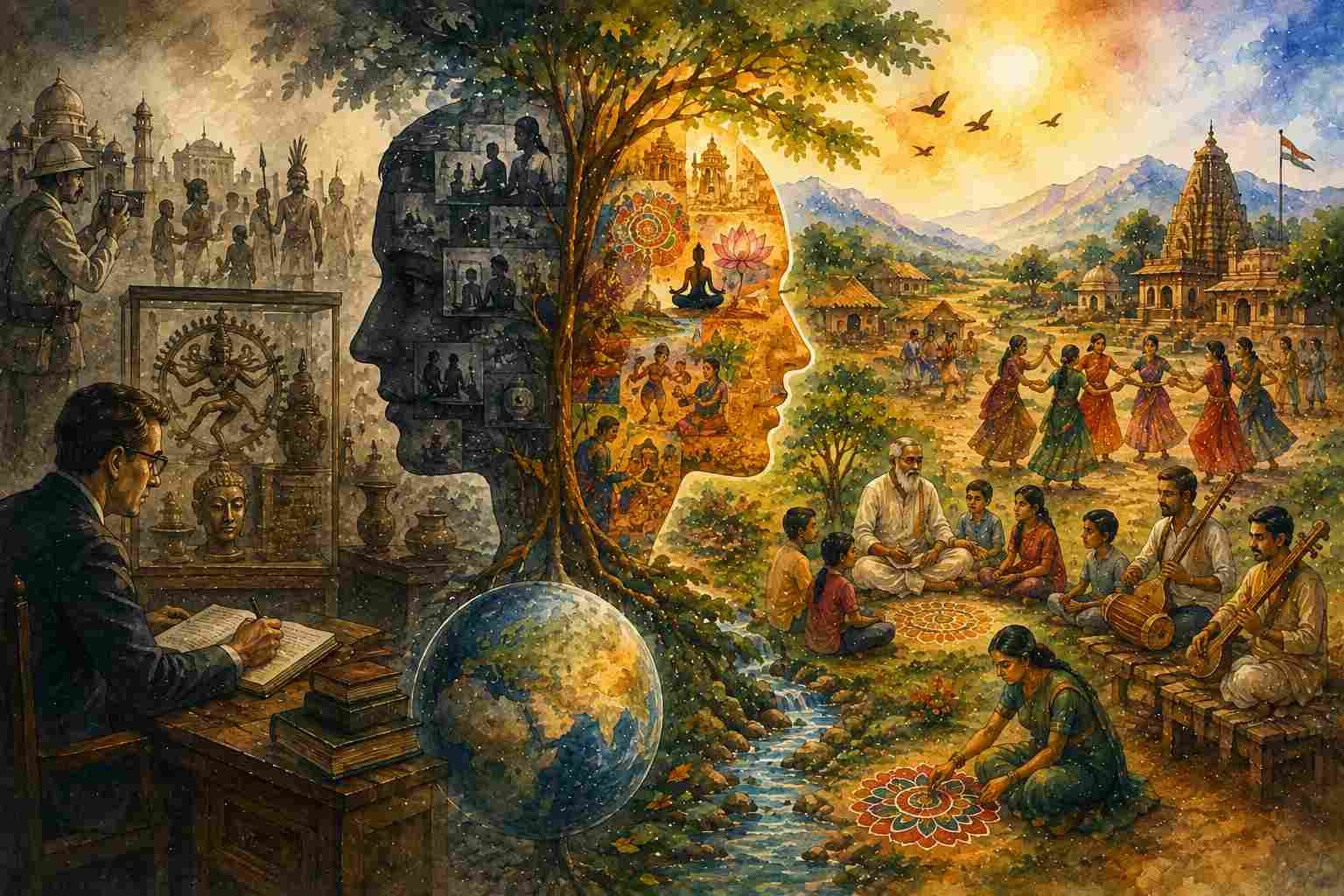
This is perhaps where I would most strongly argue for an Indic correction to the contemporary study of culture. Culture is not simply a museum containing inherited objects that must be preserved untouched. But neither is it merely a battlefield on which competing groups struggle for discursive power.
Culture is lived. It is remembered, transmitted, questioned, performed, embodied, modified and recreated.
A festival is not merely an event. It may be a calendar, a memory, a ritual, an aesthetic experience, a family gathering, a community institution and a relationship between generations. A story is not merely a narrative. It may contain ethical reflection, philosophical speculation, entertainment, identity and memory. A language is not merely a structure of signs. It carries a civilizational archive. A ritual is not necessarily reducible to belief; it may organise time, space, relationships and collective participation.
To understand these phenomena, we require more than critique. We require interpretation from within.
Towards an Indic Cultural Studies
This is why I believe a genuinely decolonised Cultural Studies curriculum in Bharat should not simply remove Western theorists and replace them with Indian names. That would be intellectually shallow and, frankly, embarrassing. Decolonisation cannot mean exchanging one reading list for another while retaining exactly the same epistemological assumptions.
The more difficult task is to change the questions. Students should certainly study Williams, Hall, Foucault, Said and Bourdieu. They should understand Marxist Cultural Studies, poststructuralism, postcolonialism, feminist theory and critical approaches to representation. These way of thinking methods have much to teach us, that we should not follow these unilateral paths. But alongside them, students should encounter concepts such as dharma, ṛta, ācāra, lokācāra, paramparā, puruṣārtha, āśrama, rasa, darśana, śāstra, pūrva-pakṣa, siddhānta, viveka and samāja not merely as “Indian cultural elements”, but as conceptual categories.
That distinction is fundamental. If dharma appears in the curriculum only as something Indians historically “believed”, we have not studied dharma. We have studied representations of Indians. If rasa appears merely as an aesthetic curiosity, we have missed its theoretical potential. If darśana is presented simply as “Indian philosophy”, without examining its epistemological architecture, we have again reduced an intellectual system to an object of cultural description.
The purpose of an Indic Cultural Studies framework should therefore be to allow students to study Bharat through its own conceptual vocabulary as well as through external analytical vocabularies. That is what intellectual plurality actually requires.
Understanding Before Judging
I have no desire to produce students who blindly defend everything inherited from the past. That would not be scholarship. Every civilisation has practices that require examination, reform and sometimes abandonment. Indian intellectual history itself contains vigorous criticism of social conduct, ritual excess, political authority, philosophical doctrines and inherited assumptions. But neither do I want to produce students who have been trained to approach every inherited practice with suspicion before they have understood it.
There is something deeply unsatisfactory about a scholarship in which the conclusion precedes the investigation. If a student enters a village festival already convinced that the festival is an instrument of patriarchy, what exactly is the research supposed to discover? If a student approaches a family ritual already convinced that it represents oppression, where is the possibility of discovering meanings that the theoretical framework did not predict? If every tradition is assumed to be a mechanism of domination, then the researcher may become less interested in what people actually say, remember, experience and practise.
That is not methodological sophistication. It is methodological closure. The scholar’s responsibility is not to protect tradition from criticism. Nor is it to protect theory from reality. It is to allow reality to challenge theory.
Cultural Studies Must Recover the Ability to See
This, ultimately, is why I argue for an Indic intervention in Cultural Studies.
I am not asking us to abandon critique. I am asking us to place critique within a larger intellectual discipline. We need students who can ask where power operates, but who can also ask where meaning comes from. They should be able to identify exclusion, but also understand belonging. They should recognise domination, but also study cooperation. They should analyse representation, but also listen to self-representation. They should study resistance, but also understand inheritance. They should question tradition, but also investigate why communities preserve it. They should be able to identify structures of inequality without assuming that every inherited structure exists only to produce inequality.
Above all, they must learn that understanding a culture from within does not require romanticising it, just as criticising a culture does not automatically mean understanding it.
The great task before Cultural Studies in Bharat is therefore not simply to “deconstruct” culture. It is to recover the intellectual ability to see culture in its fullness. For me, that means moving beyond customs, festivals and folklore, but also beyond the habit of reducing customs, festivals and folklore to power.
It means studying culture as a living field of memory, meaning, knowledge, aesthetics, institutions, relationships, practices and contestations. It means asking not only who has power? but also what is considered meaningful? Not only who is excluded?, but also what creates belonging? Not only how is tradition reproduced?, but also how is it interpreted and renewed? Not only what should be deconstructed?, but also what deserves to be understood, preserved or transformed? And perhaps most importantly, it means recovering a principle that should be obvious to every serious scholar but which our theoretical enthusiasm sometimes makes us forget:
before we judge a civilisation, we must first learn how that civilisation understands itself.
That is not a retreat from critical scholarship. It is the beginning of it. Because if Cultural Studies teaches students only to find power, they may eventually become very accomplished critics of culture while remaining remarkably poor students of culture itself. What I want instead is a scholarship capable of holding critique and understanding together, capable of entering a tradition without surrendering one’s judgement, and capable of questioning inherited practices without assuming that inheritance itself is a pathology.
For a civilisation as intellectually diverse and historically continuous as Bharat, this is not a minor curricular adjustment. It is an epistemological necessity.