Power, Representation and the Making of the “Other”
When a culture is described, who decides what that culture means?
At first glance, this appears to be a simple question of representation. Cultural Studies, however, has taught us that representation is never entirely innocent. To represent is to select, classify, frame and interpret. The person who describes a community inevitably determines, consciously or otherwise, what becomes visible, what remains marginal and which categories are considered legitimate. Edward Said demonstrated how Orientalist scholarship constructed the “Orient” through systems of knowledge intertwined with European power. Stuart Hall placed representation at the centre of cultural meaning, while Gayatri Chakravorty Spivak exposed the difficulty of allowing the subaltern to “speak” when the institutions that authorise speech are themselves structured by power. These remain indispensable contributions to the study of culture.
But there is an irony here that I find increasingly difficult to ignore.
We have become very good at teaching students to question the colonial gaze while continuing to teach them how to understand that gaze almost entirely through Western intellectual categories.
This is where i am writing this piece as a conversation about decolonisation which must become considerably more serious.
The Colonial Gaze Was Also a Knowledge System
Colonialism did not operate only through armies, taxation and territorial administration. It also produced knowledge about the societies it governed. Communities were classified, mapped, enumerated, named and placed into administrative categories. Bernard Cohn’s Colonialism and Its Forms of Knowledge remains particularly important for understanding how colonial knowledge in India was connected to the practical requirements of governance. This is why the problem with colonial representation was deeper than inaccurate description. The deeper problem was epistemic authority.
- Who possessed the authority to say what a community was?
- Who decided which categories were scientific?
- Who determined which forms of knowledge were legitimate?
- And who was reduced to the status of an object that could be described but not recognised as a producer of knowledge?
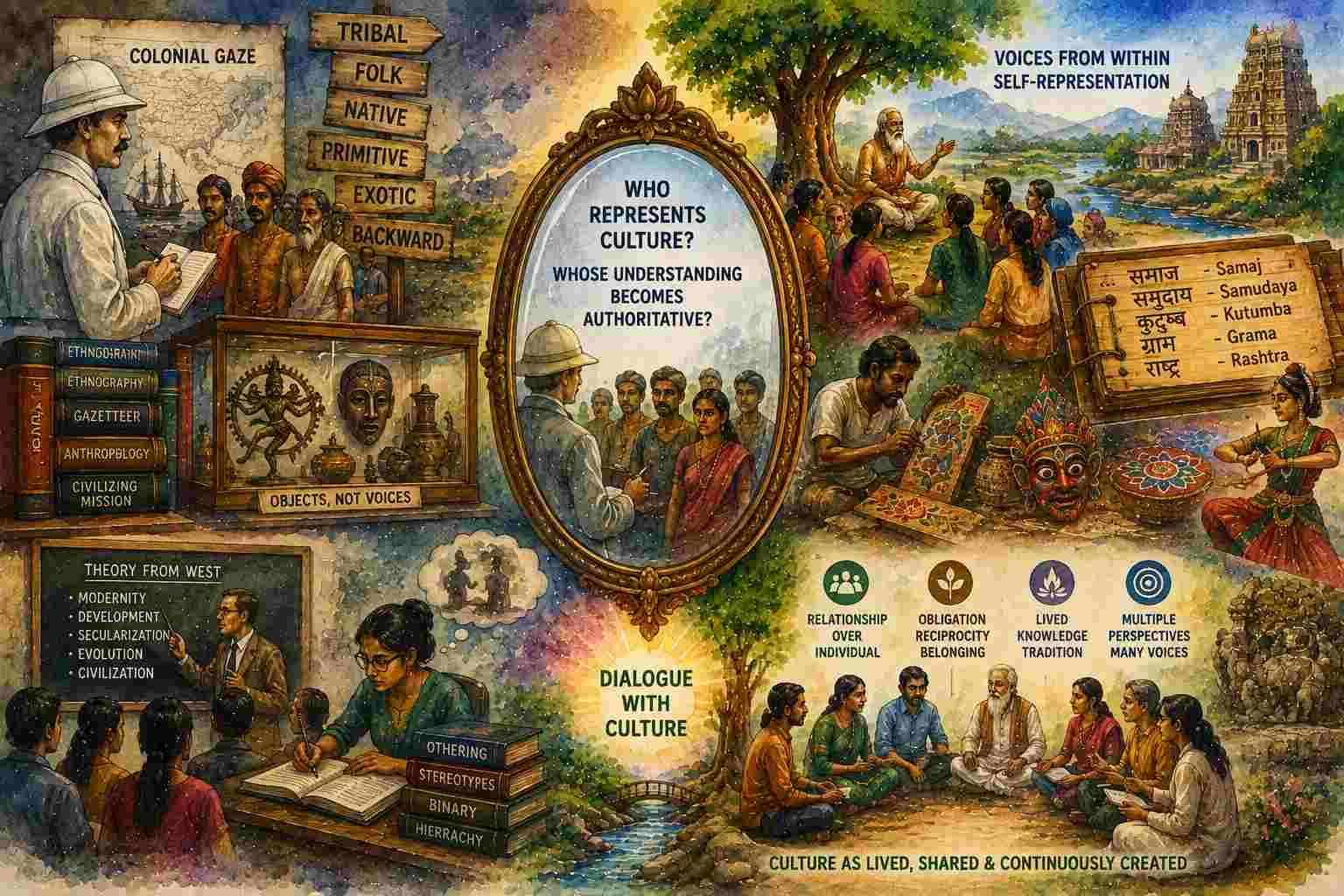
Once a community was classified as “primitive”, “tribal”, “native” or “folk”, its own conceptual explanation of itself could easily be pushed aside. A complex intellectual tradition could become “religious belief”. A social institution could become “custom”. A philosophical argument could become “myth”. An oral archive could become “folklore”.
The category then became more powerful than the people. That is precisely why representation matters.
The Problem Does Not End With Colonialism
Yet here I want to push the argument further than the conventional postcolonial critique.
If colonialism produced categories through which colonised societies became objects of knowledge, then decolonisation cannot merely mean criticising those categories. We must also ask what conceptual resources existed before the categories arrived, and whether the society itself possessed intellectual mechanisms through which it understood and represented its own social world.
This is where I find some contemporary Cultural Studies strangely incomplete.
We teach Said’s critique of Orientalism. We teach Foucault’s relationship between knowledge and power. We teach Hall on representation. We teach Spivak on the difficulty of speaking for the subaltern. But then Bharat frequently re-enters the classroom merely as the object to which these theories are applied. The theory comes from elsewhere. The case study comes from here. Europe theorises. Bharat gets interpreted. At some point, surely, we must ask whether this arrangement itself deserves examination.
Bharat Is Not Merely a Case Study
An Indic approach does not require us to reject Said, Hall, Foucault or Spivak. That would be intellectually childish. Their arguments have fundamentally altered the way scholars think about representation, discourse and knowledge.
But they should not become the final vocabulary through which every civilisation is required to understand itself. Bharat possesses enormous traditions of self-description: Itihāsa, Purāṇa, Kāvya, Smṛti, Darśana, śāstra, Sthala-purāṇa, regional chronicles, genealogical traditions, temple records, oral histories, performance traditions and paramparā. These sources are not automatically transparent or historically neutral. They contain memory, interpretation, normative claims, theological assumptions and political purposes. They must be first studied in their own right.
But what happen is that the student or scholars start critically analyzing them with modern lenses. But we need to understand that there is a world of difference between critically examining indigenous sources and treating them as intellectually inferior until translated into Western categories. That distinction is fundamental.
- If dharma is translated simply as “religion”, something disappears.
- If darśana becomes merely “philosophy”, something disappears.
- If śāstra becomes simply “text”, something disappears.
- If paramparā becomes merely “tradition”, something disappears.
- If samāja becomes merely “society”, something disappears.
Translation is unavoidable in comparative scholarship. But translation should help us cross conceptual worlds; it should not erase the world we are trying to understand.
From Representation to Self-Understanding
This is why I believe Cultural Studies must move beyond the question, “Who represents whom?” and ask another question: How does a civilisation represent itself? That is not a sentimental question. It is a methodological one. If a community possesses its own categories of memory, identity, sacred geography, social order and ethical life, those categories are themselves data. They are not merely obstacles standing between the researcher and some supposedly more objective reality. The community’s own explanation may be incomplete. It may contain contradictions. It may conceal relations of power. It may romanticise its own past. All of these possibilities must remain open to investigation. But the academic researcher is also capable of misunderstanding.
And this is the point at which I become frustrated with certain forms of cultural scholarship: the researcher is often granted methodological suspicion, while the community is granted methodological suspicion. Why should the scholar automatically be assumed to possess the more sophisticated vocabulary? Why should the community’s explanation be treated as naïve until an academic theorist interprets it? Why should the tradition be required to defend itself in a language that it did not create? These questions should disturb us.
The Problem of Naming
Representation becomes particularly powerful through naming.
- Who decided that a community was “tribal”?
- Who decided that another was “folk”?
- Who decided that a practice was “superstition” rather than a knowledge tradition?
- Who decided that one form of knowledge was “scientific” while another required the qualifying adjective “indigenous”?
- Who decided that an institution was “traditional” simply because it preceded European modernity?
These are not merely questions about vocabulary. Names organise the field within which reality becomes visible.
Colonial knowledge frequently depended upon classification, enumeration and administrative categorisation. The important point is not that every colonial category was invented from nothing. Social identities and differences certainly existed before colonial rule. The point is that colonial institutions could reorganise how those differences were recorded, administered and made legible. Cohn’s work remains important precisely because it draws attention to this relationship between knowledge and governance.
Therefore, Cultural Studies must study not only culture but also the production of knowledge about culture.
The Insider Is Not Automatically Right; the Outsider Is Not Automatically Superior
An Indic approach must also avoid creating another simplistic binary. I am not arguing that only insiders can understand a culture. That would be methodologically indefensible. Communities contain disagreement, hierarchy, memory, contestation and competing interpretations. An external researcher may sometimes identify structures or historical patterns that participants themselves do not consciously articulate. But the reverse assumption is equally indefensible: that the academic observer automatically understands a culture better than the people who inhabit it.
The answer is therefore neither insider romanticism nor outsider supremacy. It is dialogue. The researcher should bring analytical distance, while the community brings lived knowledge, memory, categories and experience. Neither perspective should be treated as automatically infallible. This is, in fact, far more intellectually demanding than simply applying a predetermined theory to a community.
The Indic Question
A genuinely decolonised Cultural Studies curriculum in Bharat should therefore add another layer to the familiar questions of representation. We should certainly ask who represents whom. But we should also ask how Bharatiya communities have represented themselves to themselves. We should ask who has the authority to speak, but also which institutions, texts, practices and paramparās have transmitted that speech across generations. We should study how colonialism represented India, but also investigate what survived those representations, what was transformed, what was appropriated, what was rejected and what was regenerated. Most importantly, Bharat should no longer enter the classroom merely as a geographical location in which Western theories happen to find empirical material.
Bharat must also be allowed to become a producer of concepts.
- Its traditions can generate questions.
- Its texts can contain arguments.
- Its communities can produce knowledge.
- Its oral traditions can function as archives.
- Its practitioners can be interlocutors rather than merely informants.
- Its categories can become analytical resources rather than objects waiting to be translated.
This does not require the disappearance of Western theory. It requires something much more reasonable: intellectual reciprocity. Said, Hall, Foucault and Spivak should remain important interlocutors. But an interlocutor is not a gatekeeper.
Who Has the Right to Explain?
This ultimately brings us back to the title of this essay.
Who represents culture? The obvious answer is: whoever writes about it. But the more important question is: who has the authority to decide what counts as an adequate representation? Who selected the categories through which culture is studied? Who wrote the textbooks? Whose concepts became universal? Whose concepts became “local”? Why is one civilisation permitted to generate theory while another is repeatedly asked to supply examples?
I do not want a Cultural Studies curriculum in which the West disappears. I want one in which the West loses its monopoly over theoretical authority.
That is a very different proposition. Decolonisation should not mean replacing Western intellectual dominance with an uncritical celebration of everything indigenous. That would merely invert the hierarchy without overcoming it. The real task is more difficult: to create a genuinely plural intellectual field in which different civilisations can produce concepts, formulate questions and challenge one another. For me, that is the real meaning of decolonising Cultural Studies. Not the removal of Western theory. Not the romanticisation of Indian tradition. But the refusal to accept that theory must always come from the West while culture must always come from somewhere else.
Until we are willing to ask that question, we have not really decolonised Cultural Studies. We have merely learned to criticise the colonial gaze in a vocabulary that the colonial gaze helped make authoritative.