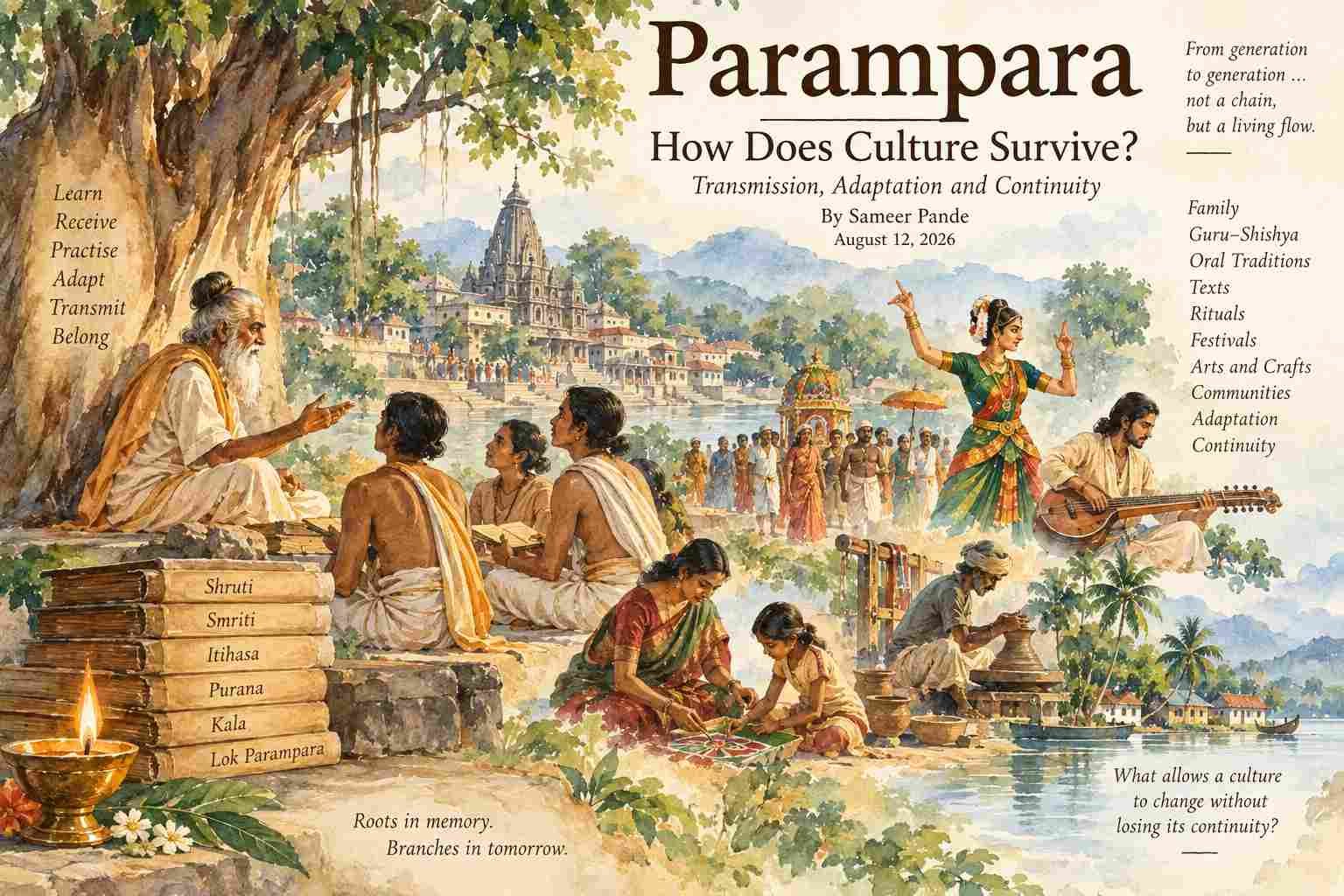
Transmission, Adaptation and Continuity
What allows a culture to survive across generations?
At first glance, the answer appears obvious: tradition. Parents teach children what they themselves learnt; teachers transmit knowledge to students; communities repeat rituals and festivals; texts are copied, recited and interpreted; crafts are taught through apprenticeship. But repetition alone cannot explain cultural continuity. A practice may be repeated for generations and yet become empty of meaning. Another practice may change considerably and nevertheless remain recognisably continuous with what came before.
This is where the Indic idea of paramparā becomes particularly interesting.
The English word “tradition” can sometimes suggest something handed down unchanged. Paramparā, by contrast, carries the sense of succession and transmission. It directs our attention not simply to what is inherited, but to the relationship between one generation and the next. A paramparā exists because something is received, understood, practised and passed onward.
Culture therefore survives not because it refuses to change, but because it develops mechanisms through which change can take place without necessarily destroying continuity.
Paramparā Is More Than Inheritance
Every generation is born into an inherited world. A child does not begin with a blank cultural slate. Language, stories, relationships, rituals, manners, memories and conceptions of right conduct already surround the child.
But inheritance by itself is insufficient. Something becomes a living tradition only when it is transmitted.
This distinction is important. A manuscript lying unread in a library is part of a cultural inheritance, but its cultural significance depends upon people who continue to read, interpret and teach it. A classical musical composition survives not merely because its notation exists, but because someone learns how to perform it. A craft survives not because an old object remains in a museum, but because knowledge of how to make such objects continues to pass between people.
Culture, therefore, requires carriers.
In the Indic world these carriers have historically been numerous: family, guru-śiṣya relationships, schools, monasteries, temples, communities, occupational groups, performance traditions and networks of pilgrimage. Textual transmission existed alongside oral transmission; formal learning existed alongside embodied practice.
This plurality of transmission is one reason cultural memory can survive political and institutional disruption.
The Family as the First Paramparā
The first site of cultural transmission is usually the family.
Much of what we call culture is never formally taught. Children learn how to address elders, how to welcome guests, how to participate in festivals, how to respond to grief, how to share food and how to conduct themselves in particular social situations simply by living among others.
This is cultural education without a textbook.
The family also transmits stories. Some are explicitly religious; others concern ancestors, local heroes, migrations, occupations, places or remembered events. Through these narratives, an individual acquires not only information about the past but a sense of relationship to it.
This is why cultural memory is not identical to historical memory. History asks, among other things, what happened. Cultural memory also asks: what does the past mean to us, and why should it continue to matter?
The Guru-Śiṣya Relationship: Knowledge as Practice
The Indic tradition also developed distinctive forms of transmission through teacher and student.
The guru-śiṣya relationship is often reduced today to a romantic image of an ancient teacher passing wisdom to a devoted disciple. Historically, however, forms of teacher-student transmission varied greatly across intellectual and occupational traditions.
Its deeper significance lies in recognising that knowledge is not always reducible to information.
A student of music must learn to listen and perform. A craftsperson must acquire technique through practice. A philosopher must learn not only doctrines but methods of reasoning. A ritual specialist must master procedures through disciplined repetition. Knowledge is therefore frequently embodied.
This is one reason traditions cannot be preserved simply by digitising their texts.
We can preserve a manuscript in perfect condition and still lose the living knowledge necessary to interpret or practise it.
Oral Tradition and the Discipline of Memory
The Indian experience offers an especially striking example in the preservation of oral knowledge.
The Vedic traditions developed highly sophisticated methods of oral transmission through which textual material was memorised and recited with extraordinary attention to linguistic and phonetic detail. Different modes of recitation created additional safeguards against alteration.
The important point is not that oral transmission means “unchanging tradition.” It is almost the opposite.
A tradition survives through disciplined repetition because repetition itself is structured by rules. Continuity is actively produced.
This helps us correct another common misunderstanding: tradition is not necessarily the absence of innovation. Sometimes innovation requires a strong structure of continuity within which innovation can be recognised.
A musician can improvise because the musician knows the grammar of the tradition. A philosopher can reinterpret an inherited idea because the philosopher knows the intellectual vocabulary in which the argument has been conducted. A ritual can acquire new meanings because its participants remain connected to an inherited form.
Continuity can therefore provide the conditions for creativity.
Repetition Is Not Continuity
This distinction deserves emphasis.
If we simply repeat an inherited practice without understanding why it exists, the practice may survive outwardly while disappearing inwardly.
Conversely, a practice may change its external form while preserving an underlying principle.
Consider a festival. Its mode of celebration may change because technology, urbanisation, migration or economic circumstances change. Yet the festival can continue to organise collective memory, relationships and a shared conception of sacred or communal time.
The continuity lies not necessarily in every external detail but in the relationship between form and meaning.
This does not mean that anything can change and still be called tradition. There must be some recognisable connection with what was transmitted before. But that connection need not be mechanical repetition.
A living paramparā therefore has both memory and adaptability.
Who Transmits, and Who Gets Left Out?
Yet we should not romanticise transmission.
Every tradition has questions of authority. Who is permitted to teach? Who is allowed to participate? Whose version of the past becomes authoritative? Which practices are preserved, and which disappear?
These questions are particularly important in the Indian context.
A history of cultural transmission cannot be written only through elite textual traditions. Dalit communities have transmitted their own memories, devotional traditions, intellectual critiques and forms of collective identity. Adivasi communities have maintained oral traditions, ecological knowledge, ritual practices and relationships with landscape outside the structures of Sanskritic textual transmission. Women have been important transmitters of household ritual, oral narrative, devotional practice, craft and regional cultural memory, even when formal institutions of learning were dominated by men.
Regional and vernacular traditions likewise cannot be treated merely as peripheral expressions of a single Sanskritic centre. Tamil, Kannada, Telugu, Bengali, Marathi, Assamese, Malayalam, Odia and numerous other linguistic traditions have generated their own literary and cultural worlds.
If paramparā means transmission, then we must ask whose transmission we are studying.
When Traditions Meet
Indian cultural history also demonstrates that transmission does not always occur within closed communities.
Traditions meet.
Ideas move through pilgrimage, trade, migration, debate, marriage, political interaction and artistic exchange. Communities borrow, adapt and reinterpret. A local practice can acquire a wider significance; a philosophical idea can enter a new linguistic world; a regional form can transform an older cultural pattern.
This makes the history of Indian culture less like a series of isolated streams and more like a network of continually interacting traditions.
Such interaction can produce both synthesis and conflict. Cultural exchange is not always harmonious. It may involve unequal power, competition over authority or the displacement of one practice by another.
Continuity therefore should not be confused with uninterrupted harmony.
What Happens When Transmission Breaks?
A culture can lose continuity in several ways.
A language may cease to be transmitted. A craft may survive only as a museum object. A ritual may continue without anyone understanding its meaning. A philosophical vocabulary may disappear even while its associated practices remain. A younger generation may become separated from the institutions and relationships through which knowledge was previously transmitted.
Modernity does not automatically cause such breaks, nor does tradition automatically prevent them. Urbanisation, migration, mass education, technology and changing economic structures can weaken older forms of transmission, but they can also create new ones.
Digital media, for example, can simultaneously flatten traditions into superficial images and make previously inaccessible manuscripts, performances and teachings available to entirely new audiences.
The question, therefore, is not whether transmission should remain exactly as it was.
The question is whether meaningful transmission remains possible.
Continuity Through Renewal
This brings us to the central paradox of paramparā.
A tradition that cannot change may eventually become incapable of speaking to the people who inherit it. But a tradition that changes so completely that no meaningful relationship with its past remains may cease to be a tradition in any substantive sense.
Continuity therefore lies somewhere between preservation and rupture.
The Indic conception of paramparā allows us to think about this relationship without assuming that tradition is simply an obstacle to change. A tradition can be questioned from within. It can be interpreted anew. It can absorb new circumstances while retaining a recognisable intellectual or cultural grammar.
This is why civilisations survive longer than particular institutions.
Institutions can disappear. Political dynasties can end. Languages can change. Cities can decline. Yet cultural patterns can survive by moving into new forms.
The survival of a culture, then, depends less upon freezing its past than upon maintaining the capacity to transmit meaning across changing circumstances.
That is perhaps the most important lesson of paramparā. We do not inherit culture merely to repeat it. We inherit it so that we can understand it, practise it, question it and eventually transmit it in a form that remains meaningful to those who come after us.
The question is therefore not simply: What have we inherited? It is also: What have we understood well enough to transmit?
And perhaps the deeper question is even more demanding: What must a generation preserve, what may it transform, and what must it create so that continuity remains alive?