What does a society remember when it does not sit down to study its history?
It remembers through festivals, stories, songs, performances, images and rituals. A child may not remember a philosophical argument, but may remember a festival celebrated every year with the family. A person may never have read an epic, yet may know its characters through theatre, song, television, painting or oral narration. A community may not possess a written archive of its history, yet may preserve its memory through dance, craft, ceremony and story.
This is why utsava, katha and kalā deserve to be taken seriously as cultural institutions. They are not merely forms of entertainment added to the “serious” business of politics, economics or education. They are among the means through which societies teach people what is beautiful, meaningful, admirable, sacred, humorous, tragic and worth remembering.
The deeper question is therefore not simply why human beings celebrate or create art. It is how cultural practices turn memory into lived experience.
Utsava: When Memory Becomes Participation
The distinctive feature of a festival is that it is not simply watched. It is participated in.
An utsava transforms time into shared experience. A particular day, season, place or event becomes culturally significant because a community repeatedly gathers around it. The calendar itself therefore becomes a carrier of memory.
Consider Navarātri in Gujarat. Garba is not merely a dance performed during a festival; it involves dancers, musicians, craftspeople, organisers and others in a participatory cultural environment. UNESCO’s documentation of Garba emphasises that its transmission occurs through practice, observation and performance across generations, in both rural and urban settings.
The same principle operates in very different cultural worlds.
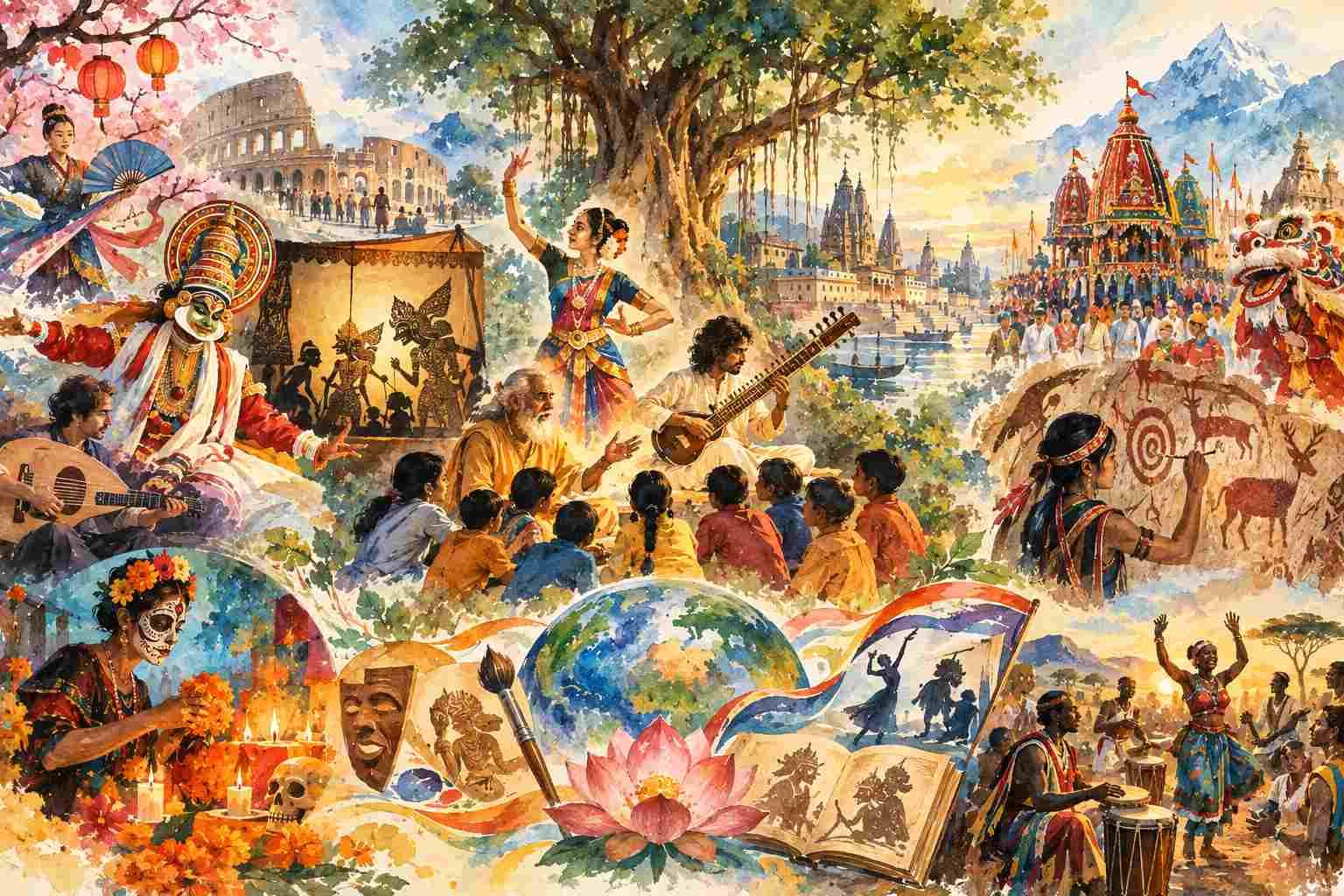
Japan’s festivals and performing traditions similarly connect ritual, seasonal time, community and artistic practice. In Mexico, the Indigenous festivity associated with Día de los Muertos connects remembrance of the dead with family ritual, food, offerings and the agricultural cycle. UNESCO describes it as a practice in which the relationship between the living and the dead reinforces social belonging and collective identity.
The forms differ radically. The cultural function is comparable: a community gives memory a recurring public form.
A festival therefore teaches without looking like a classroom.
A child learns who belongs, what is celebrated, what is sacred, which stories matter and how relationships should be enacted by participating in the festival itself. Culture is learned through the body before it is explained through concepts.
Katha: A Society Thinking Through Stories
If utsava gives culture a calendar, katha gives it a narrative.
Human beings rarely transmit values only as abstract propositions. We tell stories.
The story of a person who keeps a promise, the king who sacrifices his interests for his people, the woman who confronts injustice, the fool who exposes the arrogance of the powerful, the hero who chooses duty over comfort, or the individual who fails because of greed—all of these can communicate moral possibilities without becoming philosophical lectures.
This is why katha is more than “storytelling.” It is a mode through which communities organise experience into meaningful patterns.
The Indian epics provide perhaps the most obvious examples. The Rāmāyaṇa has never existed only as a written Sanskrit text. It has travelled through regional languages, oral traditions, recitation, theatre, painting, dance and devotional practice. Ramlila demonstrates this particularly well. UNESCO describes it as a performance tradition combining song, narration, recital and dialogue, performed during Dussehra across northern India. Its different local forms demonstrate that transmission does not require identical reproduction.
This is culturally significant. The story survives precisely because it can enter different social and artistic worlds.
The same phenomenon exists elsewhere. Indonesian wayang theatre has transmitted stories through puppetry, music, narration and performance for centuries. Its repertory draws upon indigenous stories as well as Indian epics and other narrative traditions, while local performers have continually adapted its forms. UNESCO notes that the repertory and techniques were transmitted orally within families of puppeteers, musicians and puppet-makers.
Japan’s Nō theatre provides another example. Its repertoire draws substantially on traditional literature, while its highly stylised movement, masks, music and performance conventions create a distinctive cultural language. Its history itself demonstrates adaptation: Nō developed through the assimilation of performance traditions that had entered Japan from China and were subsequently transformed within Japanese society.
The lesson is important.
A story survives not because every generation tells it identically, but because every generation finds a reason to tell it.
Kalā: Art as a Way of Knowing
This brings us to kalā.
Modern discussions often place art in the category of leisure. We work, study, govern and produce; then, when those serious activities are finished, we listen to music, watch theatre or look at paintings.
Most traditional societies did not necessarily organise human experience in this way.
Art could be embedded in ritual, education, architecture, storytelling, ceremony, work and social life. UNESCO’s account of traditional performing arts makes precisely this broader point: music, dance and theatre can be connected to marriage, funerals, rituals, initiation, agriculture, entertainment and many other dimensions of social life.
The Indic intellectual tradition gives us a particularly rich vocabulary for thinking about this relationship. The Nāṭyaśāstra does not treat performance simply as amusement. Its treatment of drama, music, dance, gesture and aesthetic experience reflects a conception in which performance can represent human action and evoke emotional states.
The important idea here is not that art merely “teaches morals.” Art can do something subtler. It can teach us how to perceive.
Music trains the ear. Dance trains attention to movement and rhythm. Painting trains the eye. Theatre allows us to inhabit perspectives other than our own. Poetry gives language to experiences that ordinary speech may leave indistinct.
Art therefore produces forms of knowledge that are not identical to scientific or propositional knowledge.
A society does not preserve itself only by telling its members what to think. It also teaches them what to notice and how to feel.
When Art and Story Become Social Institutions
This is why the distinction between “culture” and “institution” can become misleading.
We generally associate institutions with constitutions, governments, schools, courts and organisations. But a recurring cultural practice can also perform institutional functions.
A theatre tradition can preserve language and historical memory. A craft tradition can transmit technical knowledge. A song can encode a community’s relationship with landscape. A festival can organise social cooperation. A story can preserve moral vocabulary.
Consider Indigenous Australian songlines. They demonstrate perhaps one of the clearest examples of how story, song, landscape and knowledge can become inseparable. Songlines connect ancestral narratives with places, ecological knowledge and routes across the landscape; knowledge is transmitted through song, story, dance and painting.
Here, “art” is a misleadingly narrow category. Song is simultaneously memory, geography, identity and knowledge.
The same principle appears in very different forms elsewhere. Traditional Mexican cuisine, for example, is transmitted through cultivation, preparation, ritual and communal eating. UNESCO describes the Michoacán tradition as a cultural model connecting agricultural knowledge, culinary techniques, ritual practices and community identity.
- What looks like food is therefore also knowledge.
- What looks like dance may be history.
- What looks like theatre may be moral reflection.
- What looks like a festival may be collective memory.
Culture Is Learned Through Participation
This may be the most important insight.
We often imagine education as the transmission of information from teacher to student. But culture is learned through participation.
A child who joins a festival learns the social grammar of celebration. A young musician learns not merely notes but a tradition of listening. An apprentice learns not merely a technique but standards of excellence. A storyteller learns which stories matter and how they should be told.
UNESCO’s broader work on intangible cultural heritage repeatedly emphasises that oral traditions and performing arts transmit knowledge, values and collective memory, while their survival depends upon an active chain of transmission.
This also explains why cultural preservation cannot mean simply putting objects into museums or digitising texts.
A museum can preserve an instrument. It cannot by itself preserve the community that knows how to use it. An archive can preserve a manuscript. It cannot automatically preserve the tradition of interpretation surrounding it. A recording can preserve a performance. It cannot reproduce the social world that made the performance meaningful.
Culture survives when people continue to practise it.
But Culture Also Changes
There is an important qualification.
Continuity does not mean immobility.
Japanese Nō adapted earlier performance traditions. Indonesian wayang incorporated multiple narrative sources. Mexican Day of the Dead contains an identifiable interaction between Indigenous practices and Catholic traditions introduced after European conquest.
Indian cultural traditions demonstrate the same principle repeatedly. The Rāmāyaṇa exists in multiple linguistic, regional and performative forms. Garba has moved from local settings into contemporary urban and global contexts while retaining recognisable connections with its ritual and musical traditions.
Adaptation, therefore, should not automatically be understood as cultural decline.
Sometimes adaptation is precisely how continuity survives.
The real danger is not change. It is the loss of the ability to transmit meaning.
A performance may become commercially packaged. A festival may become primarily a spectacle. A story may survive only as a simplified entertainment product. UNESCO itself notes that tourism and standardisation can sometimes weaken the community context of traditional performing arts.
The question is consequently not whether a cultural form has changed.
It is whether the cultural knowledge embedded within it is still being transmitted.
The Cultural Life of Meaning
This brings utsava, katha and kalā together. Utsava gives collective life a rhythm. Katha gives experience a narrative. Kalā gives perception an aesthetic and embodied form. Together they create something that formal education alone cannot easily produce: a shared world of meanings.
A civilisation survives partly because people continue to know its stories, celebrate its seasons, sing its songs, perform its dramas, practise its crafts and recognise its symbols. None of these practices is merely decorative. They are among the ways in which a society remembers what it considers important.
But this should not become an argument for freezing culture in an imagined golden past. Every living tradition has changed. Communities borrow, reinterpret and create. Some practices disappear because people no longer find them meaningful; others survive because successive generations discover new reasons to carry them forward.
That is why the cultural question is ultimately not, “How do we preserve everything?” No society can.
The deeper question is: What must remain meaningful enough to be transmitted? A culture survives when its people do more than remember the past. They continue to find reasons to celebrate it, narrate it and recreate it. That is the cultural life of meaning: the moment when memory becomes participation, participation becomes experience, and experience becomes something one generation can hand to the next.