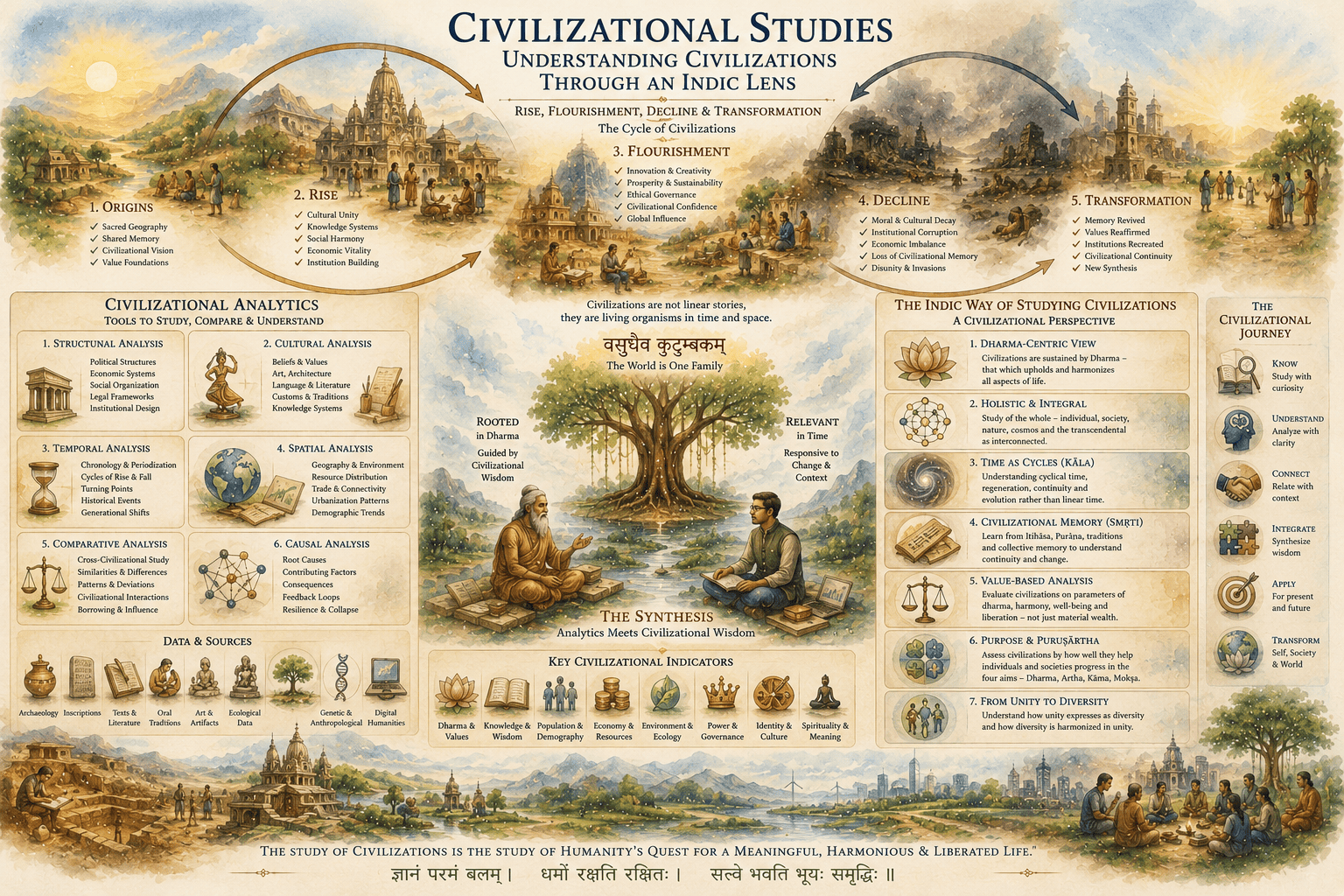
How Should We Study a Civilization?
When you enter the Civilizational Studies section, you will find that we are asking a question that is slightly different from the usual question asked in the study of history. We are not interested only in knowing what happened to a civilization. We also want to understand how a civilization works, how it changes, and how it understands itself.
That is why we have organised this section into three parts:
- Civilizational Analytics
- Rise and Fall of Civilizations
- Civilizational Dṛṣṭi
You can read these separately, but they are meant to speak to one another. Together, they give us three different ways of looking at civilization.
1. Civilizational Analytics — Looking at the Structure
Let us begin with a simple question. When we look at a civilization, what should we actually look at? It is easy to notice kings, armies, monuments, cities, temples, literature or economic achievements. These are visible and therefore they often become the centre of historical narratives. But underneath all of this is a much larger network of relationships.
How are families organised? How are communities formed? How is property held? How do people earn their livelihood? How are occupations organised? How are resources managed? How does knowledge move from one generation to another? What happens to people when they migrate? How are conflicts resolved? How are local institutions connected with larger political structures? What happens to common resources? How does economic life interact with social and cultural life?
These are the kinds of questions we explore under Civilizational Analytics. Here, we try to look at the internal architecture of a civilization. The intention is not to reduce every civilization to a fixed set of indicators. Rather, we want to develop ways of identifying and examining the relationships that allow a civilization to function. Population, family, property, occupation, cultural capital, economic flows, institutions, power, mobility, conflict, public goods and commons are some of the areas through which we can begin this analysis.
This approach also asks us to move beyond broad statements such as “this civilization was prosperous” or “that civilization was decentralised.” Instead, we ask: What made it so? What evidence can we examine? What institutions produced these outcomes? And did these arrangements remain the same across time?
In other words, Civilizational Analytics gives us the tools to look inside a civilization.
2. Rise and Fall of Civilizations — Looking at Change
Once we understand something about how a civilization is organised, another question naturally follows: What happens to it over time? Civilizations rise, expand, flourish, face crises, adapt, decline and sometimes disappear. But these processes are rarely as simple as the words “rise” and “fall” suggest.
What does it actually mean for a civilization to decline? Does the collapse of a political system mean the civilization itself has disappeared? What happens when an economy weakens but its language survives? What happens when political institutions change but cultural memory continues? What happens when a society faces demographic, ecological, technological or military pressures?
And perhaps an even more interesting question is this: Why do some civilizations adapt to major changes while others fail to do so?
The Rise and Fall of Civilizations section is where we explore these questions. Here we are interested in the conditions that contribute to civilizational flourishing and the pressures that can weaken those conditions. Demography, economy, ecology, political institutions, technology, warfare, social cohesion, intellectual life, cultural transmission and external pressures can all become part of the analysis.
But we are not looking for a simple formula which says that every civilization follows the same cycle. Civilizations are historical, and therefore they are complicated. Sometimes what appears to be decline is actually transformation. Sometimes political collapse does not mean civilizational disappearance. Sometimes a civilization survives precisely because it is capable of changing.
This is why we are interested not only in rise and fall, but in the relationship between continuity and transformation.
The important question is not always, “Did the civilization survive unchanged?” It is often more useful to ask: What changed? What continued? What disappeared? What was renewed? And what allowed continuity to survive through change?
3. Civilizational Dṛṣṭi — Looking from Within
The third part takes us to a different level.
Suppose we have studied the institutions of a civilization and examined its historical rise and decline. We still have not answered one fundamental question: How did that civilization understand the world in which it lived?
This is where we use the term Civilizational Dṛṣṭi. Dṛṣṭi means a way of seeing. We are interested here in the categories through which a civilization understands life, society, nature, knowledge, human relationships, duty, prosperity, authority and the purpose of existence.
This is particularly important when studying Bharat. Indian traditions developed their own vocabulary for thinking about these questions. Concepts such as dharma, artha, kāma, mokṣa, ṛta, yajña, svādhyāya, samāja and paramparā belong to a long intellectual history. They cannot always be understood adequately by simply finding an English word that appears to be their equivalent.
So in this part of the website, we want to ask: How did the civilization itself understand these things? What did it mean by dharma? How did it understand the relationship between the individual and the community? What did it consider a meaningful life? How did it understand knowledge? What kind of relationship did it imagine between human beings and the earth? How were responsibilities understood and transmitted? How did it think about social order and collective life? These questions take us into texts, philosophical traditions, literature, practices, institutions, art, memory and lived experience.
The purpose is not to assume that everything found in the tradition is automatically correct or desirable. Nor is it to treat the Indic tradition as one completely uniform system. The purpose is first to understand the categories on their own terms. Only after that can we compare them meaningfully with concepts developed in other intellectual traditions.
Why Three Parts?
You may reasonably ask: Why not simply put all of this under one heading called Civilizational Studies? Because each approach reveals something different. If we study only the ideas of a civilization, we may understand its worldview but know very little about how its institutions actually functioned. If we study only its institutions and social structures, we may understand how society was organised without understanding the ideas and values that gave those structures meaning. And if we study only its rise and decline, we may understand historical change without understanding the structures and ideas that shaped the civilization in the first place.
This is why we have kept the three together.
- Civilizational Analytics helps us look at structure.
- Rise and Fall helps us look at historical change.
- Civilizational Dṛṣṭi helps us look at meaning and worldview.
The three perspectives meet when we ask how a civilization thinks, organises, survives, adapts and changes across generations.
Why Is This Especially Important for Bharat?
There is another reason we have created this section in this way.
When India is studied academically, it is often divided among different disciplines. Ancient history studies one period. Political history studies another. Sociology studies social groups. Economics studies production and exchange. Anthropology studies communities. Religious studies examines beliefs and practices.
All of these approaches are useful. But somewhere between them, the larger civilizational picture can become difficult to see. What happens when we bring these things back into conversation? What happens when we ask how ideas influenced institutions, how institutions transmitted ideas, how economic life affected communities, how political change affected cultural memory, and how all of these interacted with the landscape and the people living in it?
That is the space we are calling Civilizational Studies. It allows us to step back from the individual discipline for a moment and ask about the larger pattern.
How Should You Read This Section?
There is no single correct starting point.
- If you are interested in understanding the internal organisation of civilizations, begin with Civilizational Analytics.
- If your interest is in why civilizations flourish, weaken, transform or disappear, begin with Rise and Fall of Civilizations.
- If you want to understand the ideas and categories through which a civilization understands itself, begin with Civilizational Dṛṣṭi.
But as you move through the section, you will see that the three continually come back to one another. An idea can shape an institution. An institution can preserve an idea. An economic or ecological change can challenge both. A civilization may respond by adapting, reforming or abandoning something. And what survives may not look exactly as it did before.
This is where Civilizational Studies becomes interesting. We are not simply collecting information about civilizations. We are trying to understand the relationships between ideas, institutions, people, resources, memory and change. And in doing so, we also want to ask a larger question about the study of Bharat:
Can we understand a civilization more fully when we allow it to be studied not only through categories developed outside it, but also through the categories through which it understood itself?
That is the conversation we want to have with you throughout this section.
You will find historical studies, conceptual explorations, analytical tools and comparative discussions here. Some will raise questions about how civilizations flourish; others will examine why they weaken. Some will look at institutions and patterns, while others will take us into the intellectual world of the civilization itself.
We do not expect every article to provide a final answer. The intention is to make you look again. Perhaps at a familiar historical event from a different angle. Perhaps at an institution that you had never considered important. Perhaps at an old Indic concept and wonder whether it can help us ask a new question today. That, for us, is the purpose of Civilizational Studies. To understand not only what civilizations were, but how they worked, how they changed, how they understood themselves, and what allowed them to continue across generations. And once we begin asking those questions, we may also begin to understand Bharat in a way that the usual categories of history and social science do not always allow us to see.