“The ideas are drawn from Hindu cultural categories… because they illuminate variations which escape the notice of conventional social science.”
— McKim Marriott, India Through Hindu Categories (1990)
Why Are We Doing This?
When we study Indian society today, we often begin with theories and categories that have already been developed elsewhere. We ask how Marx, Weber, Durkheim, Foucault, Bourdieu, or contemporary social science can help us understand caste, family, community, economy, politics, culture or social change in India. There is certainly value in doing this. No serious intellectual project should isolate itself from the wider world of scholarship. But there is a question that we do not ask often enough: What concepts can emerge from India itself?
This is not a rhetorical question. It is the starting point of the Indic Cultural and Social Studies Frameworks.
The concern behind this project is quite simple. If we always begin with concepts developed in other historical and civilizational settings, we may become very good at applying theories without asking whether those theories allow us to see the whole of Indian social reality. We may end up fitting Indian experiences into categories that were never developed with those experiences in mind. McKim Marriott’s observation is important precisely because it points to a possibility that is easy to overlook: Indic categories may help us see variations that conventional social science misses.
That possibility deserves to be explored seriously.
What Do We Mean by a Framework?
We use the word framework very deliberately.
A framework is not a finished theory. It is not a rigid model that claims to explain Indian society once and for all. It is certainly not a collection of Sanskrit terms presented as an alternative to modern scholarship. A framework is a way of looking at a problem. It helps us decide what we should pay attention to, what relationships we should examine, what questions we should ask and, equally importantly, what may remain invisible if we approach the same problem through another conceptual lens.
This is why changing the framework can sometimes change the research question itself.
Suppose we begin with the assumption that society is fundamentally made up of autonomous individuals. We will naturally give considerable attention to individual choice, rights, interests and institutions that regulate those individuals. But if we begin instead with relationships between the pinda, kutumba, samāja, institutions, grāma, rāṣṭra and the larger order within which these exist, we may notice a different structure of social life. The purpose is not to decide in advance which description is correct. The purpose is to make the second way of seeing available for serious inquiry.
That is what a framework allows us to do.
Why Indic Categories?
Every civilization develops its own vocabulary for making sense of human life. Those words are often connected to deeper assumptions about relationships, responsibility, authority, knowledge, economy, social order and the purpose of life. In the Indian context, categories such as dharma, artha, kāma, mokṣa, yajña, ṛṇa, āśrama, varṇa, samāja, lokācāra, paramparā and śāstra emerged within long traditions of intellectual debate and social practice. We do not assume that these categories should simply be transferred into contemporary social science unchanged. Nor do we assume that everything associated with the Indian past should be defended.
The first task is to understand them properly.
What did these categories mean in their own contexts? What kinds of relationships did they describe? What assumptions about human beings and society were embedded within them? Did different traditions understand them differently? And can any of these ideas help us understand contemporary social phenomena? These are the questions that make the project a social-scientific exercise rather than merely an exercise in cultural recovery.
There is also a methodological issue here. When dharma is translated simply as “religion,” darśana as “philosophy,” śāstra as “text,” paramparā as “tradition,” samāja as “society” and artha as “economics” or “wealth,” we may make these concepts easier to communicate to a modern reader. But we can also unintentionally replace the original conceptual world with our own.
Translation is necessary. Reduction is not. The frameworks therefore ask us to pause before translation and investigate what the original categories actually allow us to see.
We Are Not Trying to Reject Western Social Science
This point needs to be made clearly because the project can otherwise be misunderstood. We are not arguing that Western social science should be discarded. There is no intellectual merit in replacing one monopoly with another. The question is about intellectual balance and conceptual plurality.
Yes, we have in our mind that the Indian education should be overall Indian in the sens that the whole setup can be what India used to have, the Gurukula. But, now with ‘newer’ times and newer setup, the academia has already been encroached in our way of thinking. Already, the western ideas and institutions have generated a whole setup and, in this setup, Western social studies including humanities, has developed methods and theories for understanding society which are already in use. We should study them, use them, criticize them and if they are good learn from them. But we should also have the confidence to ask whether they are the only legitimate sources of concepts for studying Indian society.
Why should the movement of knowledge be permanently one-directional? Why should theories travel to India while India mainly supplies cases, data and examples? If a concept emerging from an Indic intellectual tradition helps us understand a social relationship more effectively, then it deserves to enter scholarly discussion on that basis. Not because it is Indian, but because it is analytically useful.
That is the standard we should apply.
From Civilizational Categories to Social Inquiry
The frameworks developed here are an attempt to bring three things into conversation: Indic categories, India’s civilizational experience, and contemporary social-scientific inquiry. This combination is important.
If we study Indic ideas only as historical artefacts, they remain confined to the history of ideas. If we use them without empirical investigation, they become philosophical assertions. And if we ignore their civilizational context, we risk turning them into superficial equivalents of concepts that already exist elsewhere. The real work begins when these categories are taken into research. Can a framework help us formulate a better questionnaire? Can it change what we look for during fieldwork? Can it help explain behaviour that existing categories describe poorly? Can it generate hypotheses? Can it be used comparatively? Can another researcher challenge it with evidence? These are the questions that will determine whether a framework has genuine scholarly value.
The Ten Indic Frameworks to study society
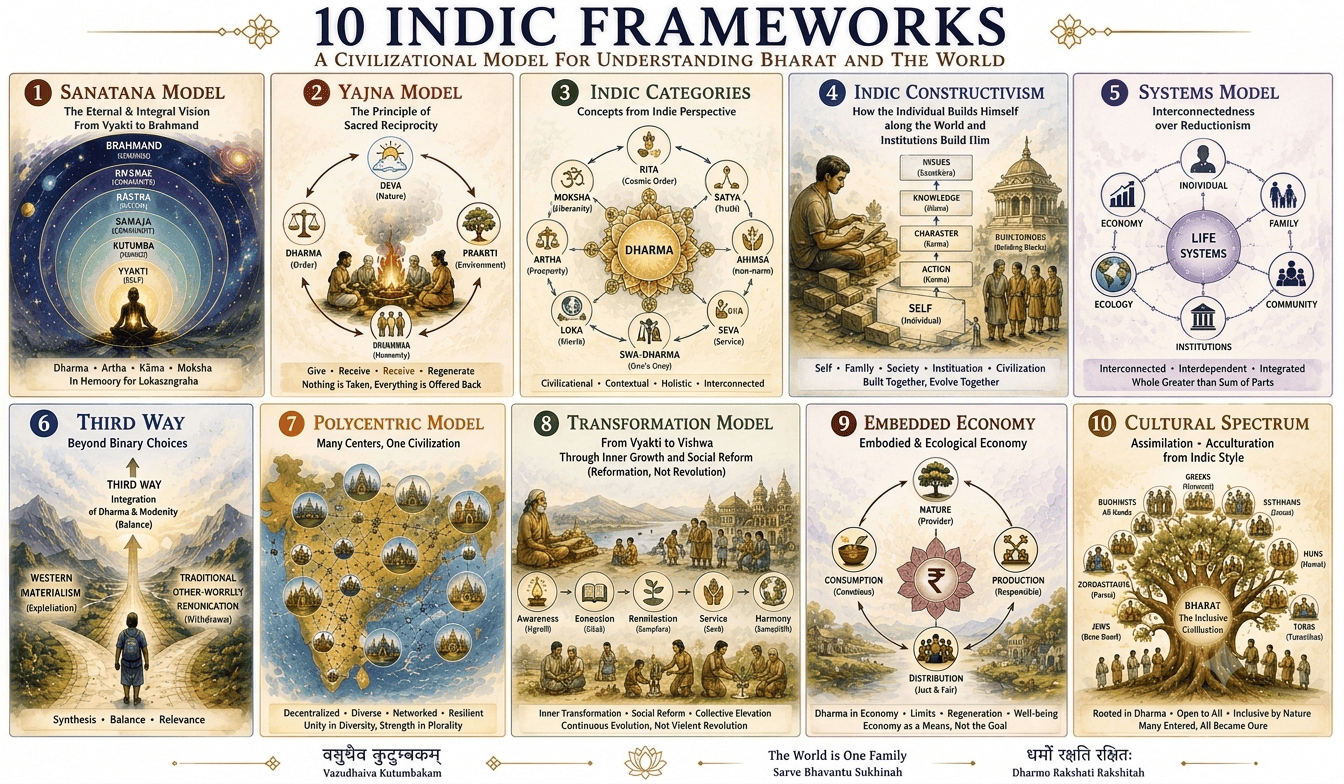
The present collection includes ten frameworks, each addressing a different aspect of social and cultural life:
1. Sanātana Model of Society
2. Yajña Model of Social Harmony
3. Indic Social Categories
4. Indic Constructivism and Navigation of the Individual through Society
5. Systems Model of Society
6. The Third Way Beyond the Binaries
7. Polycentricism, Decentralized Autonomy and Local Resource Systems
8. Holistic Transformation over Revolution
9. Indic Concept of Embedded Economy
10. A Cultural Spectrum: Assimilation, Appropriation and Alienation — the Panchamrutam Model
These ten frameworks should not be read as a completed system. They are better understood as working propositions. Some will develop further. Some will change. Some may be challenged. Others may lead to questions that we have not yet considered. That is exactly how we expect intellectual work to proceed.
What Do We Hope Will Come Out of This?
The immediate purpose is to provide researchers and students with alternative conceptual tools. But the larger purpose is much more ambitious. We want to see whether Indian social realities can contribute to the making of social theory itself. That requires a change in academic imagination. India should not be studied only as a place where existing theories are tested. Indian society can also become a place from which questions, concepts and analytical frameworks emerge.
This does not mean that every Indian concept will become a theory. Most will not. Some will prove historically specific. Some will require substantial reinterpretation. Some may not withstand empirical scrutiny. That is perfectly acceptable. The important thing is that they are given the opportunity to enter the conversation.
If they prove useful, they can travel beyond India. A genuinely productive concept does not remain “Indian” simply because it originated in India. It becomes part of social science because it helps us understand something about human society. This is where the project can eventually become comparative and genuinely global.
An Invitation to Researchers
These frameworks have emerged through sustained intellectual discussions and exchanges involving Dr. Ritendra Sharma, Dr. Sameer Pande and Aravindan Neelakandan. They are part of an ongoing effort to develop a vocabulary through which Indian social and cultural realities can be studied without assuming that the conceptual work has already been completed somewhere else.
We do not expect readers to accept these frameworks simply because they are described as Indic. In fact, we would prefer that they are questioned. Test them against history. Take them into the field. Compare them with existing theories. Find their limitations. Identify where they work and where they do not. Modify them. Extend them. Reject them if the evidence demands it. That is how frameworks become scholarship.
Beginning a Different Conversation
Ultimately, this project is asking something quite modest, but also quite consequential.
- Can Indian social realities generate theory?
- Can civilizational categories become analytical tools?
- Can we study society without assuming that one civilization’s historical experience provides the universal template for everyone else?
We do not claim to have answered these questions. We are trying to create the intellectual conditions in which they can be asked seriously. The objective is therefore not to construct an “Indic social science” that stands apart from the rest of the discipline. It is to widen the discipline itself—to allow Indic categories to enter the same space of comparison, criticism, testing and refinement that other intellectual traditions already occupy.
If this work succeeds, the outcome will not simply be a list of new frameworks. It will be a different relationship between civilization and social studies. Bharat will no longer appear only at the end of the research process, as a case to which someone else’s theory is applied. It can enter at the beginning, as a source of questions and concepts, and remain in conversation with other intellectual traditions throughout the process. That is what we are attempting with these frameworks.
Not to close the conversation, but to make the conversation larger.