Wealth Within a Larger Purpose
When we speak of artha today, the first translation that usually comes to mind is “wealth”, and the second is perhaps “economics”. Both translations are useful, but neither captures the full semantic range of the Sanskrit concept. Artha can refer to wealth, material resources, livelihood, property, economic interest, political power, advantage, purpose and, in particular contexts, the material basis through which human life and social institutions are sustained. The classical Indian discussion of artha therefore cannot be reduced to a discussion of money or private accumulation.
The more important question is what kind of place material prosperity occupies within the larger conception of human life developed in the Indian tradition. The puruṣārtha framework does not treat the human being merely as an economic actor. Human life has several legitimate aims, among which dharma, artha and kāma are closely related, while mokṣa represents a different and ultimately transcendent orientation. The fact that artha is recognised as a puruṣārtha is itself significant. Material well-being is not excluded from the good life. The question is instead how it is acquired, preserved, enjoyed and employed.
The Dharmashāstra tradition is particularly valuable here because it does not discuss wealth in abstraction. It places questions of livelihood, property, inheritance, debt, taxation, occupation, expenditure, gifts, household obligations and political economy within a normative framework. The result is neither a rejection of wealth nor an unrestricted celebration of accumulation. It is an attempt to situate economic activity within an ordered conception of life.
Artha as a Puruṣārtha
The recognition of artha as one of the legitimate aims of human life is already a decisive departure from the assumption that Indian thought regarded material prosperity as inherently opposed to spirituality. The classical tradition did not ask the householder to become economically incapable in the name of religion. On the contrary, the gṛhastha was expected to maintain a household, discharge obligations towards dependants, honour guests, support religious activity and participate in the wider social order. All of these activities required material resources.
The Mahābhārata repeatedly discusses dharma, artha and kāma together. In one particularly important passage, Bhīma argues that a life deprived of these legitimate objectives cannot simply be regarded as superior because it has withdrawn from worldly activity. The discussion then develops into a systematic reflection on the relationship between the three aims. The text warns against the person who pursues one of them excessively while neglecting the others:
अर्थार्थी पुरुषो राजन् बृहन्तं धर्ममृच्छति ।
अर्थमृच्छति कामार्थी न कामादन्यमृच्छति ॥
The passage goes on to distinguish the person who seeks wealth from the person who pursues pleasure without regard for the other aims. The larger discussion culminates in the observation that the wise person should not become exclusively devoted to dharma, artha or kāma, but should understand their appropriate place and timing. (Mahābhārata 3.34.31–41).
This is important because it prevents us from interpreting puruṣārtha as a competition between mutually exclusive goals. The householder’s economic activity is not necessarily a fall from the spiritual ideal. It becomes problematic when the pursuit of material gain is detached from the normative conditions within which it is supposed to operate.
What Does Artha Actually Mean?
Kauṭilya provides one of the most important technical definitions of artha in the Indian tradition:
मनुष्याणां वृत्तिरर्थः ।
मनुष्यवती भूमिरित्यर्थः ॥
“Livelihood of human beings is artha; inhabited territory is artha.”
He then explains the subject of the Arthaśāstra in terms of the acquisition and protection of the earth:
पृथिव्याः लाभे पालने च यावन्त्यर्थशास्त्राणि पूर्वाचार्याः प्रस्ताविताः…
The opening of the Arthaśāstra consequently places economic and political life within the larger question of securing and governing inhabited territory. The text subsequently deals with agriculture, trade, taxation, mines, forests, weights and measures, markets, wages, state revenue, storage, irrigation, occupations and numerous other institutional dimensions of economic life.
This definition deserves much more attention than it usually receives. If artha means vṛtti, livelihood, then the subject is not simply wealth possessed by an individual. It includes the means by which human beings sustain themselves. And when the definition expands from livelihood to manuṣyavatī bhūmi, inhabited territory, the concept acquires a social and political dimension.
The economy is therefore not imagined merely as a collection of private transactions. It is embedded in the material organisation of society.
Why Dharma and Artha Cannot Be Completely Separated
The strongest statement of the relationship between dharma and artha occurs in the Mahābhārata:
सर्वथा धर्ममूलोऽर्थो धर्मश्चार्थपरिग्रहः ।
इतरेतरयोनी तौ विद्धि मेघोदधी यथा ॥
“Artha is in every way rooted in dharma, and dharma is connected with the acquisition of artha. Know the two to be mutually originating, like the cloud and the ocean.” (Mahābhārata 3.34.29).
The metaphor of the cloud and ocean is unusually suggestive. The text does not imagine dharma and artha as two sealed compartments. Material prosperity provides the means through which many social and religious obligations can be performed, while dharma determines the normative conditions within which economic activity becomes legitimate.
This explains why the Dharmashāstra tradition can simultaneously recognise the importance of wealth and impose restrictions upon its acquisition. If wealth were considered intrinsically wrong, there would be no need for such a detailed jurisprudence concerning property, inheritance, debts, contracts, wages and legitimate livelihood. The very existence of these discussions demonstrates that economic activity was regarded as an ordinary and necessary part of social life.
The question was not whether wealth should exist. The question was what constituted legitimate wealth.
The Means of Acquisition Matter
This becomes particularly clear in Manu’s discussion of livelihood. Manu advises:
यात्रामात्रप्रसिद्ध्यर्थं स्वैः कर्मभिरगरहितैः ।
अक्लेशेन शरीरस्य कुर्याद्धनसञ्चयम् ॥
A person should accumulate wealth for the maintenance of life through occupations that are not blameworthy and without unnecessarily afflicting the body. (Manusmṛti 4.3).
The significance of agarhitaiḥ karmabhiḥ should not be overlooked. Manu is not merely recommending economic productivity. He is placing a condition upon economic productivity: the occupation through which wealth is obtained must not be reprehensible.
This introduces an important distinction between the quantity of wealth and the legitimacy of wealth. A society concerned only with accumulation can ask how much wealth has been generated. A Dharmashāstric analysis asks an additional question: by what means was it generated?
The distinction is particularly relevant to the contemporary discussion of economic ethics. The Dharmashāstra position does not permit the argument that a desirable economic outcome automatically legitimises every method used to achieve it. Economic action remains subject to dharma.
The Gṛhastha and the Material Foundation of Social Life
The importance of artha becomes even clearer when we examine the institution of the gṛhastha. The householder occupies a distinctive place in the āśrama system because household life requires continuous economic activity. Food must be produced, dependants must be maintained, guests must be received, children must be educated and various obligations towards gods, ancestors, teachers and society must be fulfilled.
This is why the Indian tradition does not treat household prosperity as an embarrassment. The problem is not that the householder possesses resources. The problem arises when possession becomes detached from responsibility.
The Manusmṛti repeatedly deals with the management of household resources, inheritance, division of property, legitimate occupation, debts and obligations. The Yājñavalkya Smṛti develops these subjects further, and later commentators such as Vijñāneśvara devote considerable attention to the legal and economic implications of these rules.
Economic life is therefore institutionally located within the household. The household is not merely a consumption unit. It is a site of production, reproduction, obligation, inheritance and transmission.
The modern separation between “economics” and “family” can therefore obscure an important feature of the classical Indian conception: economic life was embedded in relationships.
Saṃgraha and Vyaya: Accumulation and Expenditure
One of the more interesting features of the Dharmashāstric treatment of wealth is that it does not discuss only acquisition. It is equally concerned with the appropriate management and expenditure of resources.
The household must know both saṃgraha and vyaya, accumulation and expenditure. The Manusmṛti discusses the management of wealth in precisely this context, recognising that economic competence involves not merely obtaining resources but regulating their use.
This is important because accumulation by itself does not constitute economic wisdom. Resources have to be allocated across different obligations and needs. The householder must distinguish between necessary expenditure, productive expenditure, religious expenditure, social obligations and personal enjoyment.
The point is not to impose an artificial modern accounting framework upon the Dharmashāstra. Rather, the texts themselves show that economic prudence involved an awareness of the temporal life of wealth. Wealth is acquired, preserved, transferred, spent, inherited and sometimes lost. It is therefore a form of responsibility rather than merely a static possession.
Artha, Dāna and the Circulation of Wealth
The institution of dāna adds another dimension to the discussion. It would be misleading to translate dāna simply as “charity”, because its place in the Indian tradition is much wider. It is connected with ritual obligation, social relationships, merit, hospitality, patronage and the movement of resources from one person or institution to another.
The importance of giving presupposes possession. One cannot give what one does not possess. This means that the Dharmashāstric emphasis on dāna cannot be interpreted as a rejection of wealth. It assumes that legitimate wealth can and should become socially productive.
This helps explain the wider Indian conception of prosperity. Wealth becomes meaningful when it sustains relationships and institutions beyond the individual possessor. The wealthy householder is therefore not imagined as a person whose responsibility ends with private consumption.
The economic question becomes connected with the question of obligation: what does possession require of the possessor?
Artha and the Social Order
The economic order in the classical Indian tradition is consequently embedded in the larger social order. The Dharmasūtras and Smṛtis discuss occupations, property, inheritance, debt, contracts, wages, commercial transactions and disputes because economic relationships inevitably generate questions of justice and obligation.
Kauṭilya develops this institutional dimension even more extensively. The Arthaśāstra contains separate administrative arrangements for agriculture, commerce, weights and measures, customs, mines, forests, warehouses, animal husbandry, shipping, labour and numerous specialised offices. Its opening structure itself lists subjects such as the establishment of settlements, revenue collection, accounting, mines, markets, warehouses, weights and measures, customs and agricultural administration.
This makes the Arthaśāstra particularly important for understanding the Indian conception of economic life. Economic prosperity is not expected to arise merely from individual desire. It requires institutions capable of maintaining order, protecting productive activity, regulating transactions and preserving public resources.
The economy therefore has an institutional architecture.
The King and the Material Welfare of the Prajā
The relationship between artha and governance becomes particularly explicit in the political literature. Kauṭilya’s concern is not merely with the treasury as an instrument of royal power. The productive capacity of the janapada is itself central to the stability of the state.
This is why the famous principle occurs:
प्रजासुखे सुखं राज्ञः प्रजानां च हिते हितम् ।
“The happiness of the king lies in the happiness of his subjects, and his welfare in their welfare.”
The statement belongs to a political context rather than a modern theory of welfare economics. Nevertheless, it makes clear that the material condition of the population is treated as a matter of legitimate state concern. Kauṭilya’s extensive treatment of agriculture, taxation, trade, public works and economic administration reinforces this point.
The king’s treasury therefore cannot be understood independently of the productive base from which revenue arises. A state that destroys the productive capacity of its population eventually undermines its own material foundation.
The political economy of the Arthaśāstra is consequently deeply concerned with the relationship between production, protection and revenue.
The Danger of Making Artha an Absolute
The recognition of wealth as legitimate does not mean that the tradition treats unlimited acquisition as legitimate. The Mahābhārata is particularly explicit about the danger of making artha the sole object of life. It states that the person who pursues wealth excessively while neglecting the other aims becomes deficient in the very purposes for which wealth is supposed to be acquired. The text says:
अतिवेलं ह्यर्थार्थी नेतरावनुतिष्ठति ।
स वध्यः सर्वभूतानां ब्रह्महेव जुगुप्सितः ॥
The discussion immediately proceeds to the consequences of pursuing kāma while neglecting dharma and artha, describing the eventual destruction of relationships and material foundations. (Mahābhārata 3.34.25–28).
The underlying argument is not that wealth is evil. It is that wealth becomes self-defeating when it is treated as an absolute end. The person who acquires wealth for the sake of maintaining life, family, obligation and legitimate enjoyment is operating within one framework; the person for whom accumulation itself becomes the sole measure of success is operating within another.
The distinction between artha and lobha becomes important here. The former is a legitimate objective of life; the latter describes a disordered desire for acquisition. The Dharmashāstra tradition therefore requires us to distinguish between possession and attachment, prosperity and greed, economic capacity and the psychological condition in which economic capacity is converted into an unlimited appetite.
Kāma and the Question of Consumption
The same reasoning applies to kāma. The classical tradition does not deny legitimate enjoyment. The householder is not expected to become indifferent to food, family, beauty, comfort or pleasure. But enjoyment depends upon material resources and therefore cannot be separated entirely from artha.
The Mahābhārata explains kāma in connection with the pleasure arising from contact with objects and the corresponding mental disposition. (Mahābhārata 3.34.30).
This provides another reason why artha cannot be reduced to accumulation. Wealth is also a medium through which legitimate forms of household life and enjoyment become possible. Yet the text simultaneously warns that pleasure pursued without regard to the other dimensions of life can become destructive.
The mature economic question is therefore not simply how much one can consume, but what forms of consumption are compatible with the larger purposes of household and social life.
Yājñavalkya and the Proper Ordering of Life
The Yājñavalkya Smṛti offers a useful formulation of this broader approach. It instructs the individual to consider his own welfare and not neglect dharma, artha and kāma according to time and capacity:
धर्मार्थकामान् स्वे काले यथाशक्ति न हापयेत् ।
The significance of yathāśakti, “according to one’s capacity”, is worth noting. The Smṛti tradition does not assume that every individual possesses identical resources or identical obligations. Economic conduct must be understood in relation to one’s circumstances, stage of life and duties.
This is one reason the Dharmashāstra corpus cannot be read as a single economic code applicable identically to every person. It is a jurisprudential tradition in which deśa, kāla, āśrama, varṇa, ācāra, capacity and circumstance repeatedly enter into the determination of appropriate conduct.
The economic life of a person is therefore contextual.
From Household Economy to Political Economy
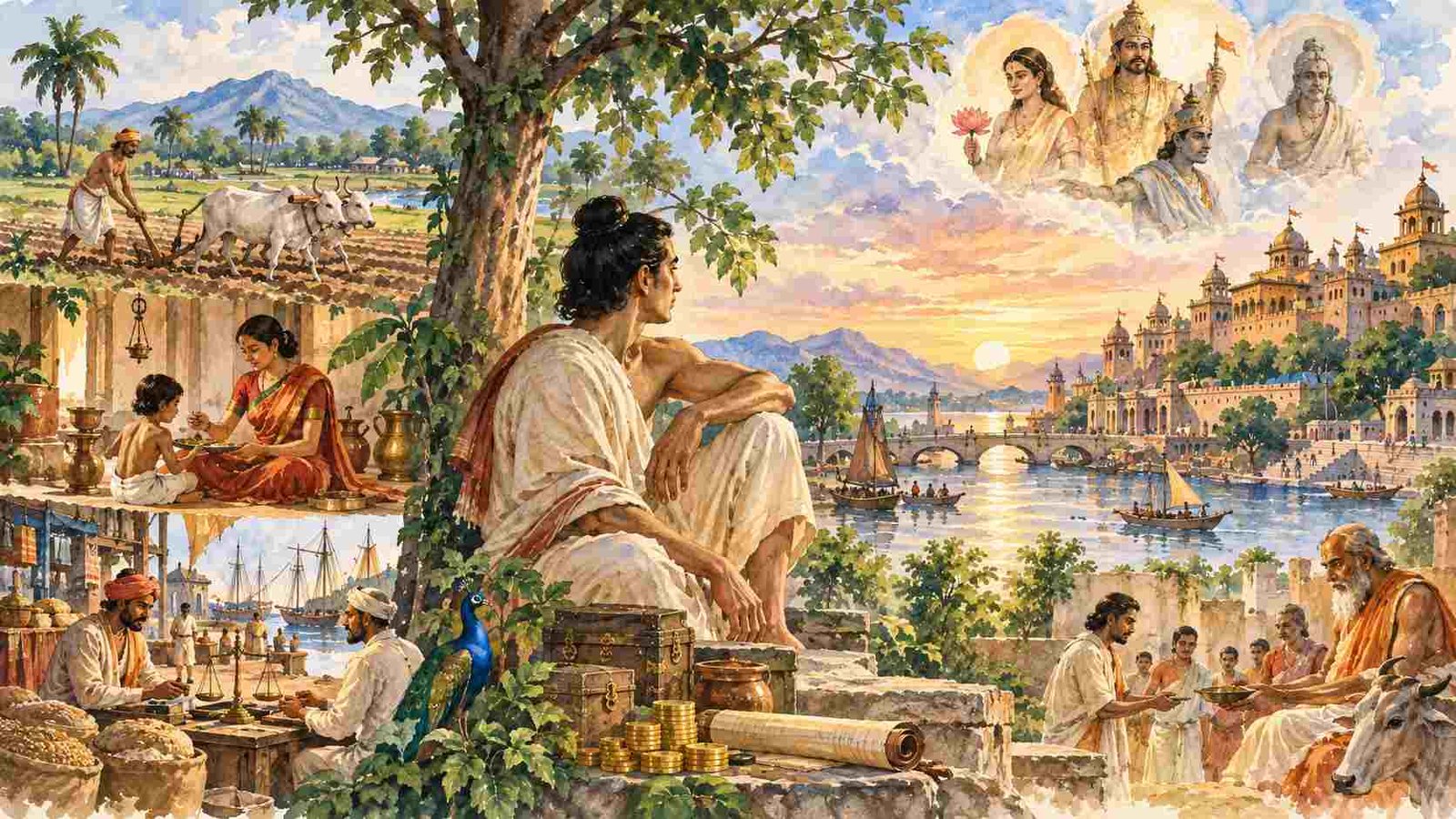
One of the most important insights available from reading the Dharmashāstra corpus alongside the Arthaśāstra is that artha operates across several scales. At the level of the individual, it concerns livelihood. At the level of the household, it concerns property, maintenance, inheritance and expenditure. At the level of the community, it concerns exchange, occupation and social obligations. At the level of the state, it concerns taxation, production, revenue, infrastructure and security.
Kauṭilya’s Arthaśāstra makes this movement particularly visible. The text begins with the acquisition and protection of the earth and then develops an extraordinarily detailed institutional discussion of administration and economic life. Its second book alone contains discussions of settlement, land, fortifications, treasury, revenue, mines, gold, warehouses, trade, weights and measures, customs, agriculture, liquor, slaughterhouses, shipping, livestock and other economic activities.
The conceptual significance of this structure should not be missed. Artha is not merely private wealth. It is the material infrastructure of social and political existence.
What, Then, Is Economic Life For?
The Dharmashāstric answer becomes clearer when these different strands are read together. Economic life is necessary because embodied human beings require material resources, households require maintenance, social obligations require resources, institutions require support and political communities require productive foundations. The pursuit of artha is therefore neither an unfortunate concession to worldly existence nor an autonomous sphere in which every form of acquisition becomes legitimate simply because it produces wealth.
The classical Indian position is more demanding. It asks the individual to acquire wealth through legitimate means, preserve it with prudence, employ it responsibly and avoid allowing the pursuit of wealth to destroy the very relationships and normative structures that make wealth meaningful. It asks the householder to understand that economic capacity brings obligations with it.
This is why the relationship between dharma and artha is better understood as an internal relationship rather than as a conflict between two unrelated spheres. The Mahābhārata expresses precisely this point when it calls artha dharmamūla, rooted in dharma, and describes dharma and artha as mutually connected like the ocean and the clouds.
Such a conception also complicates the modern opposition between “wealth” and “ethics”. The Dharmashāstra tradition does not require us to choose between economic prosperity and moral life as though the two were naturally opposed. Instead, it asks whether the economic order itself is organised according to legitimate purposes and restraints.
Artha and the Larger Purpose of Human Life
Ultimately, artha occupies a distinctive position within the Indian conception of human flourishing because it is both necessary and insufficient. Without material resources, many ordinary obligations of household and society become difficult or impossible to fulfil. Yet material prosperity by itself does not answer the question of what human life is ultimately for.
This is precisely why the puruṣārtha framework is intellectually valuable. It does not ask us to deny economic life in order to take ethical and spiritual life seriously. Nor does it permit economic success to become the sole measure of human accomplishment. It places economic life within a larger anthropology.
The person earns, but must also ask how the earning was accomplished. The person possesses, but must also ask what obligations possession creates. The person consumes, but must also ask whether consumption remains proportionate to the purposes of life. The household accumulates, but it must also transmit and distribute. The ruler collects revenue, but must preserve the productive conditions of the prajā. The individual seeks prosperity, but prosperity remains one dimension of a life that also contains duty, relationship, enjoyment and the possibility of liberation.
In this sense, the classical Indian conception of artha is neither anti-material nor materialist. It recognises material prosperity as an essential component of ordered human life while refusing to make material prosperity the final definition of that life.
The question with which we began can therefore be reformulated. The question is not simply whether wealth is good or bad. The Dharmashāstric tradition asks us to examine the entire chain through which wealth enters human life: its source, its legitimacy, its accumulation, its preservation, its expenditure, its social circulation and the purposes to which it is ultimately directed.
Once artha is understood in this wider sense, economic life appears not as a sphere outside dharma, but as one of the places where dharma has to become concrete. A person’s relationship with property, livelihood, debt, inheritance, consumption and giving is itself part of the moral organisation of life.
The deeper question is therefore not merely, “How much wealth should a person possess?” It is the more fundamental question that the Dharmashāstric tradition repeatedly forces us to confront: what kind of human being, household and society does our relationship with wealth produce?
That is perhaps where the Indian discussion of artha begins to become more than an economic theory. It becomes a theory of human flourishing.
Primary Textual References
- Manusmṛti, especially 2.12–13; 4.1–3; 4.226; 7.80–90; 8. sections on debt, property and transactions; 9. sections on inheritance, household management and property. The Sanskrit text is available through the Sanskrit Documents corpus.
- Yājñavalkya Smṛti, especially Ācārādhyāya 1.115 and the Vyavahārādhyāya dealing with property, debts, contracts, inheritance and legal procedure. Sanskrit and traditional commentary materials are preserved in the Sanskrit textual tradition. The Sanskrit Documents catalogue identifies the Yājñavalkya Smṛti among its Smṛti texts.
- Mahābhārata, especially Vana Parva 3.34.21–42, for the relationship between dharma, artha and kāma, including the important statement “सर्वथा धर्ममूलोऽर्थः”.
- Kauṭilīya Arthaśāstra, especially Book I on the definition and scope of artha, and Book II on economic and administrative organisation. The text explicitly defines artha through vṛtti and develops extensive institutional discussions of agriculture, trade, revenue, mines, markets, weights and measures and other economic activities.
- Gautama Dharmasūtra, particularly the sections dealing with household duties, property, inheritance and social obligations.
- Baudhāyana Dharmasūtra and Āpastamba Dharmasūtra, for the relationship between household life, livelihood, obligation and normative conduct.
- Nārada Smṛti, particularly its extensive treatment of vyavahāra, property, debt, contracts, partnership, deposits, sale and other forms of economic dispute.
- Viṣṇu Smṛti, for its treatment of conduct, household duties, property and juridical norms.
- Bṛhaspati Smṛti and Kātyāyana Smṛti, particularly important for the development of classical Indian legal thought concerning transactions, property, debt, commercial disputes and judicial procedure.
- Medhātithi, commentary on the Manusmṛti, and Vijñāneśvara’s Mitākṣarā, commentary on the Yājñavalkya Smṛti, should be consulted wherever the precise juridical meaning of the Smṛti passages is being interpreted rather than merely translated.
Suggested modern scholarly references
- Kane, P. V. History of Dharmaśāstra (Ancient and Mediaeval Religious and Civil Law in India). Bhandarkar Oriental Research Institute.
- Kangle, R. P. The Kauṭilīya Arthaśāstra. University of Bombay.
- Olivelle, Patrick. Manu’s Code of Law: A Critical Edition and Translation of the Mānava-Dharmaśāstra. Oxford University Press.
- Olivelle, Patrick. Dharmasūtras: The Law Codes of Āpastamba, Gautama, Baudhāyana, and Vasiṣṭha. Oxford University Press.
- Lariviere, Richard W. The Nāradasmṛti. University of Pennsylvania.
- Davis, Donald R. Jr. The Spirit of Hindu Law. Cambridge University Press.