There are historians who write history from the sources that already dominate the archive, and there are historians who ask whether the archive itself has been read from the wrong direction. Dharampal belonged to the second category. His importance lies in the subjects he studied—education, science and technology, village institutions, panchayats, civil resistance, cattle, polity and Indian society and also in the unusual way in which he approached the historical question.
Rather than beginning with the assumption that pre-colonial India was backward and then searching for evidence of development, Dharampal turned to an unlikely source: the records produced by the British themselves. Surveys prepared by colonial administrators, revenue officials, collectors, missionaries, engineers and other officials became the foundation of his historical reconstruction. His central intervention was therefore methodological as much as historical: What happens to our understanding of India when we allow the colonial archive to speak before imposing upon it the categories of later colonial historiography?
This question explains why Dharampal remains important for anyone interested in the decolonisation of history, education, political science, public administration and the social sciences.
Who was Dharampal ji?
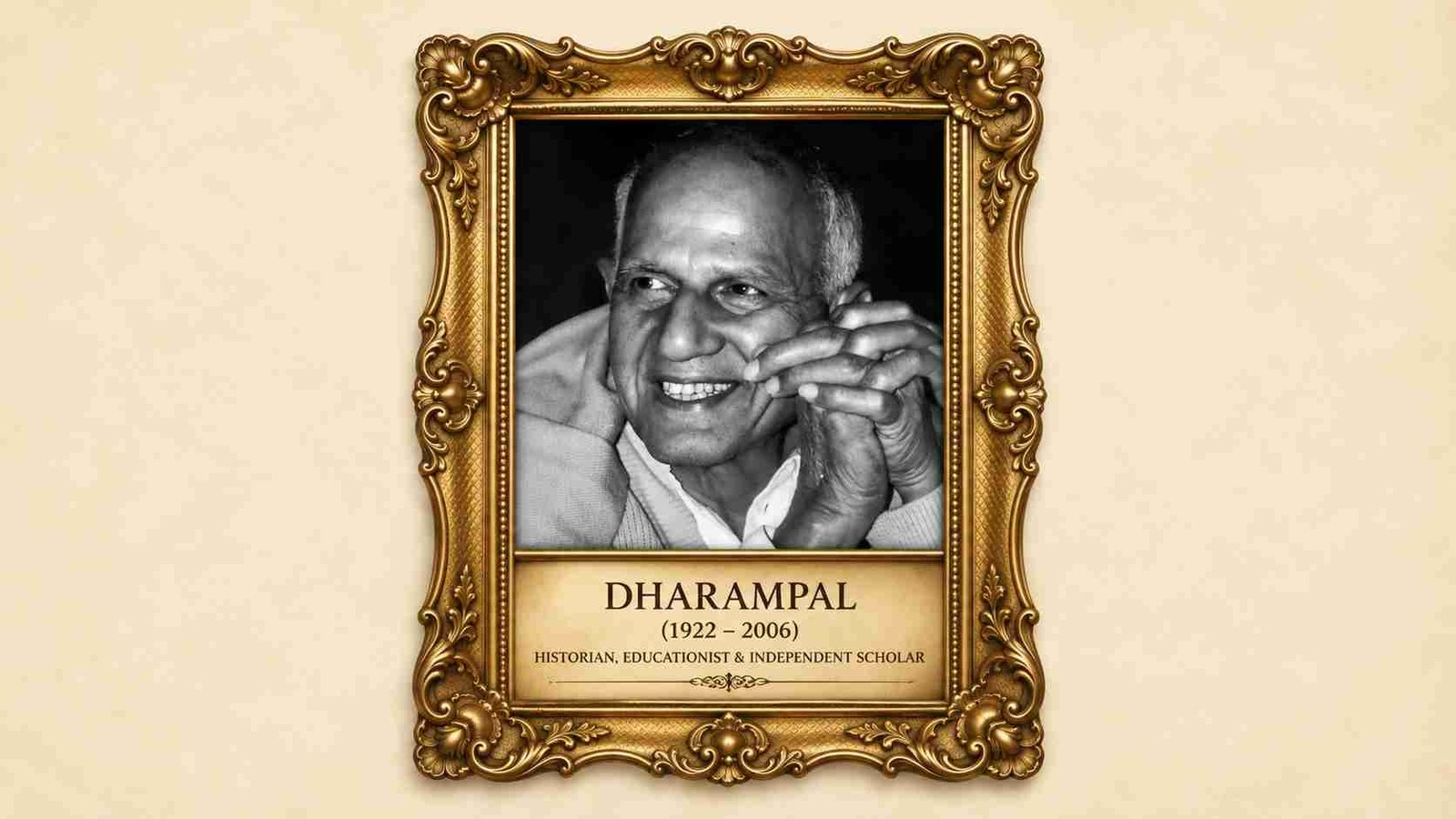
Dharampal (19 February 1922–24 October 2006) was an Indian historian, Gandhian thinker, researcher and writer. He was born in Kandhla in present-day Uttar Pradesh and grew up during the nationalist movement. His intellectual formation was deeply influenced by Mahatma Gandhi and the wider Gandhian concern with village society, decentralisation, swaraj and the regeneration of indigenous institutions.
His own description of his generation is revealing. Writing about himself, Dharampal said:
“Born in 1922, I consider myself a child of the Gandhian era…”
He recalled seeing Gandhi at the Lahore session of the Indian National Congress in December 1929. This Gandhian background is important because Dharampal was never simply attempting to produce a counter-history of India. He was asking a much larger question: if India had possessed its own social, economic, educational and political institutions, why did independent India so readily continue to understand itself through categories inherited from colonial rule?
His intellectual journey moved gradually from activism and rural reconstruction toward archival research. From 1958 to 1964 he served as General Secretary of the Association of Voluntary Agencies for Rural Development (AVARD), associated with Jayaprakash Narayan and Kamaladevi Chattopadhyaya. During the 1960s he became increasingly interested in India’s indigenous political and social institutions, particularly the panchayat system. His research eventually took him into British archives in India and Britain.
From the mid-1980s, he became closely associated with Sevagram Ashram in Wardha, which became his principal home until his death in 2006. He also served for several terms as a member of the Indian Council of Historical Research and in 2001 was appointed Chairman of the National Commission on Cattle. But institutional positions do not explain Dharampal’s lasting influence. His importance comes from the archive he opened.
The Question That Changed the Inquiry
Much of modern Indian historiography was constructed through a peculiar epistemological sequence. First, colonial observers described Indian society. Then colonial administrators classified it. Later historians frequently used those classifications as historical categories. And eventually Indians began studying their own society through those inherited categories.
Dharampal interrupted this sequence. He effectively asked: What if we return to the original administrative records and examine what the colonial state itself actually observed before those observations were transformed into theories about Indian society? This is the significance of his research. The archival material he assembled was enormous. According to the Dharampal archive, his research corpus contained approximately 15,500 pages of archival material, gathered principally between 1966 and 1982. Between 1996 and 2006 he organised selections from this material into eighteen thematic archival compilations covering roughly 1600–1947, with particular attention to the transformative period between 1757 and 1857. That is an important fact about Dharampal’s scholarship. He was not primarily constructing an argument from secondary literature. He was recovering dispersed primary documentation.
Dharampalji’s Methodology
The most distinctive feature of Dharampal’s work was his method. He went looking for what might be called colonial administrative ethnography—the thousands of reports produced by British officials because the colonial state needed to understand the society it governed.
Why were these documents produced? Because the colonial government needed to know how much revenue could be collected, how villages were organised, how education functioned, what technologies existed, how artisans worked, who controlled resources, how local institutions operated and how communities governed themselves. In other words, the colonial state unintentionally produced an enormous empirical record of Indian society. Dharampal mined this record.
The irony is fascinating: the same state that represented India as backward also left behind documents that often revealed a much more complex and capable society.
His methodology can therefore be understood through five interconnected principles.
1. Primary sources before secondary narratives
Dharampal preferred the actual reports of collectors, administrators and surveyors over later generalisations about India. In The Beautiful Tree, for example, he relied extensively on surveys of indigenous education undertaken in the Madras, Bengal and Bombay Presidencies. The archival record included information about schools, teachers, students, caste composition, curriculum, fees, institutional financing and local educational arrangements. This was not simply “finding old documents.” It was a methodological decision.
2. Read the colonial archive against colonial conclusions
Dharampal did not simply reject colonial records because they were colonial. Nor did he accept colonial interpretations because they appeared in official documents. He separated observation from interpretation. A British collector could record the number of schools in a district. That numerical observation is one thing. His conclusion about the intellectual capacity of Indians is another. This distinction is particularly valuable for decolonising research. The archive itself can be colonial, but the data contained within it need not automatically support the colonial interpretation attached to that data.
3. Reconstruct institutions rather than merely ideas
Dharampal was interested in how society actually functioned. This is why his work is especially relevant to political science and public administration. He investigated institutions such as:
- village schools,
- panchayats,
- local revenue arrangements,
- indigenous technological practices,
- community resource systems,
- local political institutions,
- traditional social organisation.
His question was – “What did Indians believe?” and also – What did Indians actually do? How did institutions operate? Who financed them? Who participated? Who exercised authority? How were resources distributed? This makes his work unusually empirical for a thinker who is often discussed primarily as a civilizational or Gandhian intellectual.
4. Recover patterns from dispersed evidence
One document rarely proves a civilizational argument. Dharampal therefore worked through large collections of documents and compared reports from different regions and periods. His archival compilations were organised thematically around polity, economy and society. The archive he assembled covered approximately three and a half centuries, with particular emphasis on the period around the establishment and consolidation of British power. You can read his writings here.
His method was consequently closer to historical reconstruction through cumulative evidence than to anecdotal history.
5. Ask what colonial transformation did to existing institutions
Dharampal’s question was not simply: “Was India developed?” That would reproduce the very binary he was trying to escape. His more interesting question was: What happened to institutions that already existed when colonial power entered and progressively reorganised the economic, political and educational environment? This distinction is crucial. The debate is not simply “British good versus Indian good.” The deeper historical question is about institutional transformation.
The Beautiful Tree: Indian Education Before Colonial Restructuring
Dharampal’s most famous work is undoubtedly The Beautiful Tree: Indigenous Indian Education in the Eighteenth Century, published in 1983. The title itself comes from Gandhi’s famous 1931 metaphor describing indigenous Indian education as a beautiful tree that had been damaged by colonial intervention. Dharampal placed Gandhi’s statement alongside the archival evidence that Gandhi himself had been trying to locate decades earlier. (For full book read here)
The significance of the book is that Dharampal did not just repeat Gandhi’s claim but He went looking for evidence. He examined British surveys of indigenous education conducted in the early nineteenth century, particularly the Madras and Bengal Presidencies. These reports recorded schools, pupils, teachers, curriculum and social composition. One striking feature of the archival evidence is that education was not restricted to formal schools. A substantial amount of learning occurred through private instruction within households. A Madras report cited by Dharampal, for instance, recorded 5,699 students in schools but 26,963 receiving private tuition at home. (CIS Indus)
That observation changes the question itself. If we define education exclusively as modern institutional schooling, we may underestimate the scale of pre-modern educational activity. Dharampal therefore challenged the tendency to equate the absence of modern European-style institutions with the absence of education. At the same time, his work should not be turned into the simplistic claim that pre-colonial India had universal or perfectly egalitarian education. The archival records themselves reveal regional variation, caste differences, gender differences and unequal access. Indeed, Dharampal reproduced documents that explicitly recorded such variations.
This is an important methodological lesson: Dharampal’s strongest argument is not that everything in pre-colonial India was perfect. It is that the historical reality was considerably more complex than the standard colonial narrative allowed.
Indian Science and Technology in the Eighteenth Century
His first major archival intervention was Indian Science and Technology in the Eighteenth Century: Some Contemporary European Accounts, published in 1971. Here Dharampal assembled European accounts relating to Indian technological practices. The work dealt with areas such as metallurgy, agriculture, textiles, construction, water management and other technical knowledge. Again, his objective was not to establish that India was “superior” to Europe. The more important argument was methodological: Why should the history of Indian science begin with the arrival of European science? If European travellers, engineers and administrators themselves encountered sophisticated technological practices in India, then those observations become part of the historical record.
The book therefore opened an important research field: the history of indigenous technological knowledge.
Dharampal’s archival corpus subsequently became significant for discussions of Indian metallurgy, textile production, agricultural knowledge and other forms of technical expertise. The primary volume remains available through the Dharampal archive. (Read Full book here)
Civil Disobedience and Indian Tradition
Another major work was Civil Disobedience and Indian Tradition: With Some Early Nineteenth Century Documents (1971). This book is particularly important for understanding Dharampal’s relationship with Gandhi. Modern political theory often presents civil disobedience through a genealogy running from Western political thinkers to Gandhi and then to later democratic movements.
Dharampal asked a different question: Was resistance to unjust authority already embedded within Indian political and social traditions?
This opens an important field of inquiry into the relationship between dharma, authority, legitimacy and resistance. For Dharampal, Gandhi’s political vocabulary could not be understood adequately if Gandhi were treated merely as an Indian interpreter of European political ideas. Gandhian politics had roots in Indian civilizational experience. That argument connects Dharampal’s historical research with his broader attempt to recover Indian categories of political thought.
Panchayat Raj and Indian Polity
Dharampal’s engagement with political institutions began much earlier. His Panchayat Raj as the Basis of Indian Polity: An Exploration into the Proceedings of the Constituent Assembly appeared in 1962. Later research into the Madras Panchayat system led to The Madras Panchayat System, Volume II: A General Assessment.
This part of his work is especially relevant today because Dharampal was interested in a question that modern public administration continues to confront:
How should political authority be organised between the centre and the local community? Dharampal’s historical reading emphasised the importance of decentralised institutions and village-level authority. His research placed the village not merely as an administrative unit but as a political and social institution possessing its own authority, resources and mechanisms of collective decision-making. His published work on panchayat institutions therefore belongs to a much broader intellectual project concerning decentralisation, local autonomy and swaraj. (Read Here)
This is where Dharampal becomes particularly interesting for public administration. The contemporary administrative vocabulary speaks of: decentralisation → subsidiarity → local governance → participatory governance → community institutions.
Dharampal approached similar questions through the historical experience of Indian society.
Bharatiya Chitta, Manas and Kala
Perhaps the most philosophical expression of Dharampal’s thought appears in Bharatiya Chitta, Manas and Kala. Here he moved beyond institutional history. His concern became the deeper question of civilizational consciousness. Can India understand itself using conceptual categories borrowed entirely from European intellectual history? Or does Indian society possess distinctive ways of understanding personhood, society, time, knowledge and political life?
The book attempts to explore the Indian chitta, manas and kāla as dimensions of Indian civilizational consciousness. The stated purpose was not to provide a final or exhaustive definition of the Indian mind, but to emphasise the need to understand these categories if India was to recover its bearings in the modern world. This is arguably where Dharampal’s historical work becomes a civilizational epistemology. The archive tells us what institutions existed. But Dharampal then asks a deeper question: What kind of civilizational consciousness produced and sustained those institutions?
From History to Civilizational Self-Understanding
This is perhaps the most important way to understand Dharampal. He was not merely trying to demonstrate that India had schools. Nor was he merely demonstrating that Indian artisans possessed technological skills. Nor was he simply arguing for village panchayats. These were pieces of a larger puzzle. The larger question was: Can a civilisation reconstruct itself if it has lost confidence in its own categories of understanding?
Dharampal believed that historical knowledge had consequences for civilizational self-understanding.
If Indians were repeatedly taught that their ancestors had no meaningful educational institutions, no significant technological knowledge, no effective local governance and no tradition of social organisation, then modern Indians would inevitably begin to see Western institutional forms as the natural starting point of progress.
Dharampal wanted to disturb that psychological and intellectual inheritance.
His daughter, historian Gita Dharampal, described his lifelong endeavour as an attempt to help Indians appreciate their culture and past achievements “without glorification”, while avoiding a sense of subservience to the West and regenerating social, political and economic institutions from within, according to the needs of Indian society. (Read Here)
That phrase—“without glorification”—is important. A serious reading of Dharampal should not become civilizational romanticism. His methodological contribution is stronger than that.
Dharampal’s Most Important Works
His major works can be read as different windows into the same larger intellectual project:
| Work | Central Question |
|---|---|
| Panchayat Raj as the Basis of Indian Polity (1962) | What was the historical basis of decentralised Indian polity? |
| Indian Science and Technology in the Eighteenth Century (1971) | What did European observers record about indigenous Indian technologies? |
| Civil Disobedience and Indian Tradition (1971) | Did traditions of resistance predate modern Western theories of civil disobedience? |
| The Beautiful Tree (1983) | What did British surveys reveal about indigenous Indian education? |
| Some Aspects of Earlier Indian Society and Polity (1986) | What features of Indian social and political organisation have contemporary relevance? |
| Bharatiya Chitta, Manas and Kala (1991/1993 English) | What distinctive categories shape Indian civilizational consciousness? |
| India before British Rule and the Basis for India’s Resurgence (1998) | What institutional resources existed before colonial domination? |
| Despoliation and Defaming of India (1999) | How did colonial representations contribute to the denigration of India? |
| The British Origin of Cow-Slaughter in India (2002) | What does the documentary record reveal about colonial policy and the cow question? |
| Understanding Gandhi (2003) | How should Gandhi be understood within his civilizational context? |
| Rediscovering India (2003) | A wider collection of Dharampal’s essays and speeches on Indian society and civilisation. |
The Dharampal archive lists these works and his larger five-volume Collected Writings, while Hindi and Gujarati editions of his collected works were subsequently published in multi-volume form. (Read Here)
Quotes
The Famous “Beautiful Tree” Passage
Perhaps the most widely remembered passage associated with Dharampal is actually Gandhi’s 1931 statement, reproduced and investigated by Dharampal in The Beautiful Tree.
Gandhi said:
“They scratched the soil and began to look at the root, and left the root like that, and the beautiful tree perished.”
This was Gandhi’s metaphor for the destruction of indigenous educational arrangements through colonial intervention.
But there is another reason this passage is fascinating.
In 1939 Gandhi admitted that he was still searching for documentary evidence to substantiate his earlier statement about education in pre-British India. Dharampal’s subsequent archival research can therefore be seen partly as an attempt to pursue a historical question that Gandhi himself had left open.
That makes The Beautiful Tree more than a book about schools.
It represents an unusual dialogue between Gandhian intuition and archival verification.
Other Important Dharampal Quotations
One of Dharampal’s recurring observations concerned the deterioration of indigenous education following the consolidation of British power. He wrote:
“There is a sense of widespread neglect and decay in the field of indigenous education…”
He connected this deterioration with the changing political and institutional environment under European supremacy. Another important statement appears in his broader reflections on India’s self-understanding:
“How can any society survive, let alone create, on the basis of borrowed images of itself?”
This question captures perhaps the essence of Dharampal’s intellectual project. It appears in material discussing his Indian Science and Technology in the Eighteenth Century and the problem of reproducing inherited European representations of Indian society.
The quotation is worth taking seriously because Dharampal was not arguing merely that India should reject Western knowledge.
He was asking something more fundamental:
Can knowledge borrowed from another civilizational experience become the only legitimate language through which a society understands itself?
That is a very different proposition.
Dharampal and Decolonisation
This is where Dharampal becomes extraordinarily relevant to contemporary debates on decolonising the social sciences. Decolonisation is sometimes reduced to replacing European authors with Indian authors. Dharampal’s approach suggests that the problem is deeper.
The issue is not merely who wrote the textbook. The issue is: What categories are being used to describe Indian society? Suppose we study Indian education. If our only categories are:
school → literacy → classroom → teacher → curriculum → examination
we may miss a large portion of the historical Indian educational ecosystem. Similarly, if we study governance exclusively through:
state → bureaucracy → law → centralisation
we may overlook village institutions, community authority, customary arrangements and local resource systems. This is why Dharampal is so relevant to an Indic approach to social sciences. His work encourages researchers to move from: India as an object of Western social science towards: India as a civilisation possessing its own empirical history, categories and institutional experience. That is a methodological shift.
Dharampal as a Research Method
For contemporary researchers, Dharampal’s methodology can be converted into a powerful research design. Imagine studying Indian education before colonial rule. Instead of beginning with Macaulay and colonial educational policy, begin with district-level records. What schools existed? Who financed them? Who taught? Who studied? What was taught? How long did students remain? What was the relationship between household education and institutional education? What happened to these institutions after the revenue and administrative systems changed?
Then compare regions. The same approach can be applied to technology. What did European engineers actually observe? Which technologies were locally produced? Who possessed the knowledge? How was knowledge transmitted? What happened to the production system after colonial trade and revenue policies changed?
The same approach works for political institutions. What did British administrators observe about village assemblies? How were resources managed? Who exercised authority? How were disputes resolved? What happened when colonial administrative institutions expanded?
This is Dharampalian research at its best: not nostalgia, not glorification, but empirical reconstruction.
Why Dharampal Matters for Indic Social Science
Perhaps Dharampal’s greatest contribution was that he refused to accept the division between “tradition” and “modernity” in its conventional European form. For him, the Indian past was not merely something to be preserved in museums.
It contained institutional memory. The panchayat could become a question for public administration. Traditional education could become a question for educational sociology. Indigenous technologies could become a question for science and technology studies. Village resource systems could become a question for political economy. Indian civil disobedience could become a question for political theory. And chitta, manas and kala could become a question for civilizational studies.
This is why Dharampal’s work sits at the intersection of history, political science, sociology, economics, education, Gandhian studies and Indic civilizational thought. He did not merely ask Indians to be proud of their past. He asked them to study it seriously. And that distinction matters.
The Dharampal Legacy
Dharampal died at Sevagram on 24 October 2006, but the archival project he initiated continues to circulate through his collected writings and archival compilations. His published corpus has appeared in English as well as Hindi, Gujarati and other Indian-language editions. The official Dharampal archive now provides access to his bibliography and substantial archival material.
His legacy can therefore be understood at three levels. At the historical level, he recovered evidence concerning indigenous education, technology, polity and society. At the methodological level, he demonstrated the importance of returning to primary colonial records and distinguishing documentary observation from colonial interpretation. At the civilizational level, he asked whether Indians could understand themselves without depending entirely upon categories inherited from the colonial experience. Perhaps that is why Dharampal remains so relevant to the contemporary project of decolonising the social sciences. The real challenge he leaves us is not to repeat his conclusions.
It is to adopt his question. What happens when we stop asking the colonial archive to tell us what India was—and start asking it what it actually recorded? That is where Dharampal’s intellectual journey begins. And perhaps, for an Indic social science, that is where a new historiography must begin as well.
Selected References
Primary works by Dharampal
- Dharampal. Panchayat Raj as the Basis of Indian Polity: An Exploration into the Proceedings of the Constituent Assembly. New Delhi: AVARD, 1962.
- Dharampal. Indian Science and Technology in the Eighteenth Century: Some Contemporary European Accounts. Delhi: Impex India, 1971.
- Dharampal. Civil Disobedience and Indian Tradition: With Some Early Nineteenth Century Documents. Varanasi: Sarva Seva Sangh Prakashan, 1971.
- Dharampal. The Beautiful Tree: Indigenous Indian Education in the Eighteenth Century. New Delhi: Biblia Impex, 1983.
- Dharampal. Some Aspects of Earlier Indian Society and Polity and their Relevance to the Present. 1986.
- Dharampal. Bharatiya Chitta, Manas and Kala. Hindi 1991; English translation, Centre for Policy Studies, 1993.
- Dharampal. India Before British Rule and the Basis for India’s Resurgence. Wardha: Gandhi Seva Sangh, 1998.
- Dharampal. Despoliation and Defaming of India: The Early Nineteenth Century British Crusade. 1999.
- Dharampal. Understanding Gandhi. 2003.
- Dharampal. Rediscovering India: Collection of Essays and Speeches (1956–1998). 2003.
- The official bibliography provides the complete publication list.
Archival and online sources
The Shri Dharampal archive contains his bibliography, life chronology and a substantial selection of the archival compilations he prepared from approximately 15,500 pages of research material.
- Shri Dharampal — Official Archive and Published Works
- Shri Dharampal — Archival Extracts
- Indian Science and Technology in the Eighteenth Century — Dharampal Archive
Note on quotations: I have deliberately distinguished quotations by Dharampal from the famous Gandhi passage reproduced in The Beautiful Tree. The latter is Gandhi’s statement, not Dharampal’s, although Dharampal’s archival investigation is directly connected to that question. This distinction is important when using the material academically.