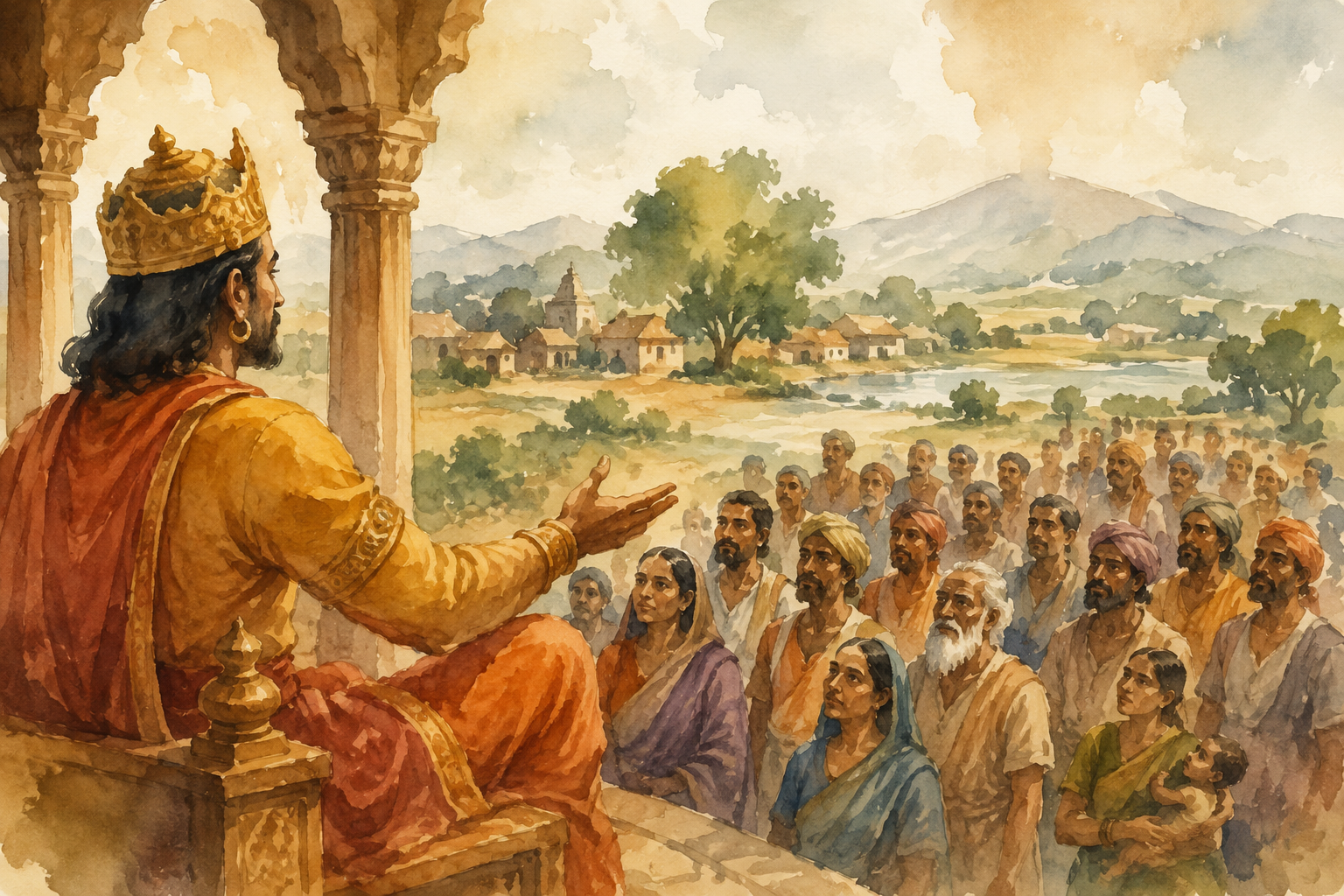
If a person possesses the power to govern, what exactly does that power oblige him to do?
Political theory has spent considerable effort explaining how political authority is constituted, how governments acquire legitimacy, how institutions exercise power and how rulers may be constrained. Yet there is another question that is equally important and perhaps more fundamental: what does power owe to those over whom it is exercised?
The Indic concept of Rājadharma approaches political authority through precisely this question. It does not regard rulership merely as possession of power. The ruler’s authority creates obligations towards prajā. The greater the ruler’s capacity to affect the lives of others, the greater the responsibility attached to that power.
This is why translating Rājadharma simply as “the duties of a king” is accurate but incomplete. Dharma does not merely mean a list of prescribed duties. In the political context, it provides a normative framework within which authority, protection, justice, punishment, taxation and public welfare are to be ordered.
The ruler therefore does not merely govern over the people. He governs for the preservation of the conditions through which society can flourish.
The Purpose of Political Authority
One of the clearest formulations appears in Kauṭilya’s Arthaśāstra:
प्रजासुखे सुखं राज्ञः प्रजानां च हिते हितम्।
नात्मप्रियं हितं राज्ञः प्रजानां तु प्रियं हितम्॥Prajāsukhe sukhaṃ rājñaḥ prajānāṃ ca hite hitam;
nātmapriyaṃ hitaṃ rājñaḥ prajānāṃ tu priyaṃ hitam.“In the happiness of the subjects lies the happiness of the king; in their welfare lies his welfare. What is beneficial to himself is not beneficial to the king; what is beneficial to the subjects is beneficial to him.”
(Arthaśāstra 1.19.34)
The significance of this passage lies in its reversal of the usual understanding of political power. The ruler’s welfare is not conceptually independent from that of the governed. His own interest is subordinated to the welfare of the prajā.
This does not amount to modern democracy, nor should we force the text into that category. The political order described by Kauṭilya is unmistakably hierarchical and monarchic. Yet hierarchy does not imply unlimited discretion. Political authority is accompanied by a normative purpose.
The ruler may possess daṇḍa, taxation, administrative authority and military power, but these instruments are legitimate only insofar as they sustain the political and social order.
Rājadharma Begins with Protection
Protection is one of the foundational obligations of kingship.
The Rāmāyaṇa offers an instructive example in the conversation between Rāma and Bharata in the Ayodhyākāṇḍa. Rāma does not ask Bharata simply whether he has strengthened the army or secured the royal treasury. He asks whether Ayodhyā remains prosperous and whether its inhabitants are able to pursue their respective occupations.
Rāma asks:
ब्राह्मणैः क्षत्रियैर्वैश्यैः स्वकर्मनिरतैः सदा…
कच्चित्सुमुदितां स्फीतामयोध्यां परिरक्षसि।
He asks whether Bharata is protecting Ayodhyā, a prosperous city inhabited by people engaged in their respective occupations, learned persons and energetic citizens. (Vālmīki Rāmāyaṇa, Ayodhyākāṇḍa 2.100.40–42).
The following verses extend the inquiry from the city to the janapada. Rāma asks whether the countryside is prosperous, cultivated, secure, endowed with cattle and free from pervasive fear.
This is important for understanding the Indic conception of governance. The success of the ruler is measured through the condition of society.
The prosperity of the marketplace, the security of agriculture, the continuity of occupations, the availability of resources and the absence of fear become indicators of good governance.
The palace is therefore not the primary measure of political success. The condition of the people is.
The Ruler Is Responsible for His Officials
One of the most striking dimensions of Rājadharma is its recognition that political power can become predatory through its own administrative machinery.
The Manusmṛti states:
राज्ञो हि रक्षाधिकृताः परस्वादायिनः शठाः।
भृत्या भवन्ति प्रायेण तेभ्यो रक्षेदिमाः प्रजाः॥
“Those servants of the king who are appointed for protection often become knaves who seize the property of others; from them he should protect his subjects.” (Manusmṛti 7.123).
This is a remarkably sophisticated observation about delegated authority.
The ruler appoints officials to protect society, but those very officials may exploit the people. Consequently, the ruler cannot absolve himself by claiming that misconduct occurred at a lower administrative level.
The Manusmṛti goes further. The king is instructed to monitor officials and investigate their conduct through surveillance mechanisms. The broader context of verses 7.122–125 explicitly places administrative supervision within royal responsibility.
The principle is therefore clear: delegation of authority does not mean delegation of responsibility.
This remains relevant to contemporary administration. When a citizen suffers because of corruption, arbitrary enforcement or administrative abuse, it is tempting to treat the problem as merely an individual officer’s misconduct. Rājadharma asks a harder question: what responsibility does the political authority bear for the institutional environment that permits such misconduct?
Revenue Without Predation
A ruler requires revenue. Armies must be maintained, infrastructure constructed, officials paid and public order protected. The Indic texts therefore do not imagine a state without taxation.
But they repeatedly warn against extraction that destroys the productive capacity of society.
The Mahābhārata’s Śānti Parva discusses taxation and the king’s economic responsibilities within its wider treatment of Rājadharma. The king is expected to maintain the productive foundations of the janapada, including agriculture, trade and animal husbandry, while collecting revenue in a manner compatible with continued prosperity.
The underlying principle is more sophisticated than simply “tax less”. The ruler depends upon the productive society that sustains the ruler. If taxation becomes so excessive that cultivators abandon production, merchants withdraw, cattle decline and productive activity contracts, the ruler ultimately weakens his own fiscal foundation. This creates an important relationship between artha and dharma: political extraction cannot be separated from the preservation of economic capacity. The ruler therefore has a dual responsibility—to collect what is necessary for governance and simultaneously ensure that the productive system remains capable of generating prosperity.
Justice Requires Self-Restraint
Rājadharma also places an unusual emphasis on the character of the ruler.
The problem is not simply whether the ruler possesses sufficient power. It is whether he possesses sufficient self-command to exercise that power properly.
The Mahābhārata repeatedly connects kingship with control of the senses, disciplined conduct and impartiality. In the Śānti Parva, Bhīṣma’s instructions on kingship begin from the proposition that the ruler must first exercise control over himself before attempting to control the affairs of the kingdom. The discussion of Rājadharma subsequently connects this self-discipline with administration, intelligence, justice, revenue and protection.
This is a crucial point. A ruler who cannot restrain anger, attachment, greed or personal preference possesses precisely the qualities that make political power dangerous. The problem of governance is therefore partly institutional and partly ethical. A legal system can prescribe procedures. An institution can distribute authority. A constitution can define limits. But none of these automatically produces prudence in the person exercising power.
This is why the Indic political tradition does not treat the character of the ruler as an irrelevant private matter.
The King as Protector, Not Proprietor
The deeper principle underlying Rājadharma is that the ruler is not the proprietor of the kingdom.
He is its trustee and protector. This distinction is visible throughout the literature of Rājadharma. The Mahābhārata presents royal authority as necessary for protecting social order, while simultaneously subjecting the king to dharma. Indeed, the Śānti Parva describes Rājadharma as the principle through which the various social duties are protected.
Kauṭilya similarly treats kingship as a demanding discipline. His formulation of the ruler’s duty as utthāna—constant exertion—and his insistence that the king’s welfare is bound to the welfare of the prajā leave little room for the conception of kingship as personal luxury. The ruler possesses authority because political order requires an institution capable of protecting society. But that authority does not convert society into the ruler’s personal possession.
This distinction is fundamental.
Rājadharma and Modern Constitutionalism
It would be a mistake to claim that Rājadharma is simply an ancient Indian version of modern constitutionalism.
It is not. Modern constitutionalism rests upon concepts such as popular sovereignty, fundamental rights, separation of powers, judicial review and representative government. Rājadharma emerged within a very different political and social world. The value of comparison therefore lies elsewhere. Modern constitutionalism asks: How should political power be institutionally limited? Rājadharma additionally asks: What kind of person should exercise political power, what should that person understand as the purpose of authority, and what obligations arise from possessing the capacity to command?
The two questions need not be opposed. Indeed, contemporary political life may require both. Institutions constrain power from the outside; political ethics disciplines it from within.
From Power to Responsibility
The enduring importance of Rājadharma lies in this transformation of the meaning of political authority. Power is not treated as an entitlement to command. It is treated as an obligation to protect.
The ruler must protect the people from external threats, but also from corrupt officials. He must collect revenue, but without destroying productive capacity. He must administer justice, but restrain personal preference. He must maintain political order, but recognise that the purpose of order is the flourishing of society. The question, therefore, is not simply whether a ruler is powerful.
It is whether his power produces security without oppression, revenue without predation, justice without arbitrariness and authority without personal appropriation.
That is why Rājadharma deserves to be studied as a category of political theory rather than merely as an ethical instruction for ancient kings. Its central question remains uncomfortable precisely because it applies to every political system:
Who protects the people from the protectors? Who restrains the administrator who has become predatory? Who protects productive society from excessive extraction? Who prevents public authority from becoming private entitlement?
The Indic answer begins with a deceptively simple proposition:
The ruler does not become worthy of power merely by possessing it. He becomes worthy of power by accepting the responsibility that comes with it.
Perhaps this is the most important lesson of Rājadharma. The greatness of a ruler is not ultimately measured by the size of his army, the magnificence of his court, the amount of revenue collected or the territory brought under his command. It is measured by the condition in which he leaves the people entrusted to his protection.
The fundamental political question is therefore not merely, “How much power does the ruler possess?”
It is: “What does he owe to those whose lives his power can change?” And Rājadharma answers: more power means more responsibility.
References
- Kauṭilya. Arthaśāstra. 1.19.33–34; 1.3; 3.1.41. Trans. R. P. Kangle, The Kautiliya Arthasastra, University of Bombay, 1960–1965.
- Olivelle, Patrick. King, Governance, and Law in Ancient India: Kauṭilya’s Arthaśāstra. Oxford University Press, 2013.
- Vālmīki. Rāmāyaṇa, Ayodhyākāṇḍa, 2.67; 2.100.40–45. The IIT Kanpur Vālmīki Rāmāyaṇa text and translation provide the relevant passage on Ayodhyā’s prosperity, occupations and protection.
- Mahābhārata. Śānti Parva, Rājadharmānuśāsana Parva, especially chapters 69 and 87. The Śānti Parva treats royal self-discipline, administration, protection, revenue and the welfare of the janapada.
- Manu. Mānava-Dharmaśāstra (Manusmṛti), Chapter 7, verses 122–125, on supervision of officials and protection of subjects from corrupt royal servants.
- Kane, P. V. History of Dharmaśāstra. Bhandarkar Oriental Research Institute, 1930–1962.
- Lingat, Robert. The Classical Law of India. University of California Press, 1973.