The Indic Problem of Assimilation in a Ninth-Century Kerala Inscription.
The civilizational vision that enabled Hindu society to accommodate difference—and the question of what happens when accommodation loses its foundations.
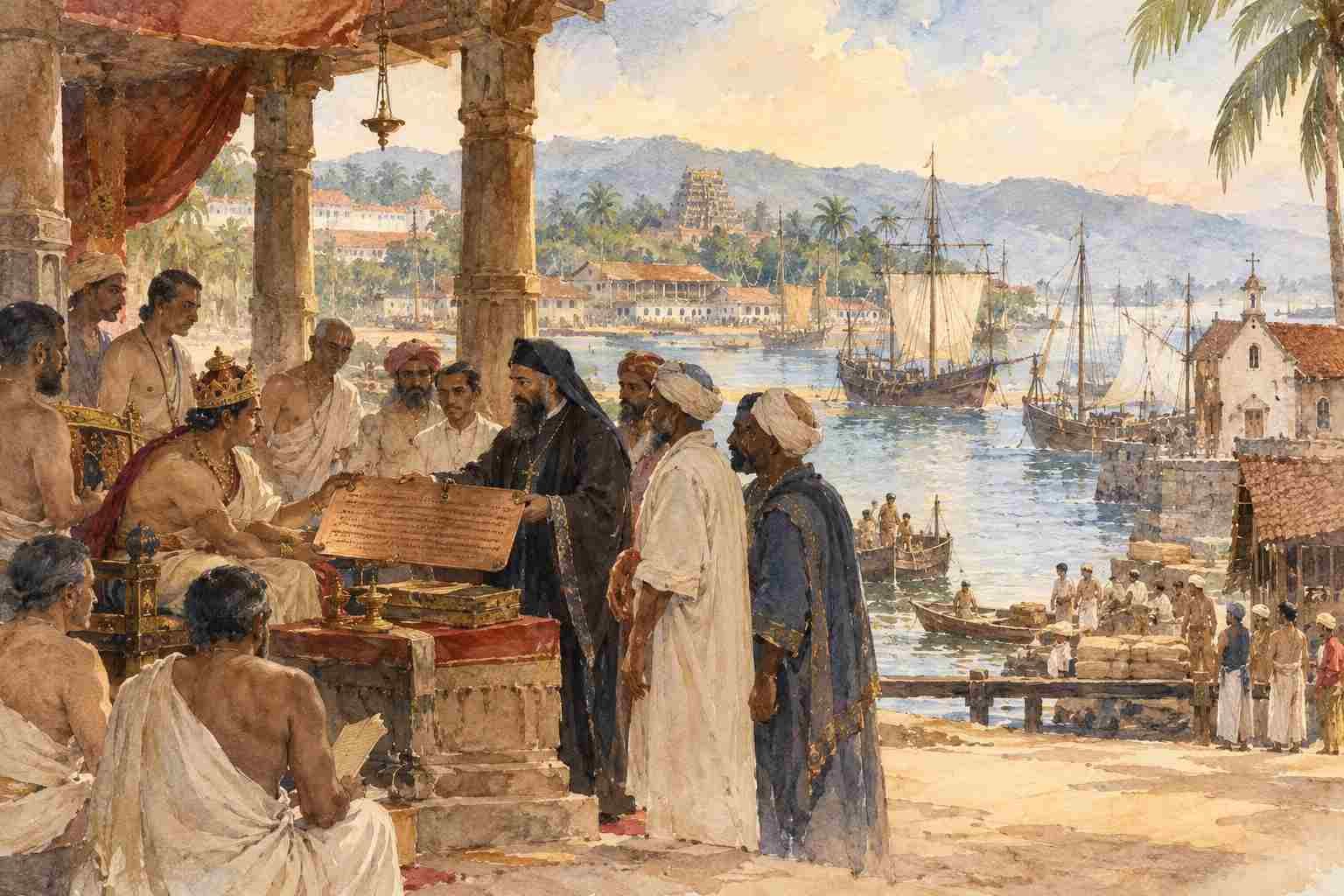
In 849 CE, on the Malabar coast, a Hindu-ruled polity recognised the rights and privileges of a Christian religious and commercial institution. The Tharisappalli copper plates, issued under the authority of Ayyan Adikal Thiruvadikal during the reign of the Chera ruler Sthanu Ravi, record arrangements associated with the church at Kurakkeni Kollam. The charter brings together political authority, religious institutions, merchant organisations, and a maritime world extending beyond the subcontinent.
The important question is not simply why a Hindu ruler tolerated Christians. It is more fundamental: What kind of civilizational outlook allows a society to accommodate people who do not share its religious beliefs without necessarily requiring them to abandon those beliefs?
The answer may lie in a distinctive feature of Hindu social imagination: the capacity to organise a shared world without insisting that every community possess an identical religious identity. The Tharisappalli plates offer a historical point of departure for exploring this possibility. They do not prove a universal Hindu doctrine of assimilation, but they allow us to investigate how accommodation operated through institutions, authority, and economic relationships.
A Civilisation That Did Not Require Everyone to Become the Same
Assimilation is commonly understood as a movement towards cultural sameness. A newcomer enters a society and gradually adopts its language, customs, and beliefs. The alternative is separation: communities live beside one another but remain socially disconnected.
The Indic civilizational experience invites us to consider a different possibility. A community may retain its distinctive religious practices while becoming part of a wider social order. Its integration need not depend upon the disappearance of its identity.
The Christian institution at Kollam could receive recognition within the political and commercial arrangements of a Hindu-ruled region without becoming Hindu. This is the crucial distinction between accommodation and homogenisation.
The Hindu civilizational imagination developed within a world of multiple deities, philosophical schools, ritual traditions, sampradāyas, and competing interpretations of ultimate reality. These traditions were not always harmonious, nor did Hindu society lack hierarchy or exclusion. Nevertheless, its intellectual history contains substantial resources for accommodating differences in practice, worship, and philosophical understanding.
The Bhagavad Gītā’s description of the plurality of approaches through which people seek the Divine, for example, offers one textual resource for reflecting on this capacity (4.11). It should not be treated as a direct explanation of the ninth-century charter. Rather, it illustrates a broader Hindu philosophical possibility: difference in the approach to the sacred need not always be resolved through the destruction of difference itself.
The historical question is how such intellectual possibilities interacted with actual institutions and political arrangements.
Dharma as the Ground of Accommodation
To understand the Indic perspective, we must move beyond the modern vocabulary of tolerance alone. Tolerance suggests that one party permits another to practise what it does not itself accept. It is valuable, but it can leave the relationship dependent upon the discretion of the more powerful party.
The concept of Dharma opens a wider field of inquiry. Across Hindu textual traditions, Dharma concerns the ordering of conduct, obligations, relationships, and social life. Its meanings vary by text and context; it cannot be reduced to a single formula. Yet it offers a way of thinking about society in which the central question is not merely what individuals believe, but how different persons and institutions are situated within an order of obligations.
From this perspective, the accommodation of a community is not simply an act of generosity. It involves locating that community within relationships of authority, livelihood, responsibility, and social participation.
The Tharisappalli charter is significant precisely because it records institutional recognition rather than an abstract declaration of goodwill. Land, privileges, political authority, and merchant organisations formed part of the arrangement. The Christian institution entered a wider network of relationships while retaining its religious character.
We should not claim that the inscription explicitly invokes Dharma as its governing theory. It does not. The connection is interpretive: Dharma provides a Hindu conceptual framework through which to ask how a society can preserve an overarching order while accommodating institutions that differ in religious identity.
The deeper civilizational capacity lies not in accepting every belief as true, but in making social coexistence possible without requiring uniform belief.
The Hindu Social World: Many Institutions, One Wider Order
The charter also points towards a feature of social organisation that deserves greater attention. The community did not enter society solely as a collection of individuals. Its religious institution, merchant connections, and relationship with political authority mattered.
This is consistent with a broader line of inquiry into Indic social thought, where family, kula, occupational associations, religious institutions, local communities, and political authority can form overlapping structures of collective life. Society is not necessarily imagined as a direct relationship between isolated individuals and a single all-encompassing state.
We must avoid projecting later Dharmaśāstra formulations or specific theories of the state directly onto ninth-century Kerala. The inscription is a record of a historical transaction, not a philosophical treatise. Nevertheless, it raises an important question: can a society accommodate newcomers by incorporating their institutions into a larger order rather than demanding that every institution dissolve into the majority?
The Tharisappalli charter suggests that this was possible in at least one historically specific setting. A Christian church could retain its religious function; merchant bodies could participate in commercial life; and political authority could recognise the arrangements connecting them.
This is a form of institutional integration. The community became connected to the region without becoming culturally identical to every other community within it.
The Civilizational Importance of Economic Interdependence
Kollam was part of a maritime trading world connecting the Malabar Coast with regions across the Indian Ocean. The charter’s institutional setting therefore matters. Commercial relationships created practical reasons for cooperation across differences of religion and language.
Trade requires more than the exchange of goods. It depends upon recognised transactions, the protection of property, institutional continuity, and relationships with political authority. Merchants may maintain different religious identities while participating in a common economic environment.
The multilingual evidence associated with the copper plates reinforces this point. The surviving material connects a regional documentary tradition with signatures in Arabic, Pahlavi, and Hebrew scripts. The precise relationship among the surviving plates remains a matter of epigraphical interpretation, but the linguistic diversity is historically striking.
A shared commercial world did not require every participant to write in the same script or possess the same religious identity.
This suggests a significant principle: civilizational cohesion can emerge through interdependence, not merely through uniformity. Communities become connected through institutions, obligations, livelihoods, and repeated interactions. Their differences may persist, but those differences do not necessarily prevent participation in a common order.
Yet accommodation must not be romanticised. The charter’s references to dependent labour and the privileges attached to the grant remind us that institutional inclusion could coexist with substantial social inequalities. A community’s recognition does not establish that every person within the wider society enjoyed equal standing.
A serious Hindu civilizational account must acknowledge both its capacity for accommodation and the hierarchies within which accommodation occurred.
When Accommodation Becomes a Vulnerability
This historical argument acquires contemporary significance when we consider migration and refugees. People fleeing persecution or conflict may arrive with deeply held religious commitments, established communal institutions, and strong attachments to inherited norms. Their religious convictions are not, by themselves, evidence that they cannot integrate. Nor should refugees be treated as a single cultural or political category.
The difficult question is what happens when the receiving society has lost confidence in its own civilizational framework, or when newcomers and established communities disagree over the obligations governing their common life.
Accommodation becomes vulnerable when it is mistaken for the absence of boundaries. A society may permit religious difference while still expecting everyone within its jurisdiction to respect the law, the rights of others, and the institutions that sustain public order. The right to practise a faith does not automatically confer a right to impose its rules upon unwilling members of the wider society.
Equally, the host society must distinguish between a community retaining its religious identity and a community seeking authority over others. These are not the same thing. Private belief, communal worship, and voluntary association are different from coercion, intimidation, or the denial of equal rights.
The danger, therefore, is not that refugees bring strong beliefs. The danger arises when accommodation loses the distinction between respecting a community and surrendering the common order that makes coexistence possible.
This principle applies to every religious community, including Hindu institutions and majoritarian movements. A civilizational framework cannot credibly defend its own freedom while denying others the same protection against coercion.
For contemporary India, the question is how to sustain a confident Hindu civilizational identity alongside constitutional equality, religious freedom, and a clear expectation of civic responsibility. The historical record can inform this debate, but it cannot substitute for evidence about present-day migration, integration, or security. Those questions require specific demographic, legal, and social analysis rather than assumptions about entire religious populations.
Recovering the Indic Drishti
The Tharisappalli plates do not tell us that Hindu society always assimilated newcomers successfully. They reveal something more concrete: in ninth-century Kerala, a Christian religious institution could receive recognition within a Hindu-ruled political and commercial order while retaining its distinctive identity.
Read through an Indic civilizational lens, this becomes an opportunity to examine how a society can accommodate difference through institutions, relationships, and an overarching normative order. Dharma offers one conceptual resource for thinking about the obligations that sustain such an order; the historical charter provides evidence of a particular institutional arrangement through which accommodation took place.
The lesson is neither that every difference must disappear nor that every difference must be accepted without qualification. It is that a society needs the confidence and institutional capacity to distinguish between diversity that can be accommodated and conduct that undermines the conditions of coexistence.
The enduring question for Hindu civilisation is therefore not simply how much difference it can tolerate. It is how it can preserve the foundations of its own social and ethical order while making room for people who do not share its beliefs.
The Indian art of making room lies in accommodating difference without dissolving the order that makes accommodation possible.