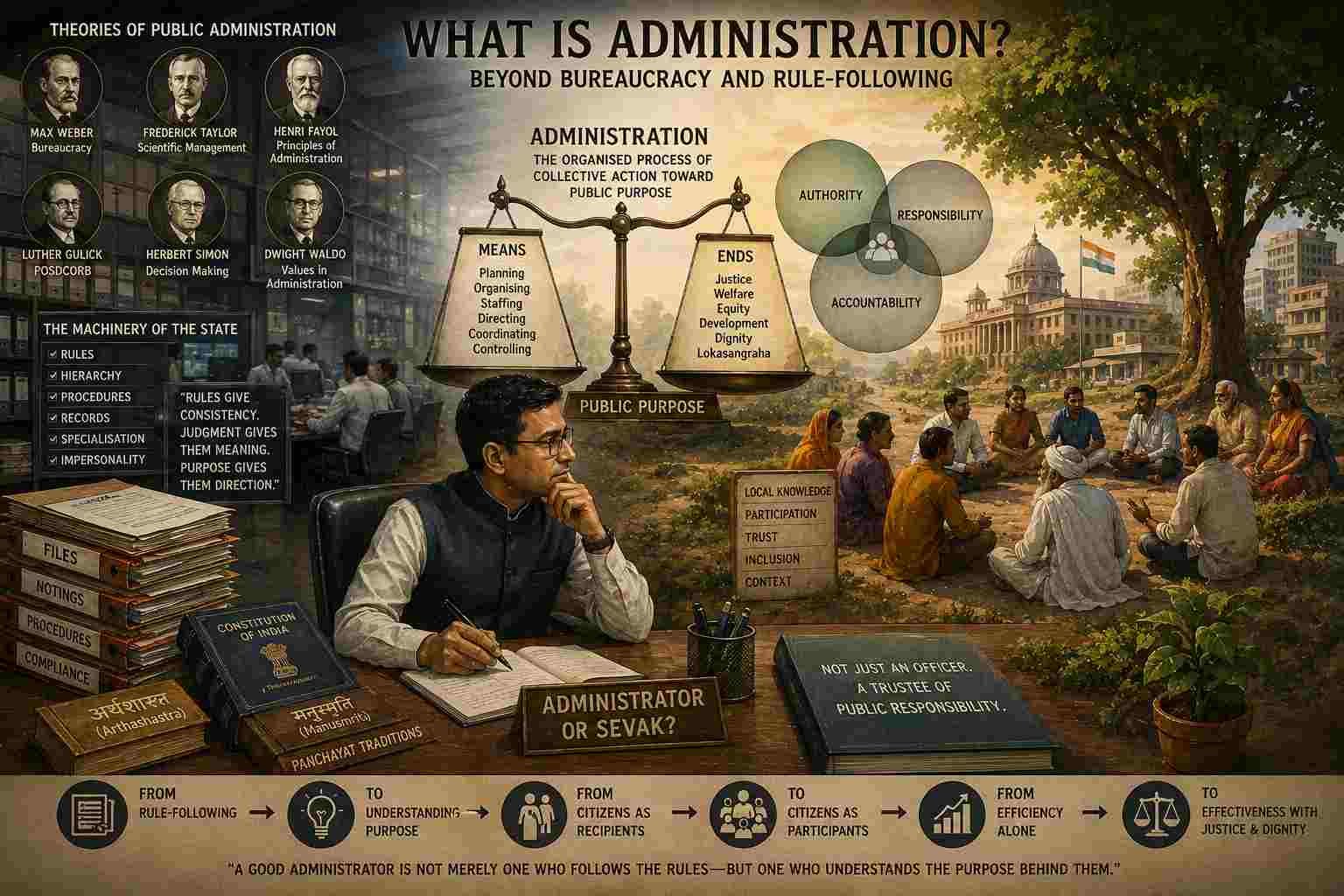
Public Administration Beyond Bureaucracy
Dharma, Lokasaṅgraha and the Indic Theory of Administration
Administration Is More Than Government
When I teach Public Administration, I often begin with a simple question: What exactly are we studying when we study administration?
The conventional answer is familiar. We study government organisations, bureaucracy, hierarchy, authority, personnel, budgeting, policy implementation and administrative reform. We move from Woodrow Wilson and Max Weber to Taylor, Fayol, Gulick, Herbert Simon and Dwight Waldo, and later to New Public Administration, New Public Management and governance.
This intellectual history is important. But I believe something is missing when this history is presented as though administration essentially began with the modern Western state. The modern state did not invent administration. It gave administration a particular institutional form. Every society has had to organise resources, responsibilities, authority, public works, security and collective purposes. The important question is therefore not merely how administration is organised, but what conception of society administration is intended to sustain.
This is where a Hindu perspective becomes intellectually important. I use the term Hindu deliberately. Dharma, rājadharma, daṇḍanīti and lokasaṅgraha are not interchangeable with generic modern terms such as “good governance.” They emerge from a civilizational understanding in which authority is connected with duty, social order and the larger purposes of life.
My argument is simple: Public Administration becomes incomplete when administrative technique is separated from administrative purpose.
From Wilson to Weber: The Rise of Administrative Rationality
Woodrow Wilson’s 1887 essay The Study of Administration helped establish administration as a distinct field of study. Wilson was concerned with administrative competence, organisation and the professionalisation of government.
Max Weber subsequently provided one of the most influential analytical accounts of bureaucracy. His model emphasised hierarchy, specialised offices, written records, defined jurisdictions, impersonal rules and legal-rational authority.
Weber’s achievement remains fundamental. Large modern societies require predictable institutions rather than government based entirely on personal preference.
But bureaucracy has an inherent problem: rules are general, while human circumstances are particular. A citizen may have a genuine problem that does not fit neatly into a bureaucratic category. An officer may follow every procedure and yet fail to solve the problem for which the procedure exists. This is why Weber’s bureaucracy should be understood as an institutional form, not as a complete theory of good administration.
Efficiency Is a Means, Not the Purpose
Taylor’s scientific management, Fayol’s principles of management and Gulick’s POSDCORB brought efficiency, coordination and executive functions to the centre of administrative thought. Their contribution is undeniable. Public institutions cannot function without planning, staffing, coordination, reporting and budgeting.
But I would ask my students to make one distinction very carefully: Efficiency is not the same thing as administrative goodness.
An administration can become extremely efficient at doing the wrong thing. A welfare department may meet its numerical targets while failing the people most in need. A school system may increase enrolment without improving learning. A city may complete infrastructure projects while weakening the communities that depend upon them.
Taylor can help us ask how efficiently something can be done. Public Administration must also ask what it should be doing in the first place. This is the point at which administrative theory becomes political philosophy.
Simon, Bounded Rationality and Administrative Judgment
Herbert Simon challenged the older search for universal “principles of administration” through his theory of bounded rationality. Administrators do not possess perfect information, unlimited time or unlimited cognitive capacity. They therefore make decisions under conditions of uncertainty and limitation.
This insight is central to modern administrative theory. It also leads to an important conclusion: administration necessarily involves judgment.
Michael Lipsky later demonstrated this through his theory of street-level bureaucracy. Frontline officials—teachers, police officers, social workers and other public servants—exercise discretion because policies cannot anticipate every situation. Their everyday decisions can therefore shape how policy actually operates.
The administrator is consequently not merely a machine applying rules. And once judgment becomes unavoidable, administrative ethics becomes unavoidable.
Waldo and the Return of Values
Dwight Waldo’s The Administrative State challenged the idea that administration could be understood as a purely technical activity. Administration distributes resources, exercises authority and affects citizens differently. It therefore involves values. This also complicates the classical politics–administration dichotomy associated with Wilson. Political leaders may formulate policy, but administrators interpret, prioritise and implement it. Implementation is therefore not politically or socially neutral.
I would make an important distinction here: Administrative neutrality does not mean moral neutrality.
An administrator should not become an instrument of partisan politics. But this does not mean that an administrator is free from responsibility for justice, public welfare, institutional integrity or the consequences of administrative decisions.
The Hindu Question: What Is the Dharma of Administration?
At this point, the Hindu intellectual tradition offers a different starting point. Instead of beginning with organisational efficiency, it asks about dharma. The concept of rājadharma in the Mahābhārata places political authority within a framework of obligation. The ruler possesses power, but power itself creates responsibility.
Kauṭilya makes the relationship between authority and public welfare remarkably explicit:
prajāsukhe sukhaṃ rājñaḥ prajānāṃ ca hite hitam
nātmapriyaṃ hitaṃ rājñaḥ prajānāṃ tu priyaṃ hitam
“The king’s happiness lies in the happiness of his subjects; his welfare lies in their welfare.” This is more than a statement about benevolent kingship. It establishes a principle of public purpose. The ruler’s personal preference cannot be the standard of public good.
That principle can be translated into an administrative question: Does the institution exist for itself, or does it exist for the purpose for which society entrusted it with authority?
The answer should be obvious, but administrative systems frequently forget it.
Kauṭilya and the Problem of State Capacity
Kauṭilya’s Arthaśāstra is particularly important because it prevents us from turning Indic political thought into a purely moral discourse. Kauṭilya is deeply concerned with state capacity: revenue, officials, intelligence, law, agriculture, infrastructure, security, trade and administration.
The state must possess the capacity to act. But capacity is not sufficient. A powerful state can still become predatory. An efficient bureaucracy can still become self-serving. Coercive authority can still become arbitrary.
This is where daṇḍanīti becomes significant. The state requires daṇḍa, the authority to enforce order, but that authority must itself be exercised within a larger normative framework. Political power cannot simply justify itself by virtue of possessing power.
Thus an Indic administrative framework brings together two dimensions that are often separated: Capacity and restraint.
Lokasaṅgraha: The Larger Purpose of Administration
For me, one of the most important concepts for developing an Indic Public Administration is lokasaṅgraha from the Bhagavad Gītā.
Kṛṣṇa tells Arjuna:
lokasaṅgraham evāpi sampaśyan kartum arhasi
“You should act, keeping also in view the holding together and welfare of the world.”
The exact interpretation of lokasaṅgraha varies across commentators, including “welfare,” “protection,” “guidance” and “holding together.” That range is itself significant.
Administration is not merely about delivering services. It is also about sustaining the conditions of collective life. This gives us a broader standard than efficiency. A policy may increase output while damaging social cohesion. A development project may produce economic growth while destroying ecological foundations. A welfare programme may distribute benefits while weakening social agency.
Lokasaṅgraha asks a larger question: Does public action contribute to the stability, welfare and continuity of the social order?
Beyond the Bureaucratic State
This also allows us to reconsider the assumption that administration is synonymous with the state.
Modern governance theory has increasingly recognised networks, communities and multiple centres of decision-making. Vincent Ostrom’s theory of polycentric governance is particularly relevant here. The Indian experience provides an important field for examining this question. Historically, social organisation was not confined to the formal state. Pañcāyats, śreṇīs and other community institutions performed regulatory, economic and social functions in different periods and regions.
I am not suggesting that these institutions were perfect or that we should romanticise the past.
The theoretical point is different: Administrative capacity need not always mean centralised state capacity.
A community may possess local knowledge that a distant bureaucracy lacks. A professional body may regulate conduct more effectively than a central department. A local institution may generate social trust that a formal administrative structure cannot easily manufacture.
This is where Indic institutional experience can enter into serious dialogue with contemporary theories of polycentric governance.
From “Efficiency” to “Dharma”
If I were to reduce the entire argument to one framework for Public Administration students, I would place five concepts alongside the conventional administrative vocabulary:
- Weber → Bureaucracy and legal-rational authority
- Simon → Decision-making and bounded rationality
- Waldo → Values in administration
- Kauṭilya → State capacity, artha and daṇḍanīti
- Bhagavad Gītā → Karma, svadharma and lokasaṅgraha
The objective is not to replace Weber with Kauṭilya or Simon with the Gītā. That would be intellectually superficial. The objective is to recognise that they ask different questions about administration. Western administrative theory has given us powerful tools for understanding organisation, rationality, bureaucracy and institutional performance.
Hindu political thought allows us to ask a prior question: What is the dharma of organised public power? That question cannot be answered by an efficiency index.
Conclusion: The Administrator Is More Than an Official
I do not want Public Administration students in Bharat to reject Weber, Wilson, Simon or Waldo. I want them to read these thinkers critically and understand the historical problems they were addressing. But I also want them to recognise that these theories do not exhaust the intellectual possibilities of administration.
For me, the Hindu contribution begins with a different relationship between power and duty. Dharma asks what sustains rightful order. Rājadharma asks what political authority owes society. Daṇḍanīti asks how coercive power should be exercised. Artha asks how material and institutional capacity can be built. Lokasaṅgraha asks whether action sustains the larger social order. These are not decorative Sanskrit additions to a Western syllabus. They can become the foundations of a serious Indic theory of Public Administration.
The administrator, therefore, is not merely an official who processes files, applies rules and meets targets. Authority creates obligation. Office creates responsibility. Administration exists for a purpose larger than the administration itself. That, I believe, is where Public Administration in Bharat must begin its next intellectual journey.
References
- Gulick, L. (1937). Notes on the theory of organization. In L. Gulick & L. Urwick (Eds.), Papers on the Science of Administration. Institute of Public Administration.
- Kangle, R. P. (1960–1965). The Kauṭilīya Arthaśāstra. University of Bombay.
- Kauṭilya. Arthaśāstra, Book I, Chapter 19, “The Duties of a King.”
- Lipsky, M. (2010 [1980]). Street-Level Bureaucracy: Dilemmas of the Individual in Public Services. Russell Sage Foundation.
- Ostrom, V. (1973). The Intellectual Crisis in American Public Administration. University of Alabama Press.
- Simon, H. A. (1947). Administrative Behavior. Macmillan.
- Waldo, D. (1948). The Administrative State. Ronald Press.
- Weber, M. (1978). Economy and Society. University of California Press.
- Wilson, W. (1887). The study of administration. Political Science Quarterly, 2(2), 197–222.
- Bhagavad Gītā, 3.20.
- Mahābhārata, Śāntiparva, sections on Rājadharma.