An Introduction to “Retaining Balance: The Eternal Way” | Indic Social Studies Series
(Yet to be Published)
Series: An Indic Social Studies Series
Published by: Centre for Indic Studies, Indus University
Author (Original Work): M. R. Venkatesh
Original Book: Retaining Balance: The Eternal Way
Booklet: Selected excerpts, observations and introductory insights from Retaining Balance
Access: Open Educational Resource / Free Academic Publication (Non-Commercial)
About the Booklet
As part of the Indic Social Studies Series published by the Centre for Indic Studies, Indus University, this educational booklet introduces readers to M. R. Venkatesh’s Retaining Balance: The Eternal Way and some of the central questions it raises about economics, society, family, civilisation and human well-being.
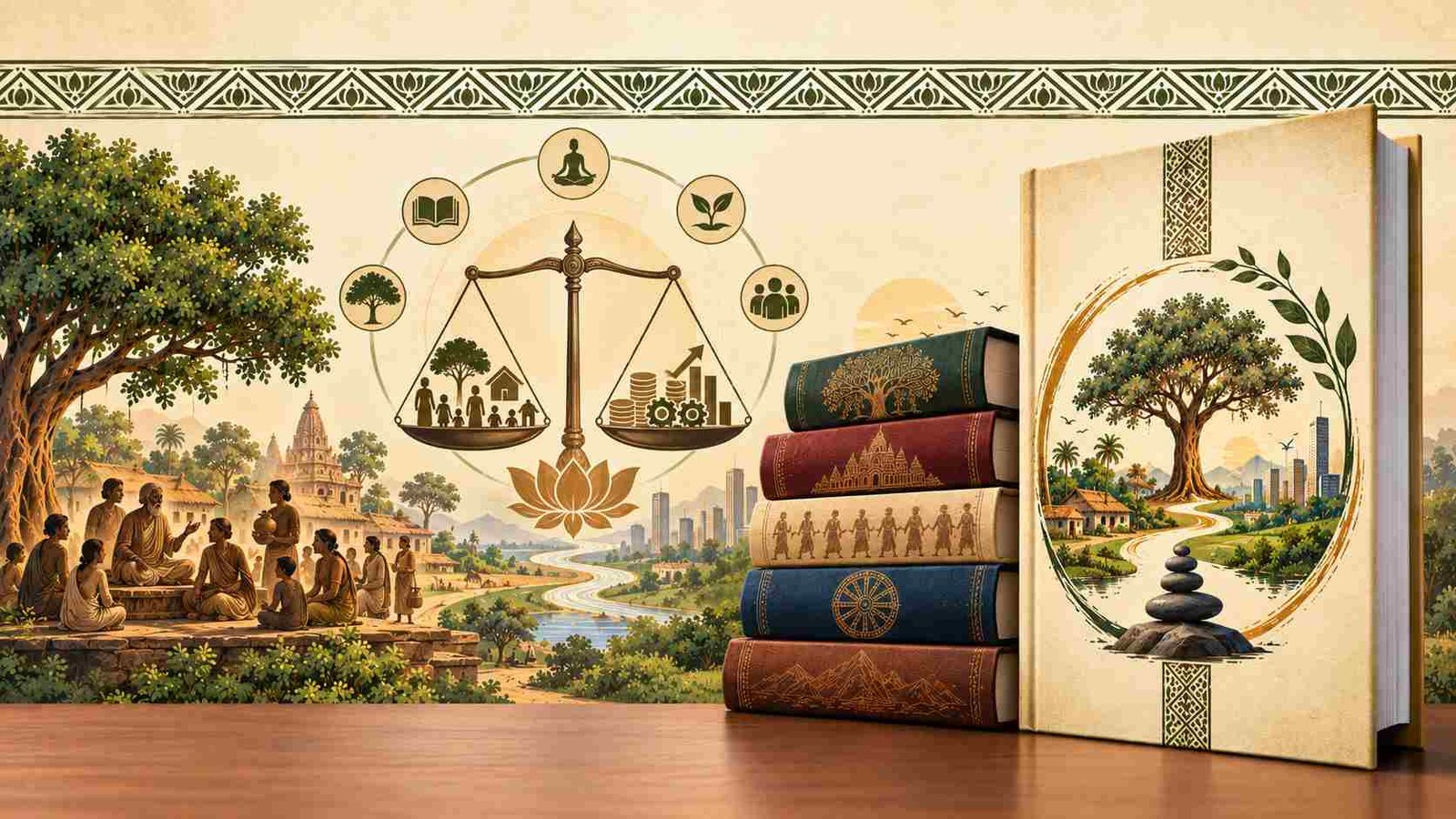
The book examines contemporary economic thought by bringing attention to institutions that often remain outside conventional economic models, particularly family, society, community and civilisational values. Its broader argument is concerned with the question of balance: how economic systems can account not only for the individual, markets and the State, but also for the social institutions and restraints through which human life is organised.
The booklet provides selected material from the work along with introductory insights intended to help students and researchers engage with its larger questions.
What’s Inside This Booklet?
1. Selected Insights from Retaining Balance
The booklet brings together selected ideas from Venkatesh’s work and introduces some of the questions he raises regarding contemporary economics and economic policy.
2. Beyond the Individual
A recurring concern in the book is the place of the individual within larger social institutions. Venkatesh examines the importance of family, society and community in understanding economic behaviour and social organisation.
3. The Missing Middle
The work asks what happens when economic analysis moves primarily between the individual and large institutions such as the market or the State, while intermediate institutions and communities receive less attention. The book explicitly develops this concern through its discussion of “the missing middle.”
4. Economics and Civilisation
The booklet introduces the argument that economics cannot be completely separated from the cultural and civilisational context in which economic behaviour takes place. Questions of family, culture, social responsibility and civilisation therefore become part of the economic discussion.
5. The Power of Restraint
One of the book’s chapters directly addresses restraint and its relationship with sustainability. The idea provides an important entry point into the book’s larger concern with maintaining balance in economic and social life.
Primary Goals
- Introduce an Indic Economic Perspective: Provide an accessible entry point into Venkatesh’s attempt to rethink contemporary economic questions through civilisational and social categories.
- Bring Family and Community into Economic Discussion: Examine the role of institutions that exist between the individual and the State or market.
- Explore the Idea of Balance: Understand the relationship between economic freedom, social responsibility, restraint and sustainability.
- Question Established Economic Categories: Encourage readers to examine whether prevailing economic frameworks adequately account for culture, family and community.
- Encourage Further Research: Use the booklet as a starting point for examining the possibilities of developing economic thought from within Indian civilisational experience.
Key Topics Covered
- Economics and Civilisation
- Individual, Family and Society
- The Missing Middle
- Culture and Economic Life
- Sustainability and Restraint
- Economic Policy and Social Institutions
- Rights and Duties
- Family as a Social Institution
- Economic Reform and the Reform of Economics
- Rama Rajya and the Question of Governance
The book’s chapter structure itself reflects this wide scope, including discussions on family, culture and economics, the “missing middle,” taxation, economic reform, restraint and Rama Rajya.
Why This Booklet?
At the centre of Retaining Balance is a question that goes beyond economics in the narrow sense:
What happens to an economy when the individual is separated from the family, the family from society, and economic activity from the civilisation in which it exists?
The booklet uses Venkatesh’s work to open this question for discussion. It examines the possibility that economic life cannot be understood only through markets, prices, production and consumption, but also requires attention to the social institutions, cultural values and restraints that shape human behaviour.
In this sense, Retaining Balance becomes a useful text for the broader Indic Social Studies Series, because it invites us to reconsider not only what economics studies, but also what kinds of social relationships and civilisational assumptions are already built into the way economics is studied.