An Introduction to “State and Government in Ancient India” | Indic Social Studies Series
(Yet to be Published)
Series: An Indic Social Studies Series
Published by: Centre for Indic Studies, Indus University
Author (Original Work): A. S. Altekar
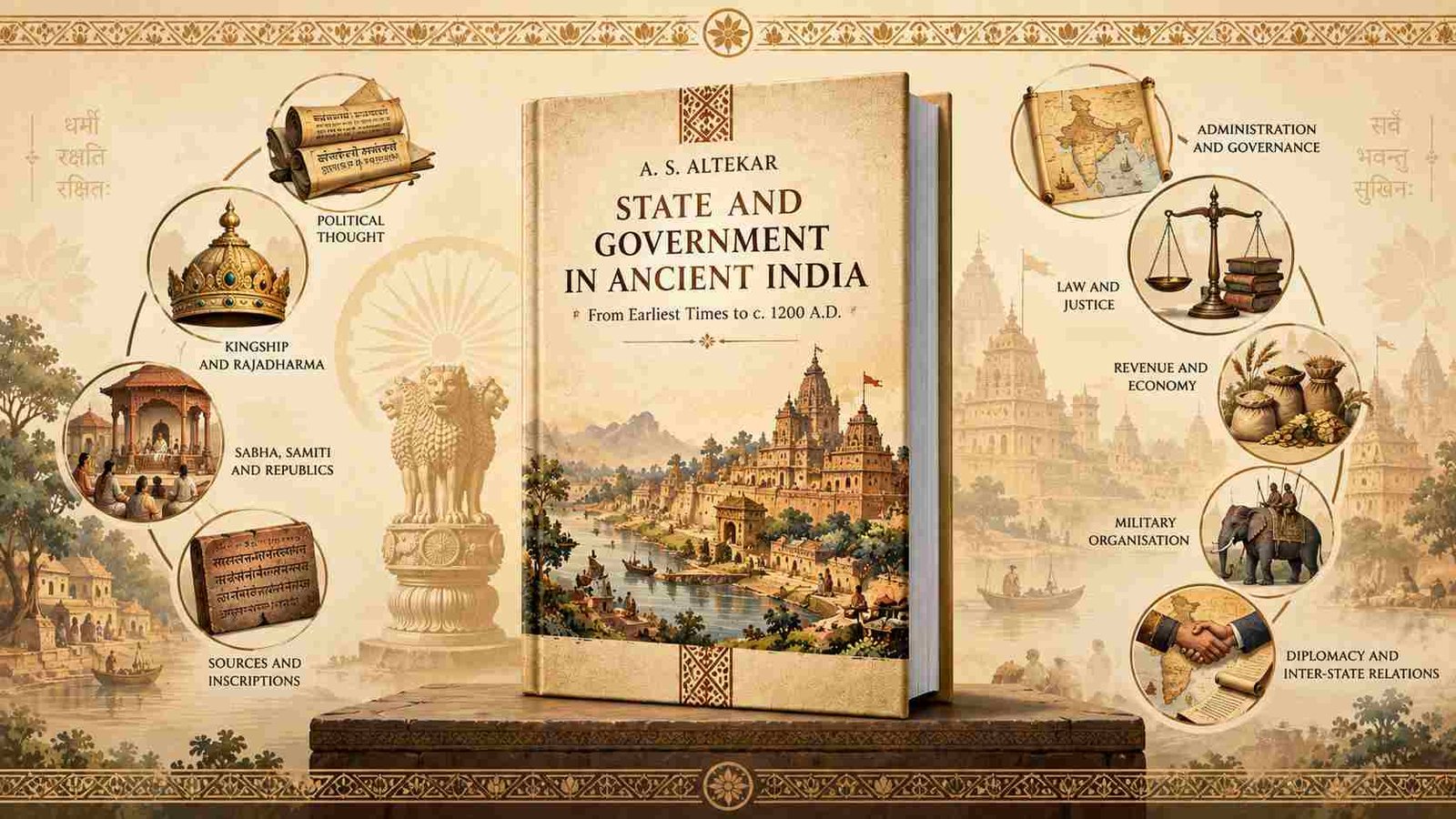
Original Book: State and Government in Ancient India: From Earliest Times to c. 1200 A.D.
Original Publisher: Motilal Banarsidass
Booklet: Selected excerpts, observations and introductory insights from State and Government in Ancient India
Access: Open Educational Resource / Free Academic Publication (Non-Commercial)
About the Booklet
As part of the Indic Social Studies Series published by the Centre for Indic Studies, Indus University, this educational booklet introduces the important work of A. S. Altekar, State and Government in Ancient India.
First published in 1949, the work attempts a comprehensive study of political ideas, institutions and administrative practices in ancient India, tracing their development from the earliest periods to approximately 1200 A.D.
Altekar does not limit his study to political theory alone. He draws upon a wide range of sources, including Vedic and classical literature, Buddhist and Jain texts, the Arthaśāstra tradition, accounts of foreign travellers, and inscriptions. His purpose is to bring together theoretical descriptions of polity with evidence concerning actual political and administrative institutions.
The book therefore provides an important starting point for asking a larger question: How did Indians think about the state, political authority, kingship, administration and the relationship between power and social order?
What’s Inside This Booklet?
1. Political Thought in Ancient India
An introduction to the different terms and traditions through which political knowledge was discussed, including Rājyasāstra, Daṇḍanīti and Arthaśāstra. Altekar himself begins by examining the scope of these traditions and the sources through which ancient Indian political thought can be studied.
2. The State and Its Functions
The booklet examines ideas concerning the origin, nature, aims and functions of the state, including the organisation of political authority and the relationship between the ruler and the wider social order.
3. Kingship and Rajadharma
Attention is given to kingship, coronation, duties of the ruler, ministers and the responsibilities associated with political authority. The question is not simply who rules, but also what the ruler is expected to do.
4. Republics and Political Assemblies
Altekar’s study also examines institutions beyond monarchy, including ancient republics, popular assemblies, sabha, samiti, Paura-Janapada and other forms of collective political organisation.
5. Administration, Justice and Revenue
The work discusses the organisation of government, officials, provinces and districts, judicial administration, taxation, revenue and expenditure, military organisation and other branches of administration.
6. Inter-State Relations
The booklet also introduces ancient Indian thinking on relations between states, including diplomacy, warfare and the Maṇḍala theory associated with the Arthaśāstra tradition. Altekar specifically expanded his treatment of interstate relations and the Maṇḍala theory in later editions.
Primary Goals
- Introduce students to the study of ancient Indian political institutions
- Examine indigenous categories of political thought such as Rājya, Dharma, Daṇḍanīti and Arthaśāstra
- Explore the relationship between king, state, society and political obligation
- Revisit evidence for monarchical and republican institutions
- Introduce the administrative dimensions of ancient Indian polity
- Encourage further research into the sources and development of Indian political thought
Key Topics Covered
- Ancient Indian Political Thought
- Rājyasāstra, Daṇḍanīti and Arthaśāstra
- Origin and Nature of the State
- Kingship and Rajadharma
- Ministers and Political Administration
- Sabha and Samiti
- Ancient Republics
- Central and Provincial Administration
- Village and Local Institutions
- Judicial Administration
- Taxation and Revenue
- Military Organisation
- Diplomacy and Inter-State Relations
- Maṇḍala Theory
- Development of Political Institutions
A Question to Begin With
When we speak of the history of political science, where do we begin?
With the modern state? With constitutional government? With political parties and elections?
Or should the history of political inquiry also include much older questions about kingship, political obligation, justice, administration, taxation, diplomacy, social order and the duties of the ruler?
Altekar’s State and Government in Ancient India provides one substantial attempt to examine these questions through the political literature and historical evidence of ancient India.