Āpastamba Dharmasūtra: Reading Dharma as a Public Order
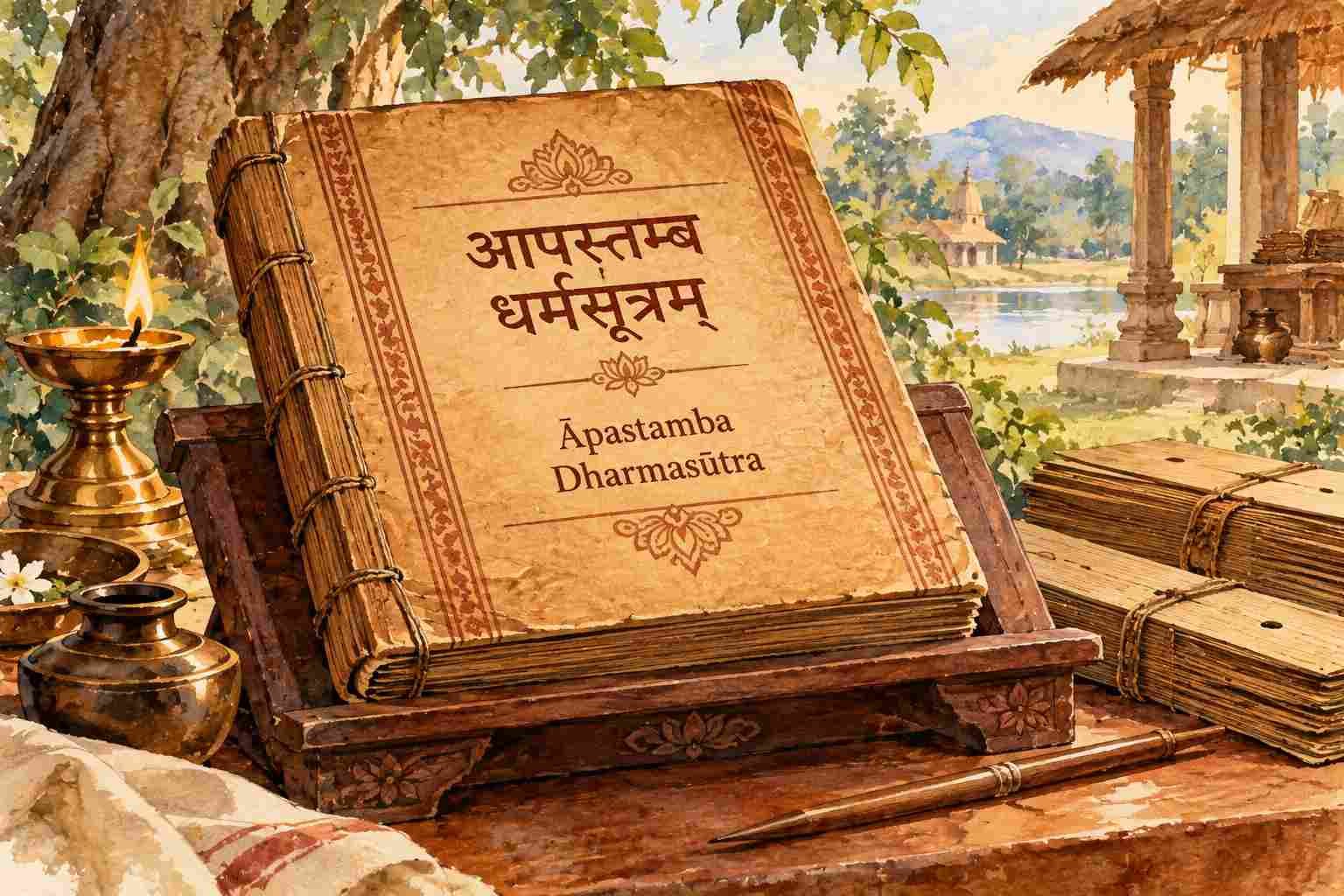
When we move from the Gautama Dharmasūtra to the Āpastamba Dharmasūtra, we are not merely reading another law-book. We are entering one of the earliest and most carefully organised attempts to ask: what makes human conduct lawful, and who has the authority to decide? The Āpastamba Dharmasūtra forms part of the larger Āpastamba Kalpasūtra and is preserved within its thirty praśnas; the Dharmasūtra proper consists of two praśnas, divided into paṭalas and khaṇḍas.
Its opening is startlingly modest. It does not begin with a cosmic king, a divine command, or a theory of punishment. It begins with agreement among those who know the law:
समाम्नायस्य साधूनाम्
“The authority for these duties is the agreement of those who know the law.”
— Āpastamba Dharmasūtra I.1.1.2
And then it immediately anchors that agreement in the Veda:
तस्य च वेदा एकं प्रमाणम्
“And the Vedas alone are its authority.”
— Āpastamba Dharmasūtra I.1.1.3
Here is the first question I would place before the reader: if dharma rests on Veda, why does Āpastamba also need the learned consensus of sādhus? The answer is that Veda is the final source, but human society needs interpreters who can apply it to changing circumstances. Dharma is not a frozen code; it is a tradition of authorised interpretation.
What kind of text is this?
The Āpastamba Dharmasūtra belongs to the Kalpasūtra tradition—the practical literature that guided ritual, domestic life, and social conduct. The larger Āpastamba Kalpasūtra contains thirty praśnas, including the Śrautasūtra, Mantrapāṭha, Gṛhyasūtra, and Śulvasūtra; the Dharmasūtra is the section concerned with sacred law and customary duty.
| Feature | Description |
|---|---|
| Text | Āpastamba Dharmasūtra |
| Place in corpus | Part of the Āpastamba Kalpasūtra |
| Structure | Two praśnas, each divided into paṭalas and khaṇḍas |
| Form | Extremely compressed sūtra prose |
| Chief concerns | Varna, studentship, purity, household, marriage, inheritance, penance, king, and judicial duty |
| Political importance | One of the earliest sustained statements of rājadharma, punishment, taxation, and judicial procedure |
| Standard translation | Georg Bühler, Āpastamba Dharmasūtra, Sacred Books of the East |
The text is not “religious law” in the narrow modern sense. It is a map of the entire social field: how one studies, eats, marries, inherits, rules, judges, and repairs moral failure.
The architecture of the text
The two praśnas should be read as two movements of one argument.
| Section | Main contents |
|---|---|
| Praśna I | Varna, Vedic studentship, upanayana, study of the Veda, purity, food, conduct of the snātaka, duties of the four varṇas, marriage, and the householder |
| Praśna II | Householder’s daily rites, hospitality, forms of marriage, partition of property, śrāddha, ascetics, king’s duties, judicial procedure, and penance |
A more detailed table of contents helps us see the text’s design.
| Praśna | Paṭalas / Khaṇḍas | Principal theme |
|---|---|---|
| I | 1.1–1.4 | Sources of dharma; the four varṇas; hierarchy and social order |
| I | 1.5–2.6 | Upanayana, studentship, conduct toward the teacher, Vedic recitation |
| I | 2.7–3.9 | Purity, food, bathing, restrictions on eating, and discipline of the student |
| I | 4.10–5.17 | Rules for the snātaka, the graduate householder, and social conduct |
| I | 6.18–7.21 | Occupations and duties of the four varṇas |
| I | 8.22–9.26 | Marriage, household life, and duties of husband and wife |
| II | 1.1–2.5 | Daily sacrifices, hospitality, guests, and domestic worship |
| II | 3.6–4.10 | Marriage types, property, and inheritance |
| II | 5.11–6.14 | King, punishment, judicial inquiry, witnesses, and civil disputes |
| II | 7.15–10.26 | Śrāddha, ancestral offerings, impurity, and purification |
| II | 10.27–11.29 | Ascetics, renunciation, and alternative paths of discipline |
| II | 11.30–12.32 | Penances, sins, and restoration of ritual and social standing |
The table is thematic rather than a mechanical reproduction of every printed heading; editions and translations differ slightly in how they label sections. But the movement is unmistakable: from the student to the householder, from the household to the king, and finally from social order to moral repair.
Dharma begins with social knowledge
Āpastamba’s first chapter gives us the four varṇas:
चत्वारो वर्णा ब्राह्मणाः क्षत्रिया वैश्याः शूद्राः
“There are four varṇas: Brāhmaṇas, Kṣatriyas, Vaiśyas, and Śūdras.”
— Āpastamba Dharmasūtra I.1.1.4
तेषां पूर्वो जातया श्रेयान्
“Among them, each preceding varṇa is superior by birth to the one following.”
— Āpastamba Dharmasūtra I.1.1.5
We should not soften this. The text accepts birth-based hierarchy and makes it foundational to its social vision. Yet it is equally important to see that hierarchy is not presented as arbitrary power. It is tied to duties: the Brāhmaṇa to Veda and teaching, the Kṣatriya to protection and governance, the Vaiśya to production and exchange, and the Śūdra to service. The political question is therefore not merely “who is superior?” but “what obligation accompanies each position?”
This is where modern readers must be alert. A Dharmasūtra is not a democratic constitution; it is a hierarchical social theory. But it is also not a licence for unaccountable rule. Its political strength lies in binding the king to procedure, evidence, and duty.
The king is not above dharma
The most politically significant portion of the text is its treatment of the king. Āpastamba does not present kingship as personal dominance. The king is the guardian of social order, and punishment is his instrument—but only when exercised after proper inquiry.
Bühler’s translation of Āpastamba Dharmasūtra II.5.11.1 states that the king may inflict punishment, including capital punishment, upon non-Brāhmaṇas only after examining the act, questioning witnesses, and applying the proper means of judicial proof; he must not punish on mere suspicion.
This is a crucial point. In the Āpastamba Dharmasūtra, daṇḍa is not raw violence. It is a legally conditioned act. The king may punish, but only after inquiry; he must not act from anger, partiality, or suspicion. And if he fails to punish when punishment is required, the moral burden of the offence falls upon him.
Ask yourself: why does the text make judicial procedure more important than the king’s will? Because in this vision, sovereignty is not the right to command. Sovereignty is the duty to protect dharma through lawful judgment.
Law, evidence, and the limits of power
The Āpastamba Dharmasūtra belongs to a wider Dharmasūtra world in which kingship includes civil administration, taxation, criminal law, and judicial procedure. Its treatment of disputes, witnesses, inheritance, and punishment shows that dharma was meant to operate as a public order, not only as private ritual purity.
| Political concept | Āpastamba’s emphasis |
|---|---|
| King | Protector of varṇa-dharma and social order |
| Daṇḍa | Necessary, but rule-bound and evidence-based |
| Judicial duty | Inquiry before punishment; no decision on suspicion |
| Taxation | A royal function, but linked to protection and governance |
| Inheritance | Family continuity regulated by public norms |
| Penance | Social restoration after moral failure |
This is why I would call the Āpastamba Dharmasūtra one of the early foundations of Indian political thought. Before Kauṭilya systematises statecraft, before the Mahābhārata elaborates rājadharma on a vast scale, Āpastamba already asks: what may a king do, under what proof, and at what moral cost?
Household, purity, and the ordinary person
It would be a mistake to read the text only politically. Much of it concerns the ordinary rhythm of life: when to eat, how to bathe, how to receive a guest, how to perform the daily offering, and how to conduct oneself after Vedic study.
The text’s concern with purity is not merely “hygiene.” Purity marks boundaries of social participation, ritual fitness, and moral discipline. For example, the text regulates eating and contact in ways that reveal how deeply ritual status shaped everyday life.
But there is another side. The householder is not a lesser figure than the renouncer. Āpastamba gives the householder a central place: through marriage, hospitality, sacrifice, and family duty, the householder sustains the social order. The praśna on householders begins with marriage and the rites of the householder and his wife.
Here we may ask: is the householder in Āpastamba a private individual or a public institution? In my reading, the answer is clear: the householder is a public institution. He feeds guests, performs sacrifices, produces heirs, transmits property, and maintains the chain of ritual obligation.
Inheritance and the question of justice
The text also deals with property and succession. In one passage, it permits a father to divide wealth among his sons during his lifetime, while excluding certain categories of persons from inheritance.
जीवति पितरि पुत्राणां विभागः
“During the father’s lifetime, there may be division of property among the sons.”
— Āpastamba Dharmasūtra II.6.14.1, thematic rendering
The exact Sanskrit wording should always be checked against a critical edition before publication, but the legal principle is clear: inheritance is not merely family sentiment. It is a matter of public law, regulated by rules of kinship, capacity, and social status.
This raises a question worth putting to any reader: can a society have family law without political authority? Āpastamba’s answer is no. Family, property, marriage, and succession all require norms that extend beyond the household.
Why Āpastamba matters today
I return to the opening. Āpastamba says that dharma rests on Veda, but its application depends on the agreement of the learned. That is a profound political idea. It means that no king, no caste, no single teacher, and no text can simply announce dharma without accountability to a wider body of knowledgeable tradition.
In my view, the enduring contribution of the Āpastamba Dharmasūtra is this: it imagines society as an ordered whole in which authority is distributed. The teacher governs the student, the husband and wife sustain the household, the king judges disputes, and the penitential system repairs failure. No one holds unlimited power.
The text is hierarchical, patriarchal, and deeply embedded in varṇa assumptions. We must say so plainly. But it also contains a disciplined political imagination: power must be lawful, punishment must follow inquiry, property must follow rules, and dharma must remain larger than any individual who claims to speak for it.
That is why the Āpastamba Dharmasūtra still deserves careful reading—not as a manual to be accepted wholesale, but as one of the earliest Indian efforts to think seriously about order, authority, justice, and the limits of power.