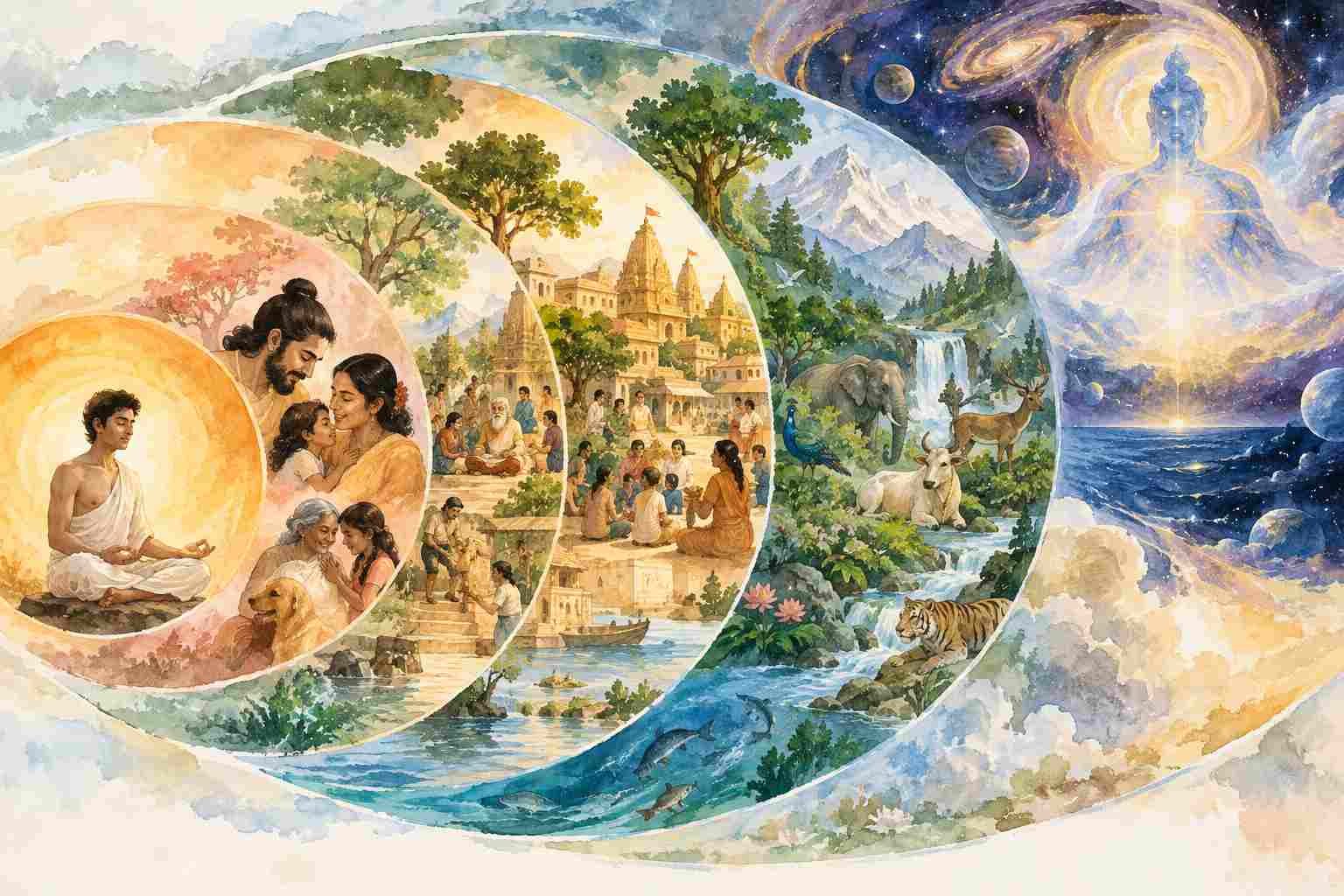
From Piṇḍa to Brahmāṇḍa: Where Does the Individual Stand in the Universe?
The Sanātana Model, relational existence and the different ways human beings have understood their place within society, nature and the cosmos.
What is an individual? Is a person an autonomous unit who enters into relationships by choice? Is the person constituted by family, community and institutions? Or is individual existence part of a much wider order that includes nature, the cosmos and a transcendent reality?
These questions lie at the heart of social and political thought. They influence how we understand rights, duties, family, community, governance, economic life and the purpose of human existence. The answers differ across intellectual traditions, and these differences are important.
The Sanātana Model approaches the question through a relational understanding of existence. It begins with the individual, but does not treat the individual as an isolated unit. It asks how human life is connected with progressively wider social, political, ecological and cosmic orders.
01. The Architecture: From Piṇḍa to Brahmāṇḍa
The movement from piṇḍa to brahmāṇḍa provides a way of thinking about the individual in relation to the larger world. The individual lives through relationships, participates in institutions, belongs to communities and political orders, and depends upon an environment that extends beyond human society.
Individual
→
Family
→
Society
→
Institutions
→
Local community
→
Region and state
→
Civilizational community
→
Creation and cosmos
These are not simply levels in a political hierarchy. Each represents a different field of relationships and responsibilities. Family influences the individual, but individuals also sustain and transform family life. Institutions organise social activity, but their legitimacy depends partly on how they serve the communities within which they operate. Political orders depend on social cooperation, while human society itself depends upon ecological conditions it cannot entirely control.
The sequence above is a contemporary analytical synthesis inspired by Indic categories. It should not be presented as a single, fixed sequence found verbatim in one ancient text. Similarly, the expression yathā piṇḍe tathā brahmāṇḍe is associated with microcosm–macrocosm thinking, but its textual history and interpretation vary across traditions.
02. Five Positions: How Is the Individual Understood?
To compare different traditions, we can arrange their approaches along five analytical positions. These positions help distinguish the individual as the primary unit of explanation, the individual as relational, the individual as socially constituted, the individual as part of a cosmic-ecological order, and the individual in relation to a transcendent reality.
| Position | Meaning | The individual is placed as… |
|---|---|---|
| A. Individual-primary | The person is the basic moral or explanatory unit. | An autonomous, rights-bearing, self-interested or choosing agent. |
| B. Relational individual | The person exists through relationships. | A spouse, child, friend, citizen and participant in shared life. |
| C. Socially embedded | Family, community and institutions help constitute the person. | A member of a moral, cultural and institutional order. |
| D. Cosmic-ecological | The person is understood as part of nature and the cosmos. | A microcosm within a wider macrocosm. |
| E. Transcendent-oriented | The deepest self or ultimate purpose exceeds ordinary social and cosmic categories. | A self understood in relation to Ātman, Brahman or Paramātman, according to the particular philosophical tradition. |
These positions are not mutually exclusive boxes. A tradition may combine several of them. The Bhagavad Gītā, for example, can be examined through social responsibility, action and cosmic order. Vedānta traditions address transcendence, but differ substantially in their accounts of the self and ultimate reality. Buddhist dependent origination emphasises relational conditions without requiring the same metaphysical commitments as Vedānta.
The letters A–E are therefore a comparative instrument developed for this analysis. They are not the original categories of the thinkers being discussed.
A · Individual-primary
Rights, consent, agency, choice and individual action provide the main starting point.
B · Relational
Personhood is understood through reciprocal relationships and participation.
C · Socially embedded
Institutions, traditions and social obligations help form the individual.
D · Cosmic-ecological
Human life is situated within nature and a wider order of existence.
E · Transcendent-oriented
Human existence is examined in relation to a reality beyond ordinary social identity.
03. A Comparative Map of Traditions and Thinkers
The following table brings together Indic sources, modern Indian thinkers, other philosophical traditions, social theory and approaches that provide a contrast to the Sanātana Model. The purpose is not to claim that all these traditions teach the same thing. It is to identify what each contributes to the question of individual existence and where its ideas intersect with, or depart from, the Piṇḍa-to-Brahmāṇḍa framework.
The fit assessments are interpretive judgments for comparative study, not claims of historical influence or equivalence. In particular, a shared emphasis on relationships does not mean that two traditions share the same account of selfhood, society or ultimate reality.
| No. | Tradition / thinker | Key text or formulation | Position | Core claim about the individual | Fit with Piṇḍa–Brahmāṇḍa |
|---|---|---|---|---|---|
| 1 | Ṛgveda, Puruṣa Sūkta | Ṛgveda 10.90 | D | The human and social order is represented through the cosmic Puruṣa. | Very high: cosmic body and social body are correlated. |
| 2 | Vedic idea of Ṛta | Vedic hymns | D | Action and existence are considered in relation to an encompassing order. | High: personal action is measured against cosmic-moral order. |
| 3 | Taittirīya Upaniṣad | Five kośas | D–E | The person is explored through layers from the bodily to the blissful. | High: the individual is examined through progressively subtler dimensions. |
| 4 | Chāndogya Upaniṣad | Tat tvam asi | E | The self is related to the underlying reality of existence. | Very high: central to inquiry into self and universal reality, subject to interpretation. |
| 5 | Bṛhadāraṇyaka Upaniṣad | Self, creation and correspondences | D–E | The self is examined through correspondences between person, world and reality. | Very high: direct relevance to microcosm–macrocosm inquiry. |
| 6 | Īśā Upaniṣad | Īśāvāsyam idaṃ sarvam | D–E | The world is understood in relation to the divine. | High: places human life within a wider sacred order. |
| 7 | Bhagavad Gītā | Loka-saṅgraha; niṣkāma karma | B–D | Action can sustain the world and serve purposes beyond private gain. | High: personal action has social and wider ethical consequences. |
| 8 | Patañjali’s Yogasūtra | Aṣṭāṅga yoga | A–E | Discipline of body and mind leads towards the distinct goal of kaivalya. | Moderate–high: inner discipline is relevant, though the framework is not primarily social. |
| 9 | Buddhist thought | Paṭicca-samuppāda, dependent origination | B–D | Phenomena arise in dependence upon conditions rather than existing independently. | High relational relevance, though not formulated as a Brahmāṇḍa hierarchy. |
| 10 | Buddhist tradition | Sigālovāda Sutta; six directions | B–C | Human life involves reciprocal duties across family, work and community. | Moderate: strong relational ethics rather than cosmic metaphysics. |
| 11 | Jain tradition | Anekāntavāda; aparigraha | B–D | The individual is morally responsible in a world containing many living beings. | Moderate–high: ethical restraint and concern beyond the human individual. |
| 12 | Manusmṛti and Dharmaśāstra | Varṇāśrama-dharma | C | Normative duties are articulated in relation to social roles and stages of life. | Moderate: strong social embedding; requires critical attention to hierarchy and exclusion. |
| 13 | Kauṭilya | Arthaśāstra; Saptāṅga theory | C | People and social activity operate within a political and administrative order. | Low–moderate: useful for institutional and political analysis, not a direct metaphysical model. |
| 14 | Śaṅkara / Advaita Vedānta | Jīva–Brahman non-duality | E | Ultimate reality is non-dual; individuality is interpreted through the distinction between empirical and ultimate standpoints. | Very high, but unity is non-dual rather than a sequence of social levels. |
| 15 | Rāmānuja / Viśiṣṭādvaita | Śeṣatva; qualified non-dualism | D–E | The individual is real and dependent upon God. | High: relationship and unity are affirmed without simply erasing individual distinction. |
| 16 | Madhva / Dvaita Vedānta | Eternal difference | A–E | The individual soul remains distinct from God. | Moderate: relation is central, but identity and difference remain fundamental. |
| 17 | Kashmir Śaivism; Abhinavagupta | Pratyabhijñā | D–E | Recognition of consciousness is related to a universal dimension of consciousness. | Very high: a consciousness-centred approach to individual and universal reality. |
| 18 | Sikh tradition | Ik Oṅkār, sevā and saṅgat | B–E | Divine unity is connected with service, community and ethical life. | High: spiritual orientation joined to social responsibility. |
| 19 | Confucian tradition | Dàxué; self-cultivation and world order | B–C | Self-cultivation is connected with family, political order and the world. | Strong structural parallel, although the metaphysical framework differs. |
| 20 | Deendayal Upadhyaya | Vyaṣṭi–Samaṣṭi–Sṛṣṭi–Parameṣṭhi | B–E | Individual, society, creation and the Supreme belong to an integrated account of existence. | Closest direct modern formulation of the broader integrated model. |
| 21 | Swami Vivekananda | Practical Vedānta | B–E | Spiritual realisation has implications for service to humanity. | High: Vedāntic unity connected with social action. |
| 22 | Sri Aurobindo | Individual and collective evolution | D–E | Individual and collective life are considered within a wider evolutionary account of consciousness. | High: connects individual, collective and cosmic development. |
| 23 | M. K. Gandhi | Swaraj; village republic | B–C | Self-rule connects personal discipline with local self-government and national life. | Moderate–high: strong ethical and social relationships. |
| 24 | Vinoba Bhave | Sarvodaya; Gramdan | B–C | Community, shared responsibility and non-possession shape social life. | Moderate–high: a practical expression of ethical interdependence. |
| 25 | Hierocles | Concentric circles | B | Concern can expand from oneself to family, city and humanity. | Closest literal concentric-circle parallel, though primarily human-centred. |
| 26 | Aristotle | Household, village and polis; Politics | B–C | Human flourishing is connected with household and political community. | Moderate: nested associations without the same cosmic-transcendent sequence. |
| 27 | Ubuntu / Hunhu | Relational personhood | B–C | Personhood is understood through relationships with other people. | Strong relational parallel; meanings vary across African traditions. |
| 28 | Andean ayllu / ayni | Community and reciprocity | B–D | Kinship, land, labour and reciprocity form connected fields of life. | Strong ecological-communal parallel. |
| 29 | Māori traditions | Whakapapa; genealogy and place | B–D | Identity extends through ancestors, land and relations with the more-than-human world. | Strong relational-ecological parallel. |
| 30 | Aboriginal Australian traditions | Kinship, Country and ancestral law | B–D | Belonging and responsibility are rooted in Country, kinship and ancestral traditions. | Strong place-based relational approach; traditions must not be homogenised. |
| 31 | Ferdinand Tönnies | Gemeinschaft / Gesellschaft | B–C | Community-based and impersonal forms of social association differ. | Useful sociological comparison, without a cosmic layer. |
| 32 | Émile Durkheim | Social facts and solidarity | C | Social facts and institutions shape individual conduct. | Moderate: strong social embedding, generally within a secular sociological framework. |
| 33 | Marcel Mauss | The Gift | B–C | Exchange binds people through social, moral and sometimes religious obligations. | Moderate: relational economy and reciprocal obligation. |
| 34 | Norbert Elias | Figuration; The Society of Individuals | B–C | Individuals and society are inseparable networks of interdependence. | Strong modern relational parallel, without a necessary cosmic dimension. |
| 35 | Martin Buber | I and Thou | B | Human existence is illuminated through dialogical relationships. | Moderate: relational philosophy rather than a complete social or cosmic model. |
| 36 | Martin Heidegger | Mitsein; Being and Time | B | Being-with-others is constitutive of human existence. | Moderate: ontological relationality, not a sequence of social levels. |
| 37 | Maurice Merleau-Ponty | Embodiment | B–D | The person is embodied and engaged with a lived world. | Moderate–high: body-world continuity, but not a complete social model. |
| 38 | Alasdair MacIntyre | Practices and traditions | C | Moral agency develops within practices, traditions and narratives. | Moderate: tradition-shaped selfhood. |
| 39 | Charles Taylor | Moral horizons; Sources of the Self | B–C | Identity is formed within frameworks of meaning and moral evaluation. | Moderate: culturally embedded identity. |
| 40 | Michael Sandel | Embedded or encumbered self | B–C | Identity and obligations cannot always be separated from community and history. | Direct critique of strongly individual-primary models. |
| 41 | Michael Polanyi | Tacit knowledge | B–C | Knowledge depends partly on embodied practice and participation in communities. | Moderate: epistemological parallel concerning transmission and participation. |
| 42 | Gregory Bateson | Ecology of mind | D | Mind and environment are connected through patterns and feedback. | Strong systems-ecological parallel, but not a normative spiritual doctrine. |
| 43 | Ludwig von Bertalanffy | General Systems Theory | D | Wholes are understood through interacting parts and systems. | Analytical parallel; does not itself supply a moral or spiritual order. |
| 44 | Elinor Ostrom | Commons and polycentric governance | B–C | Communities can develop institutions for governing shared resources. | Strong empirical institutional parallel, rather than a metaphysical model. |
| 45 | E. F. Schumacher | Human-scale economics | B–D | Economic arrangements should be assessed in relation to human needs and ecological limits. | Strong practical parallel linking people, economy and environment. |
| 46 | Thomas Hobbes | Leviathan | A | Individuals authorise sovereign power to secure peace and escape insecurity. | Strong contrast in the account of political order and sovereignty. |
| 47 | John Locke | Natural rights and consent | A–B | Individuals possess rights, and legitimate government rests on consent. | Contrast where individual rights are treated as prior to political authority. |
| 48 | Jean-Jacques Rousseau | Social Contract | A–C | Political community must reconcile freedom with collective self-government. | Mixed case: individual freedom and collective political authority are both central. |
| 49 | Adam Smith | Market coordination and division of labour | A–B | Social cooperation can emerge through exchange, specialisation and commercial society. | Partial contrast: coordination through exchange rather than a cosmic hierarchy. |
| 50 | Carl Menger | Methodological individualism | A | Social phenomena are explained through individual action and its consequences. | Strong methodological contrast with explanations that begin from relational wholes. |
| 51 | Max Weber | Social action; Economy and Society | A–B | Social action is understood through the meanings actors attach to conduct in relation to others. | Partial contrast: individual action is central, but relationships remain essential. |
| 52 | F. A. Hayek | Spontaneous order | A–C | Social order can emerge from dispersed knowledge and interactions without central design. | Contrast in explanatory emphasis; emergent order need not imply a cosmic or moral hierarchy. |
| 53 | Ayn Rand | Rational egoism | A | Rational self-interest and individual rights are central moral commitments. | Strong normative contrast with duty-centred relational approaches. |
| 54 | John Rawls | Original position and veil of ignorance | A | Principles of justice are selected through a hypothetical procedure that abstracts from particular social positions. | Contrast with historically embedded accounts, although the abstraction is a method of justification, not a claim that real people live in isolation. |
| 55 | Margaret Thatcher | Individual, family and social responsibility | A–B | Her political argument emphasised personal and family responsibility over an abstract notion of society. | Political contrast; the frequently cited phrase about society must be read in the context of her wider remarks. |
Reading the table: The positions identify the dominant analytical emphasis of each entry, not an exclusive classification. The fit column indicates a possible point of comparison with the model, not proof that the traditions are equivalent or historically connected. Some entries represent broad and internally diverse traditions; the table is a map for further research, not a substitute for reading their primary texts.
04. What the Comparison Reveals
Three broad observations emerge from this comparison.
First, relational understandings of human existence are not confined to one civilization. Confucian thought, Aristotle, Ubuntu traditions, Māori whakapapa and modern sociology each provide different accounts of how human beings are shaped by relationships. These comparisons make it possible to place Indic thought within a wider intellectual conversation without erasing the distinctive features of each tradition.
Second, social embeddedness and cosmic orientation are not the same thing. Durkheim’s account of social facts, Ostrom’s research on common-resource institutions and Bateson’s ecological thinking illuminate different forms of interdependence. They do not, by themselves, establish the metaphysical claims found in Vedānta or other Indic traditions. A model that connects social and cosmic orders must explain that connection rather than assume it.
Third, Indic traditions themselves are diverse. The Puruṣa Sūkta, Buddhist dependent origination, Jain thought, Advaita, Viśiṣṭādvaita and Dvaita should not be collapsed into a single doctrine. They differ in their accounts of selfhood, agency, ultimate reality and liberation. Their inclusion in a common comparative framework is useful precisely because it allows those differences to become visible.
05. Deendayal Upadhyaya and the Modern Formulation
Deendayal Upadhyaya’s Integral Humanism, presented in a series of lectures in 1965, provides a particularly relevant modern articulation through the relationship between Vyaṣṭi (individual), Samaṣṭi (collective or society), Sṛṣṭi (creation) and Parameṣṭhi (the Supreme).
This formulation is close to the larger intention of the Sanātana Model: to understand the individual in relation to society, creation and a transcendent order. It also challenges explanations of human life that reduce people to a single dimension, whether economic, political, psychological or social.
However, the two formulations should not be treated as identical. The Piṇḍa-to-Brahmāṇḍa sequence presented here maps a series of social, institutional, political and cosmic relationships. Upadhyaya’s fourfold formulation expresses a broader philosophical relationship between the individual, the collective, creation and the Supreme. The former is a contemporary analytical synthesis; the latter is a modern Indic philosophical formulation.
06. From a Civilizational Idea to a Research Framework
The Sanātana Model becomes more useful when it is treated as a framework for inquiry rather than merely a philosophical statement. Each level generates questions that can be investigated through historical, textual and empirical research.
| Level | Questions for research |
|---|---|
| Piṇḍa | How do agency, values, knowledge and personal choices shape action? |
| Kuṭumba | How are care, authority, inheritance, gender roles and responsibilities organised within families? |
| Samāja | How do community networks, customs, occupations and social boundaries shape belonging? |
| Saṃsthā | How do institutions transmit knowledge, regulate conduct and distribute authority? |
| Grāma | How are local resources, cooperation, disputes and collective decisions managed? |
| Kṣetra / Rājya | How do regional political institutions, administration and law shape social life? |
| Rāṣṭra | How are historical memory, cultural identity, political membership and civilizational continuity formed? |
| Sṛṣṭi / Brahmāṇḍa | How do communities understand their relationship with nature, life and the wider cosmos? |
These questions also require attention to conflict and failure. Relationships can sustain care and cooperation, but they can also reproduce inequality, exclusion and coercion. Institutions can protect communities, but they can also become instruments of domination. Local traditions may preserve knowledge, but they must remain open to historical scrutiny and ethical evaluation.
A relational model is therefore not automatically a just model. Its analytical value lies in helping us identify the connections between levels of social life, examine the consequences of those connections and evaluate the institutions through which they operate.
Conclusion: The Individual Within the Whole
The movement from Piṇḍa to Brahmāṇḍa invites us to reconsider the boundaries of the individual. Human beings possess agency and cannot simply be reduced to their social roles. Yet their lives are shaped by relationships, institutions, political arrangements, ecological conditions and, in many philosophical traditions, questions of ultimate reality.
The five positions help us compare different ways of understanding this relationship. The comparative table shows that no single tradition exhausts the question. Some begin with individual rights and choices; others emphasise reciprocal duties, social institutions, ecological interdependence or transcendence. Indic thought itself contains multiple answers, and its diversity is an essential part of the inquiry.