Article under the Sanatana Model
Read the original speech – Here
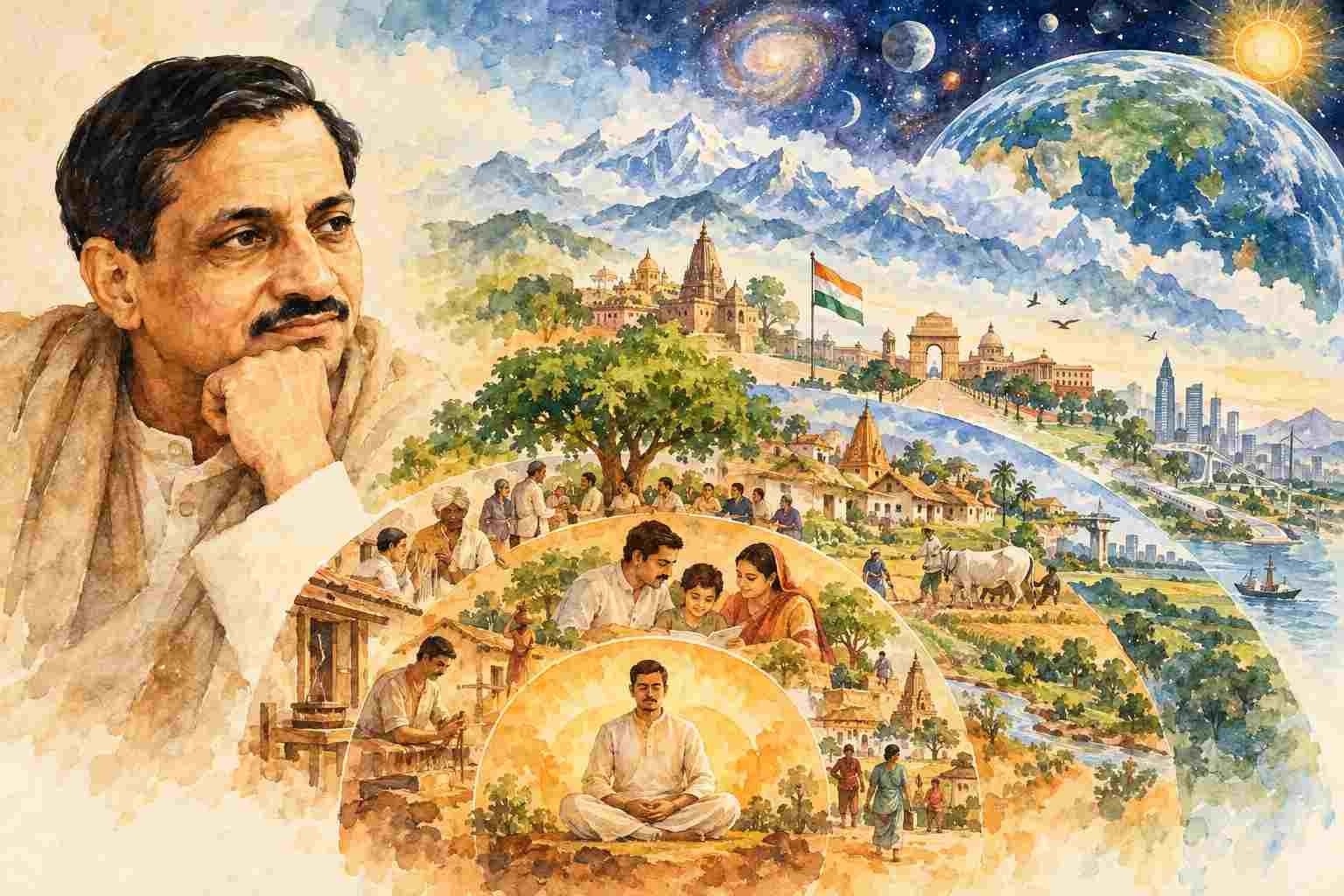
There is a haunting question at the heart of modern India: after political freedom, what is freedom for? Deendayal Upadhyaya posed it with unusual directness in April 1965: “Having attained Independence, the question naturally ought to have occurred to us, ‘Now that we [are] independent, what shall be the direction of our progress?’” His answer was not a party manifesto, nor merely an economic programme. It was a civilisational vision: the human being is not an isolated unit, nor a mere worker, voter, or consumer. The individual is a living centre—pind—whose fulfilment unfolds outward into family, society, nation, and finally the whole cosmos—brahmand.
This is the Sanatana model at its most compelling: not a nostalgic return to the past, but a way of seeing life as an unbroken continuum. Upadhyaya’s phrase for it was Integral Humanism—a philosophy that refuses to sacrifice the body for the soul, the individual for the state, the nation for the world, or material progress for spiritual abstraction.
The Crisis of Direction
Upadhyaya began his lectures not with ancient texts but with a contemporary anxiety. Seventeen years after Independence, he argued, India had won sovereignty without fully deciding its civilisational destination. “Even after seventeen years [of] independence we cannot say that a definite direction [has] been decided upon,” he observed.
For him, this was not simply a failure of policy. It was a failure of self-knowledge. “It is essential that we think about our national identity. Without this identity there is no meaning… of independence,” he said. A nation, like a person, cannot flourish by imitating another’s temperament: “As long as we are unaware of [our] national identity, we cannot recognise [or] develop all our potentialities.”
His critique was aimed at both extremes. Those who wished to rewind history to some pre-invasion moment were, he said, unrealistic: “The flow of time cannot be reversed.” But those who believed that Western ideologies could be transplanted wholesale into India were equally mistaken. “Foreign ideologies are not universal,” he insisted; they “have arisen in certain special situations and time” and carry “the limitations of the particular people and their culture.”
His medical metaphor is memorable. Just as the same medicine does not cure every patient in every climate, political remedies cannot be imported without regard to a society’s history and habits. “Those who apply a single panacea to all diseases must be considered quacks rather than doctors,” Upadhyaya wrote.
The Western Dilemma
Upadhyaya did not dismiss Western thought. He acknowledged nationalism, democracy, socialism, and the aspiration toward world unity as “good ideas” expressing “the higher aspirations [of] mankind.” His objection was that, in practice, each had become partial and mutually contradictory.
Democracy gave the individual a vote, but not necessarily bread, dignity, or inner peace. Socialism promised equality, but often at the cost of freedom. Nationalism united a people, yet could harden into conflict with other peoples. “Nationalism poses a threat to world peace,” he argued, while “democracy and capitalism join hands to give a free rein [to] exploitation,” and socialism, in turn, could suppress individual liberty.
The deeper problem, in his view, was fragmentation. The West had treated the human being in pieces: the political person, the economic person, the psychological person, the spiritual person. “The confusion in the West arises primarily from its tendency to think of life in sections and then to attempt to put them together by patch work,” he said.
Life as an Integrated Whole
Against this fragmentation, Upadhyaya placed the Bharatiya insight: life is whole before it is divided.
“The first characteristic of Bharatiya culture is that it looks upon life as an integrated whole,”
he declared. Diversity is real, but it is not ultimate; beneath plurality lies unity.
His image is the tree. The root, trunk, branches, leaves, flowers, and fruit appear different, yet all arise from one seed. “The unit of seed finds expression in various forms… Still we recognise their relation of unity with each other through [the] seed.” This is the philosophical grammar of pind to brahmand: the smallest living centre contains, expresses, and points toward the vast order of existence.
Upadhyaya extended the same logic from nature to society. Conflict exists, but it cannot be the foundation of civilisation. “Survival of the fittest is the law of the jungle,” he wrote. “Civilisations have developed not on the basis of this law but by consideration of how the operation of this law will be [the] least in human life.” Civilisation begins when human beings choose cooperation, restraint, and mutual sustenance over raw competition.
The Fourfold Human
At the centre of Upadhyaya’s model stands the complete human being: body, mind, intellect, and soul.
“Body, mind, intelligence and the soul—these four make up an individual. But these are integrated,” he said. “We cannot think of each part separately.”
This is where his critique of both capitalism and communism becomes especially sharp. Capitalism may provide bread and votes, but not necessarily meaning. Communism may promise bread, but often denies freedom. Upadhyaya’s example was the United States: “There is both bread as well as voting right. Even so there is lack of peace and happiness.” The reason, he argued, was that such systems had “not thought of the integrated human being.”
Hence the Indian ideal of the four purusharthas: dharma, artha, kama, and moksha. These are not compartments of life but coordinated energies. Artha includes wealth, politics, justice, and governance; kama includes natural desire, beauty, and fulfilment; dharma gives both their ethical orientation; moksha is not escape from the world but liberation within and through right action.
Upadhyaya was emphatic that spirituality does not mean neglect of the body. “The Upanishads declare in unambiguous words… [that] a weakling cannot realise the self.” The body is “the primary instrument to discharge the responsibilities that dharma enjoins.” Yet it remains an instrument, not the final purpose: “We regard the body as an instrument for achieving our aims,” not as an end in itself.
Dharma as the Principle of Balance
For Upadhyaya, dharma is not sectarian religion. It is the discovered law of harmonious life. “All those principles which bring about harmony, peace and progress in the life of mankind are included in this ‘Dharma’,” he explained. “The English word ‘religion’ is not the correct word for ‘Dharma’.”
Dharma regulates artha and kama, but it does not abolish them. Upadhyaya rejected the fantasy that a starving person can easily practise virtue: “What sin will not be committed by one who is starving?” Therefore, wealth creation, stable governance, education, and social order are themselves necessary supports of dharma.
But he equally warned against the state becoming all-powerful. “When the state acquires all powers, both political and economic, the result is a decline of Dharma,” he wrote. A society that looks to government for everything eventually loses initiative, character, and freedom. This is a strikingly contemporary warning: neither unregulated market greed nor an all-absorbing state can produce an integral human order.
From Individual to Universe
The deepest beauty of Upadhyaya’s thought lies in its expanding circles of responsibility. The individual is not asked to disappear into society; society is not asked to dissolve into the state; the nation is not asked to become an aggressive fortress against the world. Each level has its own dignity, and each is related to the others.
The pind—the embodied person—must develop body, mind, intellect, and soul together. The family and society must become fields of cooperation rather than domination. The nation must express its own cultural genius rather than borrow an alien identity. And the brahmand reminds us that human life is part of a larger cosmic order, governed not by conflict alone but by interdependence.
This is why Upadhyaya could say that Bharat’s task was not merely to catch up with the West, but to contribute something to the world’s unresolved dilemma: “If we possess some thing that may prove helpful to world progress we should not hesitate in imparting it to the world.”
A Model for Our Time
Upadhyaya’s Sanatana model is compelling because it refuses false choices. It says: yes to prosperity, but not prosperity without ethics; yes to liberty, but not liberty without responsibility; yes to national self-confidence, but not chauvinism; yes to spirituality, but not withdrawal from worldly duty; yes to science and modern knowledge, but not thoughtless imitation.
In an age of ecological crisis, mental distress, political polarisation, and technological acceleration, the movement from pind to brahmand feels less like an old doctrine and more like an urgent map. It asks us to see the human being again as whole: embodied but not merely bodily, social but not swallowed by society, national but not narrow, spiritual but not indifferent to bread, justice, and beauty.
Upadhyaya’s final vision is neither socialist nor capitalist, neither ancientist nor Westerniser. It is integral. As he put it: “This concept of a complete human being, [an] integrated individual, is both our goal as well as our path.”